Originally printed in the Custer County Chronicle on April 22, 2026
It is the same look on everyone’s faces, the same careworn expression. I would guess the same pit sits in everyone’s stomachs right about now. Mornings should smell damp and fresh. We should be wearing muck boots and watching mists and fog drift across pastures at first light. Those lacy spiderwebs that appear overnight should be studded with dewdrops. We should be seeing the start of green grass. But there is no grass.
The corrals and calving lot are 6 inches of dust, and the pastures are bone dry and chewed down. It hurts your heart to look at them. Every little movement of every living thing, every breath of wind, kicks up dust. And goodness knows we’ve had our share of wind.
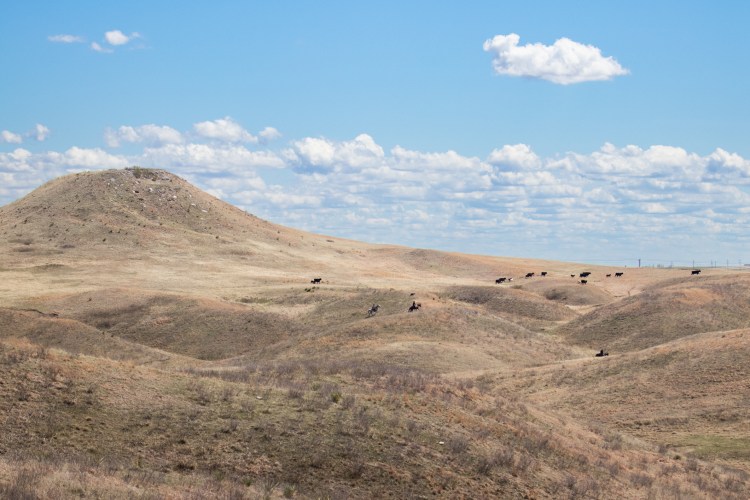
Calving season should wrap up with the eager anticipation of what comes next, but right now the “next” is uncertain.
All winter long, we remind ourselves that December and January, and even February, tend to be dry here, and that’s fine and normal. We remind ourselves that there’s plenty of time for the needed moisture. Plenty of time. Then March rolls through bringing no snow and we look to April, saying to ourselves, “We’ve gotten great snowstorms in April.”
And then April passes by. “It always rains. Eventually,” we remind ourselves. And then when cynicism creeps in and you think, “Well, at least there’s nothing to burn,” a spark lights off a 5000-acre grassfire. Apparently, there was something to burn.
“Please, God, make it rain.”
The inner monologue changes as the situation worsens, and as optimism gives way to reality.
There is no grass. Dams are dry pits. We haven’t really had measurable precipitation since October. The greenest spot on the whole ranch is the patch of lush grass around the septic tank in the yard.
Tough questions are being asked. Questions regarding the best interest of the livestock and the best use of the land. At this point, any answer will be a tough answer, most likely.
What do we do now? That seems to be the question everyone is asking.
You can’t ranch without grass. You can only feed so much hay, and where does the hay come from? You can only truck it so far, with the price of fuel. And fundamentally, regardless of how the media and four-letter organizations like to characterize those in agriculture, ranchers want what is best for the livestock and the land.
It is times of uncertainty that force us to acknowledge God. It is hard times that drive us to our knees in prayer. They are a reminder that we don’t live in a perfect world. They remind us that we don’t in fact govern the weather. Generally, in agriculture, that’s a pretty easy fact to grasp, but bad years are an extra dose of reality, that the weather is not subject whatsoever to our whims or desires. Hard times invite us to revisit God’s Word, and to be comforted in His sovereignty, and His purposes, which are always greater than ours. Uncertainty invites us to be reminded of His promise in Genesis that, “While the earth remains, seedtime and harvest, cold and heat, summer and winter, day and night, shall not cease.” Hard times invite us to marvel at His created order. God built incredible resilience into this world.
There are so many extremes of thought when it comes to the environment. There is the extreme to one side that seems to think we are constantly teetering on the brink of total annihilation, with a fixed date of destruction that surreptitiously gets moved, again and again, when the annihilation doesn’t happen. Then there is the extreme of exploitation without concern for the future, a using up of resources without concern for the next five years, let alone the next generation. There is the incredible arrogance and short-sightedness of weather manipulation, as if we actually can, or have any business trying, and truly could without making a total mess of things. And then there is a whole host of varied viewpoints somewhere in the middle of the mess, who can at least agree to the overarching idea of stewardship, if not the fine points. Stewardship being a caretaking of nature and our natural resources, neither the abandonment demanded on one side or the exploitation of the other, neither harnessing nor manipulating, but a partnering with and stewarding of the world around us.
And stewardship as mandated and defined by the Bible leads us to acknowledge that God as Creator has put in place an incredible created order, that allows regions to suffer drought and heat and natural disasters, and somehow, beautifully, amazingly rebound. The fresh green grass in recent burn scars evidences this, as well as the wonderful biodiversity in places like Hell Canyon, in the area of the Jasper Fire. It is a kind of stewardship that recognizes our responsibility but also God’s control.
If not even a sparrow falls to the ground apart from the knowledge of God, then not a raindrop falls, or doesn’t, without God’s permission either. If He clothed the fields then, 2000 years ago when the Gospel writer recorded the words of Jesus, He who is the same today clothes the fields today.
Pray for a miracle. Please, do. Pray for the skies to open and for rain upon a dry, parched earth. Pray for fruitfulness and life and safety. I know I am. But my greater prayer, the prayer growing in volume, is for faithfulness. That we would have eyes to see God’s faithfulness displayed, and that we would be faithful to Him.
Because God is not primarily about the business of our comfort. In fact, our comfort doesn’t even make the priority list of eternity. God is about the business of fitting saints for Heaven, and fitness for Heaven rarely is accomplished through comfort and ease. It is accomplished through difficulty, testing, trials.
When we reach a point of breaking and holy mending, or breaking and holy sustaining.
When our best-laid plans and our smug self-sufficiency wilt away like last season’s grasses, and we are forced to actually wait for the rain of God’s providence.
Oftentimes, God’s most poignant and lasting work in us is done in hard times when we are brought to the utter end of ourselves.
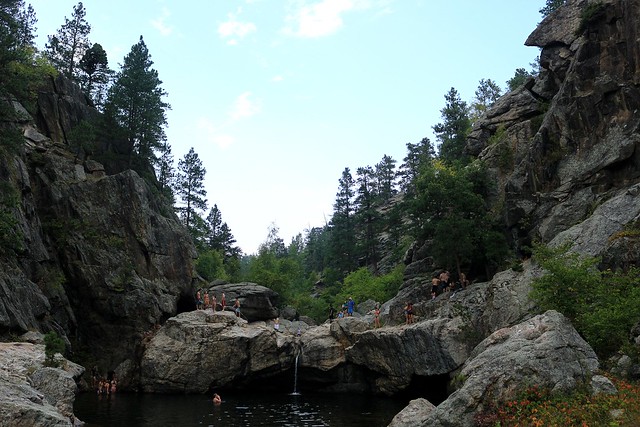




 Every day, winter moves a day closer and Christmas is right around the corner. Traditions and family habits mingle with new ways of doing things, in our new home in the Hills. The smell of cookies baking recalls last year, and the year before, and the year before, and the festive bustle of preparation adds a spice to otherwise ordinary activities. The hymns are sung in church with perhaps a little more gusto than during the rest of the year. “Joy to the World” rings loud in the sanctuary. We have such cause to celebrate! What a beautiful time of year.
 One tradition, though, almost got sidelined this Christmas because of space constraints, but the girls and I raised a cry of opposition – We live in a tiny house, but when it was suggested that we wouldn’t decorate a tree this year…Well, we didn’t hesitate to voice our opinion. So Saturday morning, Dad and I hopped in the truck and went out to cut us down a Christmas tree. It was a chilly, cloudy, breezy December morning, but the trees don’t mind. We were looking for a small tree, one that would sit on top of a table by our window, so it couldn’t be any more than three or four feet tall. We went out to a stand of trees near the highway, and started hunting.
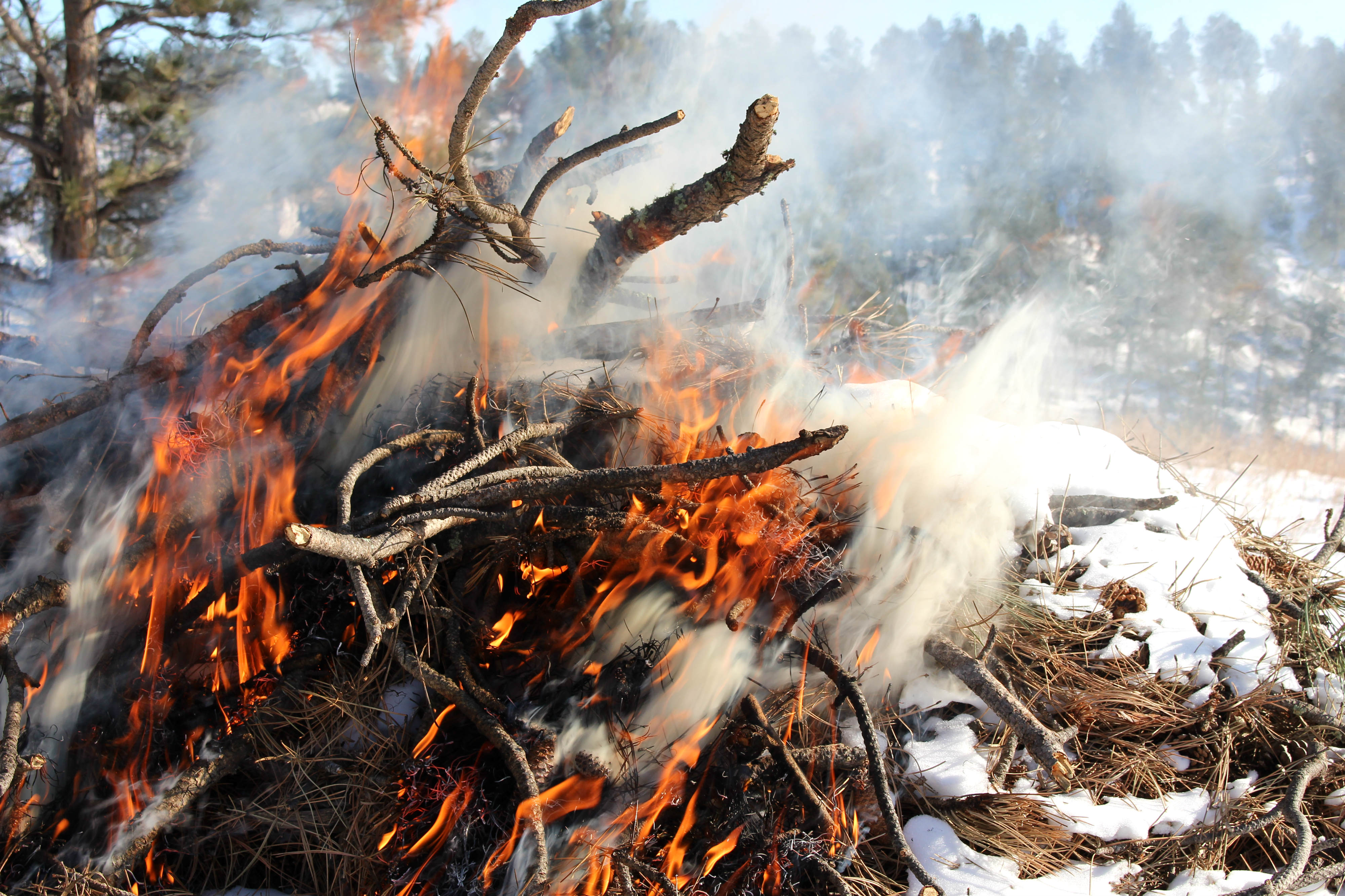
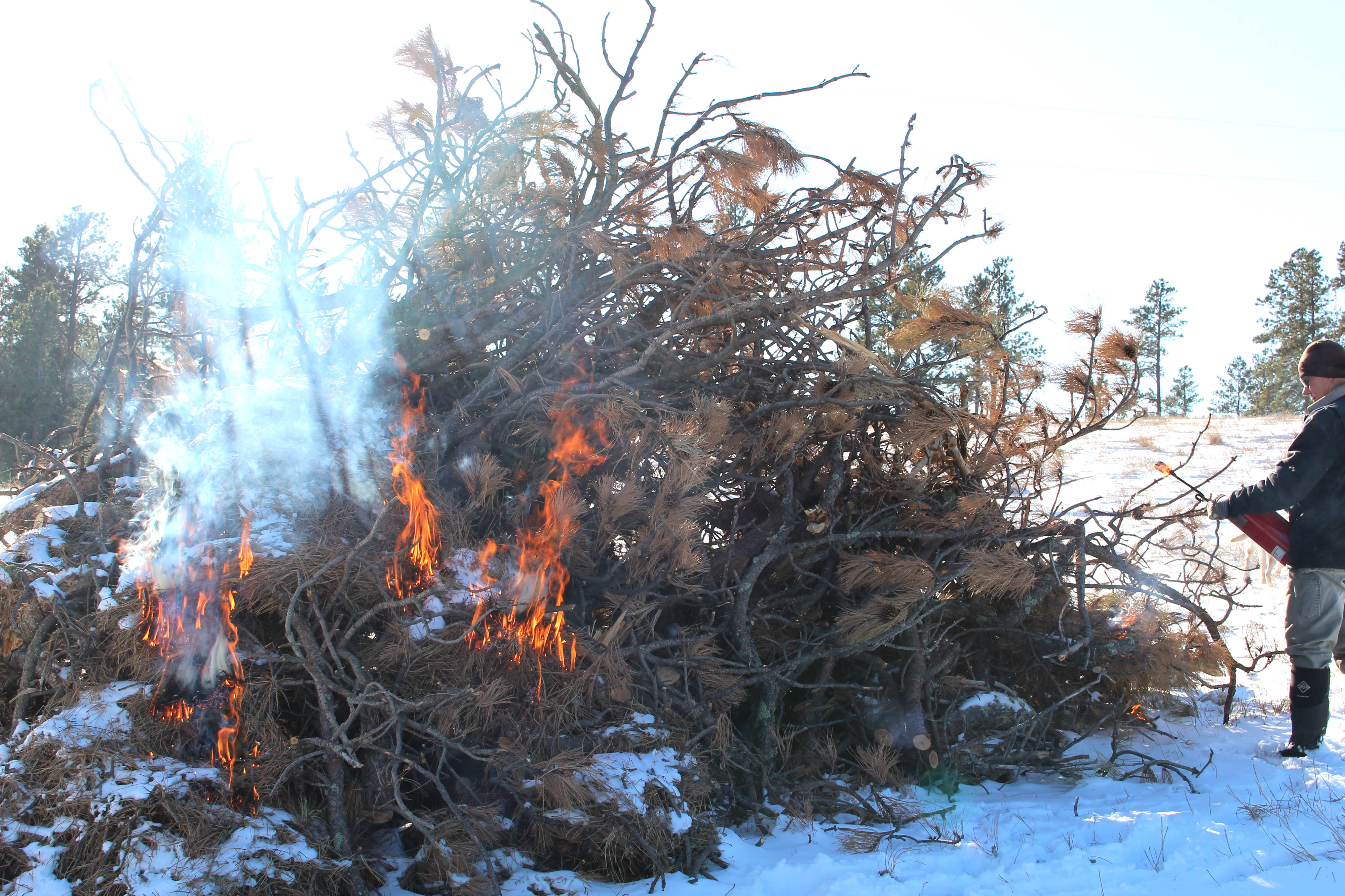
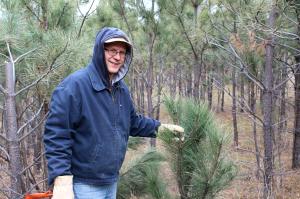 We cut down about ten trees, I think, trying to find one that would work. If an “environmentalist” had seen us, they probably would have burst an artery. But we called it “thinning.” These little stands of trees reseed and become overgrown in a matter of years, and responsible land maintenance would include thinning them or clearing parts of them completely in the next few years. Some environmentalist efforts in the Black Hills have included leaving the forest entirely alone until it is so overgrown that even animals don’t want to live there (the Norbeck Wildlife Preserve, for instance). So anyway, we chopped down a passel. There are literally millions of trees on the home place. There isn’t a shortage. There is an over-supply.
 While Dad and I were looking for the perfect tree, Remington and Dove were nearby. The cold seemed to have gotten into Remington’s blood and made him frisky. He kept coming up close, then galloping off, bucking and kicking and racing circles through the open meadow. Little Dove kept to herself, but watched us. I don’t think the cold worked in her veins the same way it worked in Remington’s.
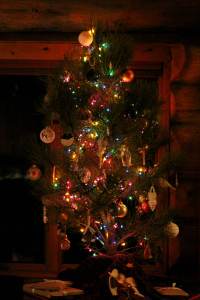 That evening, we opened boxes of ornaments, like opening boxes of memories – Each one has some sort of memory tied to it. Whether it was a gift from a special friend, or whether it was Mom and Dad’s first Christmas ornament (they got married two days after Christmas, in 1989), or whether it was handmade at a girls’ craft evening, or whether we simply remember laughing at how funny certain ornaments look, each of the ornaments has a memory tied to it. We packed as many strands of Christmas lights on our little tree, as many as we could, and hung as many of the special ornaments as would fit. We made every twig earn its keep.
 Our Creche is my favorite of our Christmas decorations. When I was little, Dad started buying the pieces of the Creche for Mom, and gave them as Christmas gifts over several years. I loved it as a child, and I love it still – The pieces each look like a watercolor portrait, and the wistful, worshipful expression on Mary’s face is such a beautiful interpretation of the Virgin Mother.
 Christmastime is possibly my favorite time of year. It is a time to celebrate, to remember, to rejoice, to mourn, to sing and make music to God, to fellowship – Although the cultural view leaves Christ out of Christmas, many still don’t. And, if I may say so, those of us who don’t leave Christ out of Christmas have so much more cause to be joyful, to celebrate, to make merry, than those to whom Christmas is simply a time to spend money and receive presents. Don’t get me wrong, I enjoy the gift-giving, the tree, the lights, the other traditions. But without Christ as the reason for the celebrating, Christmas would be a dead holiday. But it isn’t a dead holiday. At Christmas, Christians celebrate the coming of a living Messiah, who came to fulfill the promises in the Old Testament, the promise of a Person who will one day defeat and destroy Satan, the promise of a Blessing which all families of earth can enjoy, the promise of a Davidic King, a King who is reigning now and will reign forever and judge righteously, the promise of a Prince of Peace who will one day return. What a cause to celebrate!


