Originally printed in the Custer County Chronicle on August 12, 2026
Carefully kept in my possession is a nondescript box which I have jealously guarded for the better part of a decade. Possibly longer. My grandma, Loretta, was an avid quilter and the supreme domestic, having honed her skills of homemaking and handcrafts over a lifetime of peaceful industry and quiet usefulness to her husband, her five children, and her community. The beds in her house were clothed with quilts she had pieced, and knit afghans graced the arms of the chairs in the living room.
Each of her grandkids was gifted a quilt at one time or another, but my prize was the box of unfinished projects: a finished quilt top, hundreds of squares and triangles cut from old-fashioned floral cotton in a rainbow of colors, a stack of dozens of Sunbonnet Sue appliques, and three beautifully-pieced blue and white patchwork blocks, with enough extra squares to piece several more. For years, I’ve pondered what to do with all of these unfinished pieces. I’m not a quilter and genuinely dislike piecing. I’ve had plenty of ideas, though never executed any of them. Until now. I finally picked up where my grandma left off.
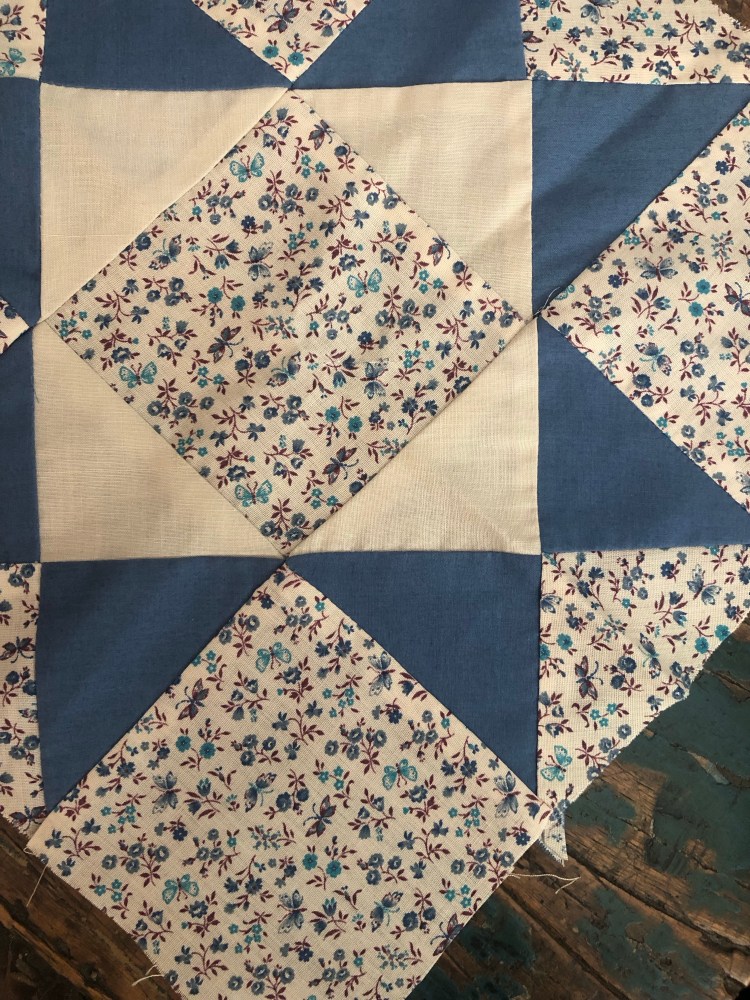
My old-fashioned heart has always longed for a slower way of life in a world that moves too quickly, and tangible forms of industriousness in a world that is ever less tangible. Ever since I was a child, I’ve gravitated towards those old-fashioned skills and handcrafts, from sewing to crocheting to drawing and painting to music to writing and more, taking delight in putting my hands to something and watching it take shape over hours, days, or even years. I remember entering all manner of handmade items in county fairs and in 4-H as a teenager, and having that yearly boost of excitement and competition that was fuel for the next year’s industry.
Societally, we have been conditioned to give preference to the easy way. If there is an easier way to do something, we are conditioned to assume the easy way is the best way. We avoid inconvenience. If there is a more convenient choice, we are conditioned to assume the more convenient choice is the best choice. We are a fast-food society, a next-day-Amazon-delivery society (well, not in rural Custer County, but you get the idea). In this fast-paced, convenience culture, we have seen handcrafts and homemaking go by the wayside. The shrinking entries in the open class exhibits at the Custer County Fair are suggestive of this. Why spend hours upon hours crocheting a blanket when you can buy one for a fraction of the price? Why learn to sew? Why make anything by hand when Amazon always has a cheaper option available? Why learn to paint when you can just insert a command into Chat GPT and have it spit out something that sort of looks like a painting? The gods of convenience and cheapness have led to a dearth of quality and enduringness, and a dearth in the learning and sharing of skills.
Some of my favorite childhood memories are wrapped up in this sharing and learning. I remember sitting cross-legged, knee-to-knee with a friend, crochet hooks in hand. She was righthanded, I’m lefthanded, so I learned by mirroring her. I remember the sewing class I took as a 10- or 12-year-old, sewing nothing but straight lines, the afternoon spent with a lady from my church who helped me sew clothes for an American Girl doll, and the hours my mom coached me as well, before the skill almost took on a life of its own. I remember the art class, and the writing club I started with a bunch of friends in highschool.
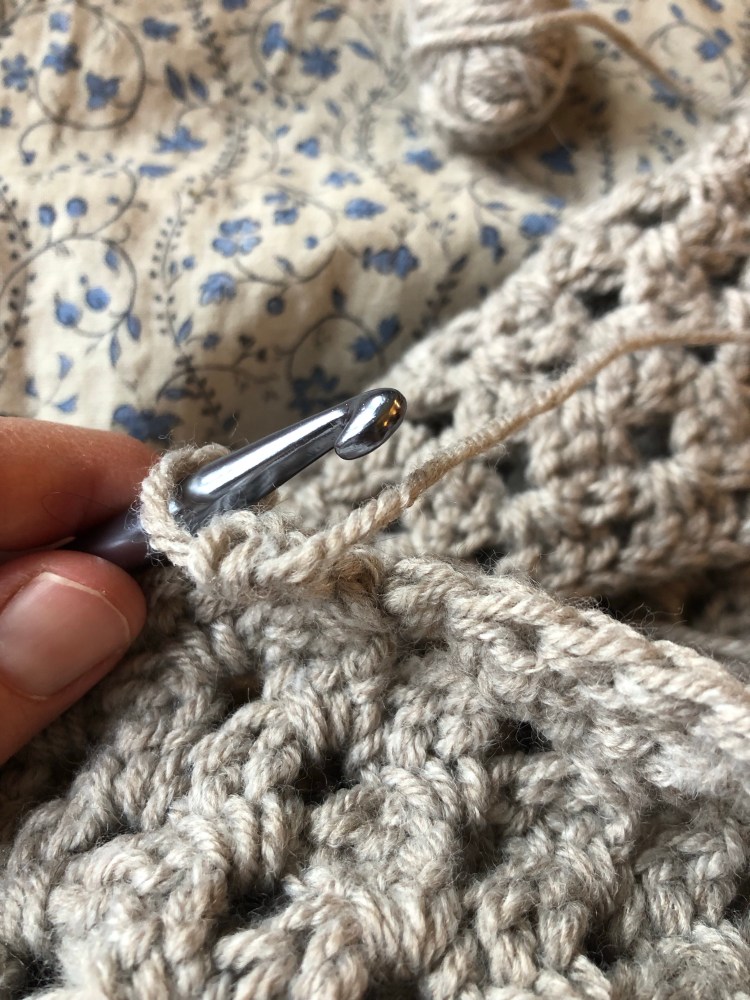
Unlike our digital alternate reality, which invites people into isolation disguised as connection with nothing material or real or tangible to show for it, these old skills thrive in community and are inherently social. Even if you’re learning a crochet stitch or leatherworking technique from a video tutorial, and bypassing that initial social context of the teacher and the learner, there still tends to be a very human context for that skill, as handmade items are gifted, bought and sold, passed down, or simply used to beautify one’s own home. They are real, and used, and delighted in.
After a few scattered hours of cutting and stitching and ironing, contending with my 9-month-old’s innate desire to be held and played with, I tied a blue and white patchwork bonnet on her blonde head and the sweetness was impossible not to ponder. When Grandma was piecing those blocks, she had no way of truly knowing what they would become, or what completion would look like. But I can’t help but think she would be touched to know that her handiwork was picked up by her granddaughter and will be used by her great-granddaughter and, perhaps, a great-great-granddaughter someday. How neat is that?
What in our digital age will be enduring? What relationships are forged? What generational continuity is fostered? What will be passed down to children and grandchildren? Who is invited in?
I get it, everyone is busy. With our stupid smartphones in hand, we convince ourselves we’re busier than we truly are. Are there skills we opt not to learn or share, because of a perceived lack of time? Do we opt not to start something because we are afraid we won’t finish it, or even because we know we won’t? Maybe it isn’t for us to finish. It might be that our grandchildren or great-grandchildren will be the ones to complete or enjoy what we began. And there is something incredibly sweet and poignant about that.
I wish we were more accustomed to thinking this way. I wish we could think of more than the next month or year. I wish that when faced with a choice or an inconvenience, we could have eyes to see down the road further than the easy way out. I wish we could think more fervently of our children and our children’s children, and what we will one day leave behind. Will we be so absorbed in our own pursuits that we don’t leave room in the future for others? Or will we be so absorbed with others that we invite people in, that we invite our children and grandchildren in, and those things that we leave unfinished can be theirs to complete? I hope to leave some things, many things, unfinished. Beautifully unfinished.

