Originally published in the Custer County Chronicle on January 29, 2025
Calving season on the ranch is a period of stark contrasts, a time of seeing some of the best of the best of God’s Creation alongside some of the saddest of the saddest. On the one hand, we revel in seeing mother cows birth and nourish and protect their young with such incredible maternal instincts, showcasing the best of God’s design for them; we search the pastures for newborn calves tucked away safely like little Easter eggs in long grass and sheltered places, waiting while their mamas graze or go to water; we see the fascinating natural formation of nursery groups by the busy mamas, so all calves are watched and all mother cows are fed and watered. But there is also the too-frequent reminder that we live in a broken world, the effects of which trickle down to the creatures we steward as well. Calves are stillborn or die afterwards, weather events challenge the best of our efforts, calving complications end tragically, and Nature takes its toll indiscriminately and sometimes it feels randomly.

Sometimes the bitterness and sweetness come by turns, first one and then the other. Sometimes they are mixed, inseparable. Sometimes they mix in the strangest sort of tragicomedy called a bottle calf that sticks around for weeks and months.
Granted, calving season for us isn’t supposed to start until the end of February, although neighbors of ours are already in the thick of it, or even are wrapping up. But we had a few, shall we say, incidents last year perpetrated by a yearling bull that was supposed to be a steer and wasn’t, and some dozen or so yearling heifers that he apparently found very attractive and which were not intended to be breeding animals. One calf showed up right before Christmas, and a few more showed up over the next month, one of which was orphaned more or less immediately. Of course, I had just dried up the milk cow.
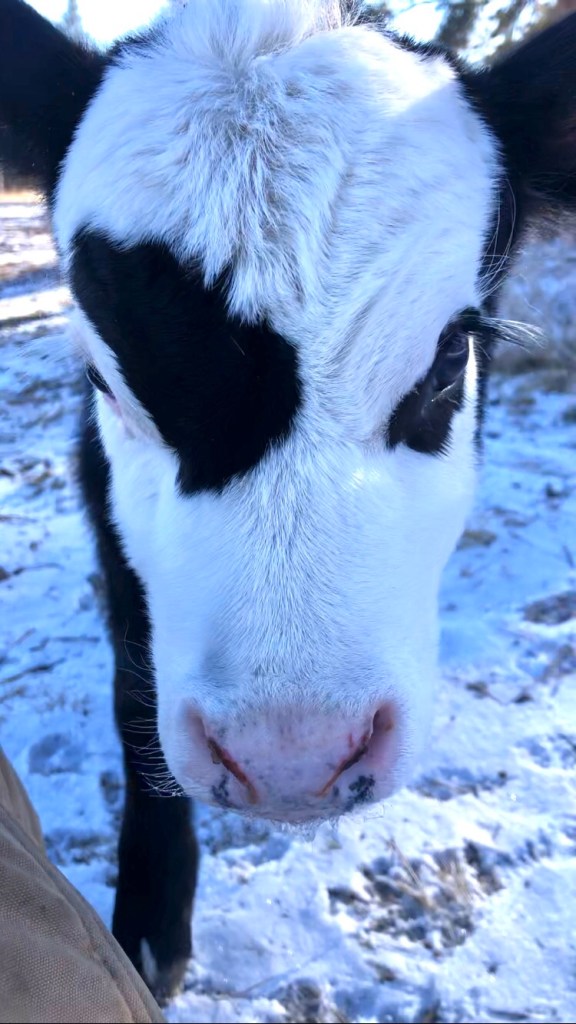
Bottle calves are supposed to be a nuisance. They’re supposed to be a hassle and, given the cost of a bag of powdered milk replacer, they are a financial nuisance, if nothing else. But clearly I’m not as wise and mature as other members of my family, because I’m afraid I don’t consider the three-times-daily feedings a nuisance, and really don’t object to calf bottles and pitchers for mixing the milk taking over the bathroom, or even the faint but persistent odor of soured milk. I don’t even mind trotting down in the dark to give Beckybell (my endearing husband named the calf after his mother-in-law – isn’t he charming?) her suppertime bottle. I’m afraid I don’t mind having my toes trampled by tiny hooves or my knees butted by the bony little head, or even the milky mess she somehow leaves all over my clothes. In fact, I thoroughly enjoy being mama cow. A few days ago, Beckybell managed to escape the nursery pen and was waiting for me and her evening bottle at the house when we got back from our walk. During the cold snap last week, her little ears froze, so she’s been wearing various ridiculous iterations of ear muffs to keep them from re-freezing, and I think we saved the ears.
But as much as I enjoy this critter and having close interactions with an animal that usually is only handled from a distance, it leaves a little sore pang in my heart. She is lacking her mama. God designed her to need her mama.
As much bad press as ranchers get from climate activists, as much as the FDA and the CDC and whatever other three- and four-letter organizations there are that vilify cows as being a blight upon the earth and an alleged contributor to global warming (or is it global cooling, I can’t remember?), or as much as PETA has gone after ranchers for “cruel treatment” of livestock, there is so incredibly much that people in those organizations do not see. Good things. Wholesome things. The best things. As agriculture as an industry has increased in size, and as the number of people engaged in it has dwindled, people have lost their understanding, yet continue to pass judgements.

They don’t see the ranchers intently watching the weather ahead of a winter snow event, heading out on ATVs with sleet biting their faces to move 100 cows into a more sheltered pasture. They don’t see the heroic and futile efforts in sub-zero weather to save a calving cow. They don’t see the careful tending during a cold snap, keeping water open and food on the ground. They don’t see the desperate attempt to warm a nearly-frozen calf downed during a snowstorm. They don’t see the careful tending of a newborn calf and the new mother. They don’t feel the defeat when a young calf dies and the cow won’t leave its side. They don’t see the bleary-eyed rancher getting up every two hours to check heifers, and they don’t hear the pre-dawn phone call up to the house to ask his little wife to bundle up and come down to the calving shed to help turn a backward calf, since she has smaller hands. They don’t see the tears shed over a failed save or the teary-eyed laughter at a success. They don’t see the miracle of a calf taking its first steps with a sleep-deprived ranching couple looking on smiling, or chuckling as an overzealous mama cow knocks it over with her aggressive licking. They don’t see the ranch wife on the umpteenth feeding of a little white-faced bottle baby, tucking the calf in for the night, sorry in her heart that there isn’t a mama cow for the little orphan.
Because we care for the livestock that God has give us to steward. We hate seeing them suffer, we love seeing them thrive, and we do everything in our power to give them the best life we can give them. At no time is that more apparent than in that sweet moment when a newborn calf hits the ground, floppy eared and wet and sneezing up fluid, and mama cow turns and sees the little intruder. As she goes to work cleaning it off, instinct overriding her surprise, we watch in quiet awe, full of pleasant warmth on the coldest of days.
 Song Dog Journal
Beckybell…what a great name. I know ranching life is hard but it’s full of romance through your words!
LikeLiked by 1 person