Sometimes I think so long about a blog post that it becomes irrelevant. But this is one I pored over for so long, and really got such a kick out of writing it, I really do want to share it. So even though the summer is pretty much over, and temps these days are hovering in the 70s in general, or lower, I remember the following events from this summer keenly. And even though the summer is over, the sentiment still remains. I hope you enjoy the article!
When the indoor thermometer is reading 85 degrees and the humidity is somewhere near 70% and I’m about to head to bed, or I’m dripping sweat (literally) while washing the dishes, it is awfully tempting to complain. And it has sure been tempting to complain. The last few days haven’t been just hot (for the Black Hills), they’ve been muggy. I’m a cool weather person, but eighty-five degrees is generally pretty nice, and even 90 degrees isn’t terrible, but with the current humidity, 85 indoors feels like a sauna. It is ridiculous. Miserable, actually. We make good use of our box fans.
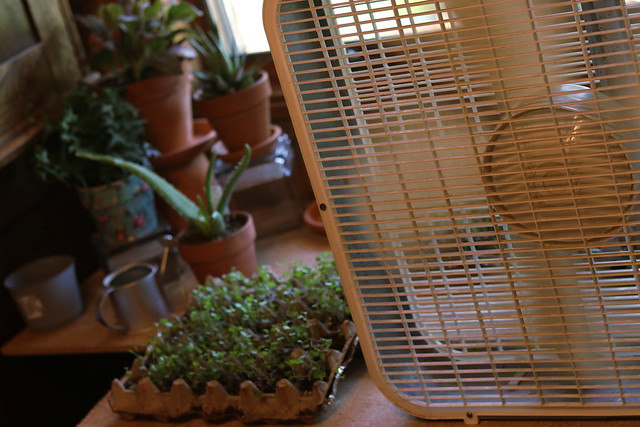 In spite of the heat and the exquisite misery of working or even just walking around in said moist cloud of heat the last few days, I have found myself thankful for our lack of air conditioning. It is a whole lot easier to put up with exertion in summer heat when one is unaccustomed to air conditioning. Truly. My truck lacks it, my cabin lacks it, my church lacks it, and I work (and play) outside. It is also a lot easier to convince myself to stay outside when it isn’t much better inside. Sometimes it’s worse.
But those aren’t the only reasons I’m thankful for lack of air conditioning.
(“Why in the world is she writing about air conditioning?” you’re probably asking yourself by now. Fair question. Keep reading.)
I’m thankful because comfort is so prosaic and lack of air conditioning is such a trivial discomfort.
(“Okay, prosaic? What does she mean by that?”)
Prosaic: unromantic and commonplace. Yes, I’m a romantic at heart. And by romantic, I don’t mean a chick-flick kind of romantic. I mean more…I don’t know…a Lord of the Rings or Master and Commander kind of romantic.
Think of your favorite book. If the protagonist had stayed comfortable, the story would never have happened. Think of the most exciting times in history, when change was happening and people were adventuring and exploring and discovering new things. If they had chosen comfort, physical or otherwise, those events never would have happened.
Air conditioning isn’t just about our temperature preference. Sixty or seventy years ago, air conditioning was essentially nonexistent. And people dealt with the heat. But we’ve changed. Being comfortable has become a priority.
Our culture idolizes comfort. And of course I’ve fallen victim to this myself. We like to be comfortable, and we like to be comfortable now. (Too hot? Turn on the air. Too cold? Turn on the heat. ) But it goes deeper. We don’t like the discomfort of being inconvenienced (I’ve written about this before in my post “The Freedom of Inconvenience”). We don’t like hurting. (Headache? Here’s a Tylenol.) We don’t like being exhausted. (Coffee, coffee, coffee.) We don’t like being hungry or thirsty. (Easy access to food and water all the time.)
Something about how comfortable we are in general makes me uncomfortable. Because we as a culture have gotten soft. Terribly soft.
But it isn’t just physical discomfort we avoid. We don’t like being afraid. We don’t like feeling or looking foolish. We don’t like being wrong. We don’t like people thinking we are wrong. We don’t like being uncertain. We’re afraid of having too little, failing too hard, hurting too much, sweating too profusely, and of feeling too much.
In general, we don’t know what it is to struggle or to face real fear. We read stories of deployed service members, or missionaries in third world countries and we shake our heads in sympathy, but we are so disconnected from the reality of their struggles, we can’t relate! We value comfort and pleasure and those are what we pour our energies into achieving. We’ve lost our enjoyment of or appreciation for or satisfaction with doing hard things that leave us exhausted and hurting, or emotionally drained. We’ve lost our satisfaction in sweating and working with our bodies.
So we take no risks, we don’t push ourselves, we don’t try new things, and we avoid situations that have the potential to cause any of those fears or feelings I just listed.
Because in a nutshell: we don’t like being uncomfortable.
How much we miss.
This year has been a growing time for me in this regard. I’ve faced some fears head-on – fears of being uncomfortable (physically, mentally, emotionally), fears of being thought to be foolish, fears of looking stupid and failing, of hurting, of exhaustion, fears of being out of place and out of my league and in over my head. I’ve faced my natural dislike of discomfort and embraced it, only to discover that the discomfort I feared has been significantly overshadowed by the satisfaction of doing something hard and doing it with enthusiasm.
If you’ve never read any Pat McManus, now is the time to change that. Some dear friends of mine introduced me to his book, A Fine and Pleasant Misery, in which he writes with clever dryness in Chapter 1 about how the point of camping used to be the misery, and being able to share misery stories afterwards. It used to be the roots in the back, the smoke in the eyes, the mosquitoes and cold and waking up wet. It was miserable, of course. That was part of the fun. Yet camping has evolved to be something where people leave their comfortable homes in their comfortable cars to go on a comfortable camping trip, somehow trying to avoid all the discomforts that naturally should crop up when leaving the comforts of home.
When did we as a culture collectively lose our taste for misery, our tolerance of discomfort, our enjoyment of the hard challenge? When did comfort become the priority? Now, maybe to a certain extent I’m romanticizing the 19th century, my favorite time period, the era of pioneers and mountain men and cowboys and explorers and miners….But think about the pioneers. Those were average families, they weren’t adventurers by trade. They packed up what few belongings they had and their whole family into a rattletrap covered wagon which became their home. For months. They slept on the ground. They walked hundreds of miles. They sweated. They were hungry. They went without. They were sunburned and windburned and freezing cold. They were uncomfortable, in ways most of us can only try to fathom. But they did it. Because there was something they desired more than comfort.
I’m tired of comfortable. I want to sweat, to be sore, to feel, to fear, to ache, to be bone-tired, have burned skin, a messy ponytail, a muddy, sweat-streaked face, dirt under my fingernails, and strong muscles. I love doing something abnormally strenuous and waking the next morning feeling like I’ve been hit by a truck. I love the sense of satisfaction when I realize what I’ve put my body through and that I actually survived and feel better for it. I could have avoided the discomfort, avoided the risk, and missed out on that delightful taste of satisfaction.
And so I come in from the garden, mopping sweat from my face, I look at the thermometer outside and the thermometer inside and groan a little, and see all the little nasty bugs swarming around our kitchen light (they migrate to my bedside table as soon as the downstairs lights are off and my bedside light is on), I feel the trickle of sweat while doing dishes, and I smile wryly. I’m thankful for discomfort.
Thankful for this fine and pleasant misery.

Support Song Dog Journal and share to social media!
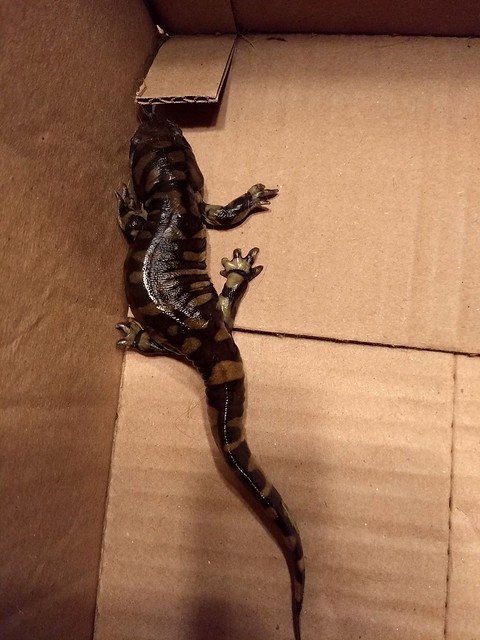
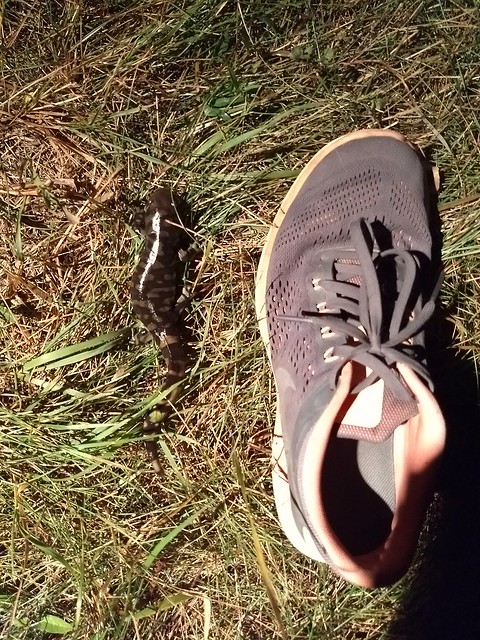 He was a large variety (the shoe is for scale), and wasn’t too happy the kittens were inspecting him. We’ve never really encountered these out here at our place, since there isn’t ever really any permanent moist-ness, but there he was. I scooped him into a box and deposited him a ways away, since I read that salamanders, including the western tiger salamander (this guy) are toxic to a certain extent and figured I’d get him out of the cats’ reach. I’d be more than happy for some input from anyone who knows more than the internet on this matter, especially since my experience is that the internet tends to exaggerate. For instance, I read that aloe is poisonous to cats, but I have a friend who had an aloe plant, until her cat ate it. The cat was fine.












 Song Dog Journal