Ranch Wife Musings | Cow-Calling

Originally printed in the Custer County Chronicle on April 3, 2024

The miracle of life is front and center during calving season. It is amazing to watch a heifer birth her first baby, looking in vague confusion at the squirming, slimy creature that made its sudden, un-asked-for appearance, and then, prompted by God-given instinct, begin to clean the baby off. The baby is up off the ground in a matter of minutes, his little legs wobbly and knock-kneed, and then he finds the life-giving udder and his little tail goes to wagging, just like a dog. What a sight to see.
The excitement of the first calf of the season is followed by weeks and weeks of chaos, confused young mother cows learning the ropes, babies everywhere, unmixing mixups, and the satisfaction of watching maternal older cows do everything on their own.

It isn’t just instinct that drives a cow, but a fascinating melding of instinct and education, and the first-time mamas are kept under pretty close watch for the first few days, and kept in the nearest pasture for the first month or so. These first-time mamas are prone to wandering off and leaving their calves, forgetting they have calves, forgetting which calf is theirs, forgetting where they left their calves, and can often be seen chasing helplessly after a sprightly baby, entirely unsure how to control the unruly child.

The second-time mamas are a little less helpless, instinct and education both more fully developed, but there still is a tendency towards some of those pitfalls of early motherhood. They are given a little more freedom than the first-timers, but are still able to be supervised. Eventually, cows figure out the concept of nursery groups, where one or three mothers are left in charge of a dozen or so babies, giving the other mothers a chance to go in to water or eat. I don’t know how they figure out shifts, but somehow they do, but early on they forget about the need for a babysitter and just wander off, until something jogs their bovine memories.

And nothing jogs the bovine memory like the sound of a calf bawling. Nothing reminds a mama cow of her maternal responsibility like the sound of the baby she forgot about or misplaced. Some calves are obliging, squealing like stuck pigs if you just look at them wrong, let alone if they are being sat on by a wiry rancher, but other calves are stoics, and won’t make a peep, which is inconvenient if you’re trying to identify them.

Thus, the necessity of the fine art of cow-calling. Although ranching is a lot of science, there are a number of things that definitely fall into the “art” category, and cow-calling is one of those things.

I remember being seated behind my now husband, bundled up against the cold, enjoying the view as we bounced around the hayfield on the ATV, looking for unmarked calves to ear tag and vaccinate. The ear tag given matches the one in the mother’s ear, so they can be easily paired up later on and a good inventory kept. The frozen hayfield wasn’t much fun to drive over, but I was having a dandy time, my arms wrapped snugly around my handsome not-quite-husband, and having been granted the official role of keeper of the vaccine gun and ear tagger. Without warning, an absolutely uncanny sound issued from my not-quite-husband’s lips. Seated as I was right behind him, arms wrapped around him as stated, I experienced the full force of this incredible and unearthly sound. It was truly awe-inspiring, unlike anything I had ever heard before.

And I burst out laughing.

I honestly thought the demonstration was for comic effect. Until I saw fifteen mother cows practically stand to attention, heads flying up from complacent grazing like they’d been stung by wasps, then leave their breakfast and take off in all different directions, whichever direction they thought they remembered having left their calves. For the record, they don’t always remember, the telltale sign being a mother cow walking around bawling until she stumbles across her baby, which is (almost) always right where she had left it.

Anyway, the cow-calling had the intended effect and the mother of the baby in question presented herself, the calf was identified, tagged and vaccinated, and we went on our merry way.

Such was my introduction to the fine art of cow-calling.
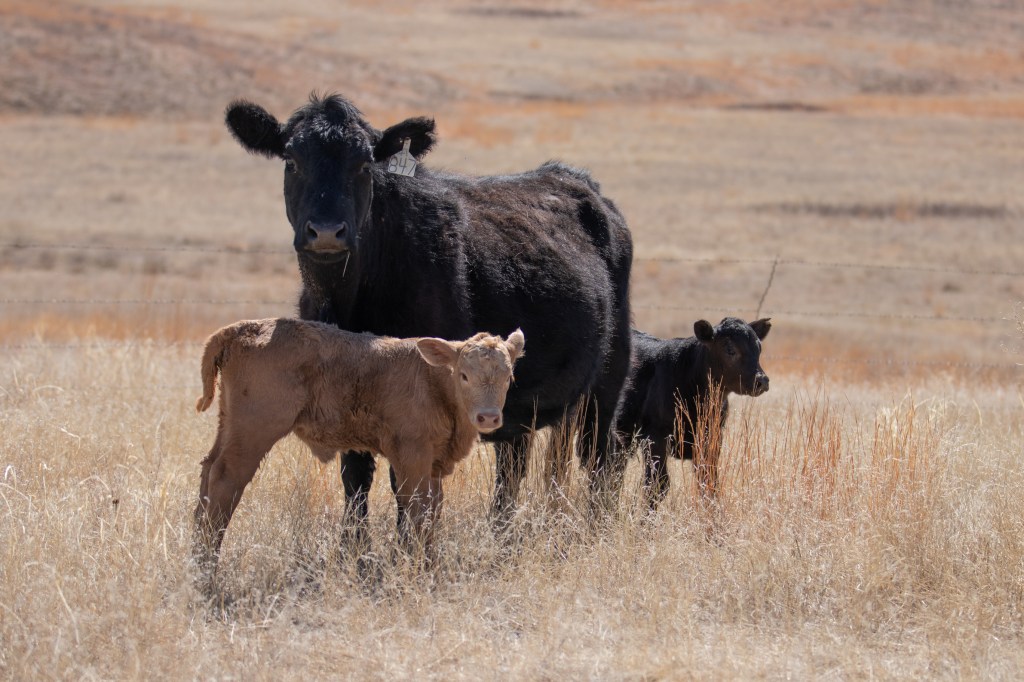
I have since had my education on this topic broadened and have learned that this useful skill can be employed not only to quickly identify an unmarked calf, but to mostly accurately separate the cows that have calved from those that have not, to bluff a cow into looking around for the purpose of reading her ear tag, or to keep a flighty cow from running off without her young baby. I’m sure there are other uses for it, but those are the main ones I have identified.

Calving season. By turns hilarious or heartbreaking. Life and death are often juxtaposed. It is the sweetness of new life and baby animals that know no fear, the enjoyment of watching them learn to play and take their first running steps in the wide open, crow-hopping on their spindly legs. It is incredible to see a cow looking for somewhere to calve, and twenty minutes later to find not only that she has had the calf but that it is up and nursing already. It is miracle after miracle after miracle.

But cow-calling still makes me laugh.

Ranch Wife Musings | Distracting in Coveralls

Originally printed in the Custer County Chronicle on February 7, 2024

I still remember the look on my now father-in-law’s face when he rattled up in his blue ranch truck to the middle of the pasture we call Hidden City. His dogs piled out, then he climbed out, and then he just looked at me. Brad and I were scooping muck out of a stock tank, getting it ready to cement the bottom. Dave had brought the sacks of cement. And to my knowledge he had no idea I’d be out there helping. We had been dating for about six days. Maybe ten. You know, the time in a relationship when the guy is trying to impress the gal?

I was sunburnt, covered in mud, and grinning.

“Boy, I bet you’re impressed,” he said.

“I volunteered,” I replied.

And that dynamic characterized our whirlwind four months of dating, and our whirlwind six months of engagement, which spanned fall cow work, preg testing, shipping calves, calving, and branding. Whenever I wasn’t on shift at the fire department, I was out at the ranch, sometimes truly helping, sometimes there “just in case.”

Honestly, it was pretty handy. A lot of our dating was spent with me riding behind him on the ATV, a convenient place to be. Not only was the view nice, but it was a great excuse to have my arms wrapped around him for extended lengths of time. I’m not sure who invented the fabricated “date” as the best way to get to know someone, but give me an afternoon riding double on a four-wheeler or perched next to him in the tractor any day.

And it prepped us for life together. We learned to work together from the get-go. We learned what each of us was like at our best and at our worst, when having fun and when frustrated, when things went well and when things fell apart. Anyone can pull it all together to go out in public, anyone is on their best behavior when other eyes are observing, but it is the day-to-day that truly reveals a person’s character. We both learned how much better, sweeter life can be with a suitable companion, that 1+1 is way more than 2, and I learned that I truly loved to play the role of the helper. If all I did was make things a little easier, that was enough.

Valentines Day is approaching, with all the wildly unrealistic expectations set primarily, I believe, by women, aggravated by Hallmark and Hollywood and romance novels, of flowers and fine wine and fine dining, and with all the myriad opportunities for men to fail to meet these unrealistic expectations. How certain things became culturally accepted as the pinnacle of romance and the standard expressions of love, I sure don’t know, and I don’t know anything about those things either.

But what I do know is I wouldn’t trade reality for those things. I guess I see real romance as something altogether different.

Real romance comes in the form of bouncing over frozen ground on an ATV to tag calves together during a snow squall. Real romance is gingerly kneeling down on the heaving flank of a 650-pound steer choked out on the ground when your husband looks at you and says sweetly, “Do you want to sit right here, honey?” and hands you the manure-crusted tail. Real romance is the satisfaction of a long day of working together. Real romance is a quick break over a cup of coffee before heading out into the cold again. Real romance is rattling along in the feeding pickup or the tractor, tagging along to be the gate-getter and net wrap cutter, encumbered by coveralls and heavy chore coat and drifts of snow. Real romance is having that strong shoulder to cry on when a cherished cat dies, or life just feels heavy. Real romance is time together over a home-cooked meal, or holding hands walking into the feed store. Real romance is hearing your husband’s voice next to you in church, even though he can’t hold a tune. Real romance is winning (almost) every single game of cribbage, even though he taught you how to play specifically because he thought you wouldn’t be any good at it (true story). Real romance is a disagreement followed by an exchange of apologies. Real romance is trust in your spouse’s faithfulness, and learning to understand someone else’s love language. Because how often is your spouse communicating love? All the time.

I love the shared experiences that are knitting our lives together into one. I love catching his eye over the backs of 200 cows, or pouring him a cup of hot coffee in the scale shed, or our exchanged smiles as we go our individual ways during chores. It doesn’t look like the movies. It sure isn’t always mushy and sweet. Life is life. It doesn’t look like the Hallmark version of a romance. A lot of the time we are covered in muck and sweat and don’t smell great. It might be routine, normal, and mundane.

But he still says I’m distracting in coveralls.

In Deep Winter

Originally printed in the January/February 2024 edition of Down Country Roads Magazine

Winter. It really sets in after the Christmas season has drifted past, after the festivities have waned away. Usually, January is when the temperatures permanently settle into their winterish lows, and we forget the autumn and forget the spring and all that’s left is winter.

The short days seem shorter still. The skies, heavy with snow or icy blue, outline the skeletons of trees in the shelterbelts, and the sentinel ponderosas standing resolute on the ridgelines of the forest.

Snow crunches underfoot, and there is no give in the ground. Dams freeze, stock tanks freeze. All is rock hard. Dead sprigs are all that remain of summer gardens, with the plants sleeping snugly out of sight, unconcerned for what’s above.

And everything is cold.

The cows are cold, standing with their backs to the wind. The horses are cold, following suit, while the chickens sulk with abandon, staring at their food and refusing to leave the coop. Even the dogs, usually so eager to escape in the morning, hesitate when the world outside is cloaked in white. We don layer upon layer to armor up against the winter, dreaming of when we can walk about without coveralls and long underwear and sweatshirts over sweatshirts impeding every action. Out we tumble in the morning, with only our eyes visible, maybe our noses, stumbling down to the barn and the chicken coop and the tractor and the corrals, fumbling with mittened, cold-bitten fingers while our toes freeze in our boots.

And it is about halfway through January’s bleakness that I start remembering why springtime is such a welcome relief, and why people dislike the winter.

And so winter goes. The festivity of Christmastime gone, the excitement of the New Year behind us, the winter drags by, sleepy, depressed, and frostbitten.

But there is another side of winter, if we can see past the thermometer and the frozen fingers.

Under the biting cold is an energy. In between snowstorms. In between days of gale-force winds. A slumbering energy, ready to burst out in joyful excitement. There is an invigorating beauty, if one knows where to look. If one chooses to look.

It’s in the horses running fresh and free in a falling snow. It’s in the dogs dashing through drift after deep, new drift, gleeful against the cold. It’s in the whirling snowflakes of a snowglobe snowfall, and the silence of a winter night under a starry sky.

How do we miss those things?

It’s the acrobatics of chickadees at the birdfeeder.

It’s the first set of footprints in a fresh snow. Or the tiniest of tiny tracks between clumps of grass, evidence of the littlest of lives at work.

The hilarious energy of the pups when they’ve been inside too long, minutes before they are kicked out again.

It’s the fire in the fingers as they warm around a mug of coffee. It’s the frosty windowpanes, those amazingly intricate flowers that only grow in winter. It’s in the crystal-clear sound of a morning glazed over. It’s in the blue-sky, springlike days that punctuate our South Dakota winters. It’s in the clouds of warm breath from every nostril, and frost-covered backs of our black angus cows, when the wind isn’t blowing and their natural furnaces have made them comfortable. 

It’s the glittering brilliance of fresh snow under a cold, waking sunrise, or under a full moon.

It’s the blue hues in the white landscape, the purples and pinks that are in every drift, every shadow, the subtle glaze of color that is anything but stark white. It is the strange and exquisite shapes chiseled into the snow, and the beautiful music of a melt-off.

Deep in winter, it is that kind of energy, that kind of excitement. Deep in winter, those glimpses of beauty so profound, against which spring in all its glory pales.

After all, winter doesn’t last forever.

Dreams and Reality

At the beginning of a new year, I always look back at the old year. So I pulled out the box in which I keep the hard copies of articles I’ve written. God is so good.

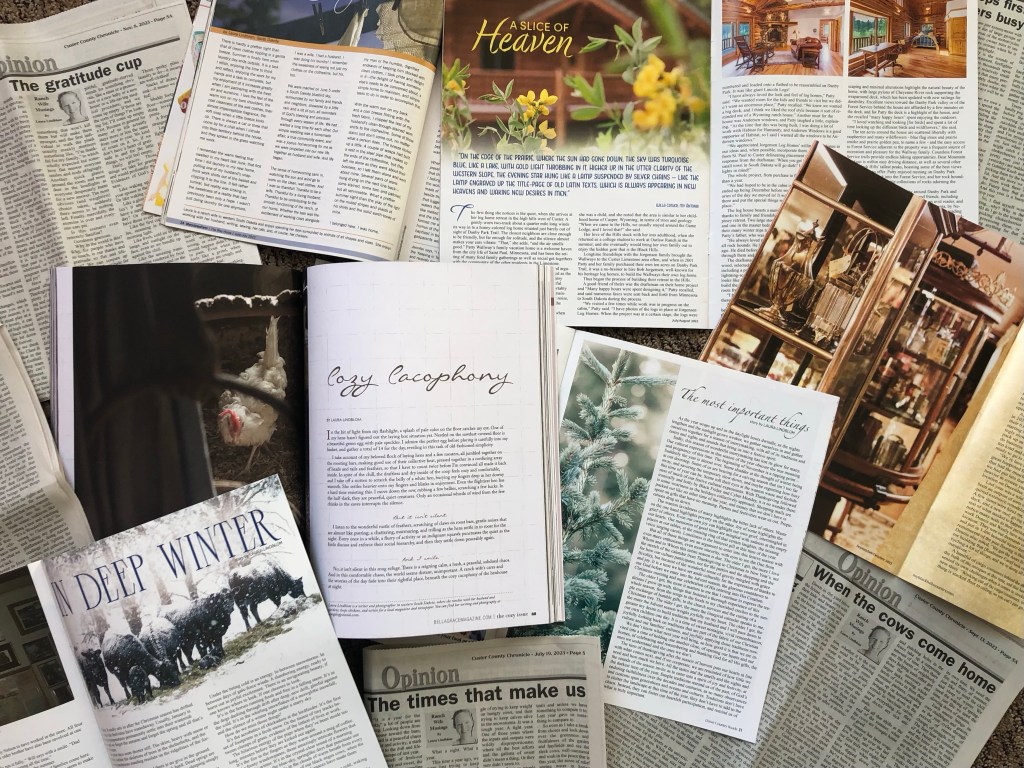
Taking this simple photo brought a happy lump to my throat. It is so surreal to see my words and photographs in print, and this isn’t even everything that was printed last year.

Looking back at the old year, it is natural to look back even further, and it is truly delightful to see the ways that God has prepared me and opened doors and answered prayers and to see the seeds of dreams as far back as 20 years ago. I fell in love with the written word as a youngster, at about the age of 12, and the writer’s dream is (almost) the first dream I can remember from childhood. The other dream I remember was that I would grow up and live in South Dakota and have horses. Little did my 9-year-old self living in Illinois know how that would turn out…

But these photos of magazines, magazine articles, and newspaper columns represent years of hoping, praying, waiting, and even forgetting. Until the time was right. And then God opened doors.

It just makes me think…how much can happen in such a short span of time. A year ago, writing was still a dream. How much can change in how little time. How different life can look in just a year, or five years. We can get so caught up in things that aren’t going right, or disappointments, or failures, and yet God can and does use those things to build our courage and our trust in His goodness and provision, and when He chooses, He can make things happen.

These little articles aren’t anything spectacular. They sure aren’t particularly prestigious. Other than two articles last year published in MaryJane’s Farm and Bella Grace, which are nationally distributed magazines, my other articles are in local papers and magazines with limited readership. And do you want to know something? I love it. I love that it is my friends and family and community that I am writing to and for. I love hearing from neighbors that they read my column, and I love interviewing locals and friends and having the privilege of telling their stories. And I love how God has given me an outlet for something I have loved for so long.

How humbling.