This Fine and Pleasant Misery

Sometimes I think so long about a blog post that it becomes irrelevant. But this is one I pored over for so long, and really got such a kick out of writing it, I really do want to share it. So even though the summer is pretty much over, and temps these days are hovering in the 70s in general, or lower, I remember the following events from this summer keenly. And even though the summer is over, the sentiment still remains. I hope you enjoy the article!

When the indoor thermometer is reading 85 degrees and the humidity is somewhere near 70% and I’m about to head to bed, or I’m dripping sweat (literally) while washing the dishes, it is awfully tempting to complain. And it has sure been tempting to complain. The last few days haven’t been just hot (for the Black Hills), they’ve been muggy. I’m a cool weather person, but eighty-five degrees is generally pretty nice, and even 90 degrees isn’t terrible, but with the current humidity, 85 indoors feels like a sauna. It is ridiculous. Miserable, actually. We make good use of our box fans.
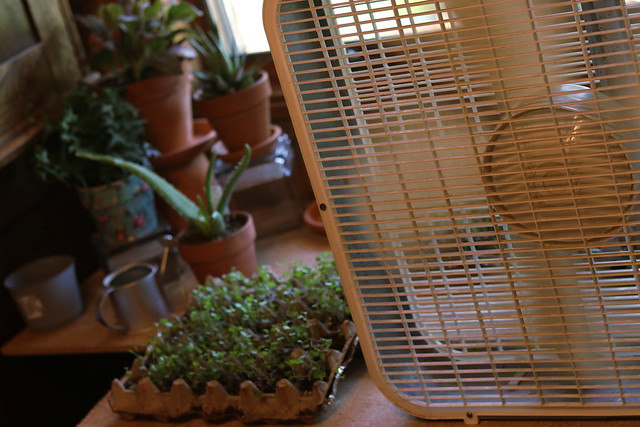
IMG_9013eIn spite of the heat and the exquisite misery of working or even just walking around in said moist cloud of heat the last few days, I have found myself thankful for our lack of air conditioning. It is a whole lot easier to put up with exertion in summer heat when one is unaccustomed to air conditioning. Truly. My truck lacks it, my cabin lacks it, my church lacks it, and I work (and play) outside. It is also a lot easier to convince myself to stay outside when it isn’t much better inside. Sometimes it’s worse.

But those aren’t the only reasons I’m thankful for lack of air conditioning.

(“Why in the world is she writing about air conditioning?” you’re probably asking yourself by now. Fair question. Keep reading.)

I’m thankful because comfort is so prosaic and lack of air conditioning is such a trivial discomfort.

(“Okay, prosaic? What does she mean by that?”)

Prosaic: unromantic and commonplace. Yes, I’m a romantic at heart. And by romantic, I don’t mean a chick-flick kind of romantic. I mean more…I don’t know…a Lord of the Rings or Master and Commander kind of romantic.

Think of your favorite book. If the protagonist had stayed comfortable, the story would never have happened. Think of the most exciting times in history, when change was happening and people were adventuring and exploring and discovering new things. If they had chosen comfort, physical or otherwise, those events never would have happened.

Air conditioning isn’t just about our temperature preference. Sixty or seventy years ago, air conditioning was essentially nonexistent. And people dealt with the heat. But we’ve changed. Being comfortable has become a priority.

Our culture idolizes comfort. And of course I’ve fallen victim to this myself. We like to be comfortable, and we like to be comfortable now. (Too hot? Turn on the air. Too cold? Turn on the heat. ) But it goes deeper. We don’t like the discomfort of being inconvenienced (I’ve written about this before in my post “The Freedom of Inconvenience”). We don’t like hurting. (Headache? Here’s a Tylenol.) We don’t like being exhausted. (Coffee, coffee, coffee.) We don’t like being hungry or thirsty. (Easy access to food and water all the time.)

Something about how comfortable we are in general makes me uncomfortable. Because we as a culture have gotten soft. Terribly soft.

But it isn’t just physical discomfort we avoid. We don’t like being afraid. We don’t like feeling or looking foolish. We don’t like being wrong. We don’t like people thinking we are wrong. We don’t like being uncertain. We’re afraid of having too little, failing too hard, hurting too much, sweating too profusely, and of feeling too much.

In general, we don’t know what it is to struggle or to face real fear. We read stories of deployed service members, or missionaries in third world countries and we shake our heads in sympathy, but we are so disconnected from the reality of their struggles, we can’t relate! We value comfort and pleasure and those are what we pour our energies into achieving. We’ve lost our enjoyment of or appreciation for or satisfaction with doing hard things that leave us exhausted and hurting, or emotionally drained. We’ve lost our satisfaction in sweating and working with our bodies.

So we take no risks, we don’t push ourselves, we don’t try new things, and we avoid situations that have the potential to cause any of those fears or feelings I just listed.

Because in a nutshell: we don’t like being uncomfortable.

How much we miss.

This year has been a growing time for me in this regard. I’ve faced some fears head-on – fears of being uncomfortable (physically, mentally, emotionally), fears of being thought to be foolish, fears of looking stupid and failing, of hurting, of exhaustion, fears of being out of place and out of my league and in over my head. I’ve faced my natural dislike of discomfort and embraced it, only to discover that the discomfort I feared has been significantly overshadowed by the satisfaction of doing something hard and doing it with enthusiasm.

If you’ve never read any Pat McManus, now is the time to change that. Some dear friends of mine introduced me to his book, A Fine and Pleasant Misery, in which he writes with clever dryness in Chapter 1 about how the point of camping used to be the misery, and being able to share misery stories afterwards. It used to be the roots in the back, the smoke in the eyes, the mosquitoes and cold and waking up wet. It was miserable, of course. That was part of the fun. Yet camping has evolved to be something where people leave their comfortable homes in their comfortable cars to go on a comfortable camping trip, somehow trying to avoid all the discomforts that naturally should crop up when leaving the comforts of home.

When did we as a culture collectively lose our taste for misery, our tolerance of discomfort, our enjoyment of the hard challenge? When did comfort become the priority? Now, maybe to a certain extent I’m romanticizing the 19th century, my favorite time period, the era of pioneers and mountain men and cowboys and explorers and miners….But think about the pioneers. Those were average families, they weren’t adventurers by trade. They packed up what few belongings they had and their whole family into a rattletrap covered wagon which became their home. For months. They slept on the ground. They walked hundreds of miles. They sweated. They were hungry. They went without. They were sunburned and windburned and freezing cold. They were uncomfortable, in ways most of us can only try to fathom. But they did it. Because there was something they desired more than comfort.

I’m tired of comfortable. I want to sweat, to be sore, to feel, to fear, to ache, to be bone-tired, have burned skin, a messy ponytail, a muddy, sweat-streaked face, dirt under my fingernails, and strong muscles. I love doing something abnormally strenuous and waking the next morning feeling like I’ve been hit by a truck. I love the sense of satisfaction when I realize what I’ve put my body through and that I actually survived and feel better for it. I could have avoided the discomfort, avoided the risk, and missed out on that delightful taste of satisfaction.

And so I come in from the garden, mopping sweat from my face, I look at the thermometer outside and the thermometer inside and groan a little, and see all the little nasty bugs swarming around our kitchen light (they migrate to my bedside table as soon as the downstairs lights are off and my bedside light is on), I feel the trickle of sweat while doing dishes, and I smile wryly. I’m thankful for discomfort.

Thankful for this fine and pleasant misery.

The Freedom of Inconvenience

There is something wonderfully simple yet gloriously complex about the process of watching the tree bud out in the springtime, watching the flowers shed their petals and be replaced by infant fruit, then watching the fruit mature, and ripen, then picking that fruit at the right time and processing it, canning it as various delectable spreads or syrups or sauces, stacking the jars neatly in the pantry to be used at a future date…the process is immensely satisfying. I love the thought that must go into identifying the fruit, identifying its readiness to be harvested, sorting it, juicing it, and canning it. The thought and learned skill that goes into the entire process, whether it be the observation and waiting, or the careful, gentle work, the meticulousness, the specificity – they all contribute to the satisfaction I get when looking at a row of jars of jewel-bright jelly.
IMG_3912And yet the whole process is terribly inconvenient, to our modern way of thinking. I was in the middle of making a batch of spicy wild plum sauce, and Sarah commented facetiously on “how much money we’d save” on spicy plum sauce, by having canned it ourselves. “Wait…we don’t buy spicy plum sauce.” And she is right. We don’t. I’ve never tasted spicy plum sauce, I’ve never used it, and I didn’t even know it was a thing until I found the recipe and decided to use some of my wild plums to make it. Why bother, honestly?

As I have been canning over the past few weeks, it has occurred to me how much time actually goes into very little of a finished product. The time it takes to pick fruit and properly process it means a lot of time goes into each finished jar. It would be so much faster just to buy it at the store.

But there is no satisfaction when admiring a jar of store-bought jelly, or a factory-sewn skirt, or thawing out a frozen meal. The satisfaction comes from having a task, completing the task, and knowing it was completed well. There is something deeply fulfilling about being capable of taking a task from start to finish, whether in the process of foraging and food preservation, or in the art and science of reading a sewing pattern and ending up with a beautiful handmade garment or other item. There is something joyous about starting with an empty stockpot, and serving up something delicious from scratch. There is something invigorating about taking a cluttered house and turning it into a haven, or taking a pile of laundry and seeing it flutter clean and fresh in the sunlit breeze.

My 40-minute commute to work could be seen as an inconvenience or as an opportunity to pray, listen to music, or just to ponder life. Our 45-minute drive to church is time to visit with family. The time it takes to do dishes by hand is time my sisters and I like to spend listening to podcasts or laughing with one another. When I have a task like canning that requires hours of my time, it is freeing and invigorating to be forced to slow down for the time it takes to accomplish that task and focus on one single thing, rather than the million “important things” that crowd into my mind. It is freeing to have to stand outside in the sun and fresh air while hanging a load of clean, wet laundry on the clothesline. It is freeing to be carefully chopping vegetables for a fresh soup. It is freeing to kneel over a length of fabric, pins in hand, or feed the fabric carefully through a sewing machine.

The inconvenience is freedom to me.


The Insanity of Convenience

In our technology-filled life and landscape, connected to “the grid,” working as “cogs in the machinery of society,” we can lose touch with (or lose altogether) the skills and the delight and the contentedness of being able to do things by hand, from scratch, start-to-finish, garden-to-table, wilderness-to-kitchen. The art of homemaking has been complicated into a series of tasks not accomplished without the intense intrusion of technology, supposedly there to make tasks easier, and making us capable of driving ourselves crazy. Some tasks have perhaps been simplified, but at the expense of the satisfaction of having actually accomplished the task. The rat maze of modern life is bound tight with things that we do in order to simplify our existence. But what is simple about modern life, except that a lot of it doesn’t require any thought or creativity, since that has been simplified out of it? There are multiple processes which we accept as just a part of our modern existence, and probably even think they are beneficial.

But are they?
IMG_4227eInstead of washing dishes by hand, drying them, and putting them away (at which point the task has been completed in no more than a half hour of time), there is the intrusion of the dishwasher, taking about as much time to load, run, dry, and put away the dishes as it does to do them by hand. Add the confusion of someone partially emptying a dishwasher, only to have another person come to add more dishes and no one knows if the dishwasher is clean or dirty.

Instead of everyone having fewer clothes that we wash by hand only after they are actually dirty and then dry on the clothesline, folding them as we take them off the line (at which point the task is finished), we have more clothes that we wash more often before they are actually dirty, dry in the dryer, only to forget about them and need to re-dry them to fluff them before we can fold them, which are then put into baskets and then forgotten again, until the laundry has piled up from a week of laundry-doing (because we do it so often, there is actually laundry to pile up), and then in desperation it is folded wrinkled anyway, by which time another two or three loads are waiting to be washed. All because we have a washing machine and dryer and we can wash and dry that much laundry.

Instead of well-planned trips to the grocery store or to town once or twice a month, there is the temptation to run to the store whenever you think of something you need, simply because we have a vehicle and either live close enough to the store to do that (that was our situation in Illinois), or because we drive by the store on our way to and from work multiple days a week.

Instead of having a couple of highly useful appliances, we have five dozen different ones that all do different things – supposedly to make life easier. If you can find the one you need and remember how to use it.

Instead of nutritious, simple meals, we complicate our lives with prepackaged foods, processed foods, and quick trips to a drive through over the lunch break. And then we wonder where the obesity, high cholesterol, high blood pressure, and general malaise come from.

We don’t memorize phone numbers, because we don’t need to – they are all in our phones. We don’t keep written, sweet records of communication with people in the forms of letters and cards, because it is all stored on the computer. We don’t keep a tidy recipe book or recipe card box, because we don’t need to, those are on the computer, too. We don’t print favorite photos to paste in a family album – instead, we have folders and folders of digital images, stored on our phones, computers, Facebook, that take ages to sort through if you ever want to find something, so we never look at them.

Please don’t understand me as saying that we should just scrap technology and modern advancements (although…I’m not not saying that, either…), but how much meaning has been added to our lives by our modern conveniences? Arguably, none. Spiritually speaking, absolutely none. Socially speaking, well, I think the studies and people’s attitudes and ineptitudes speak for themselves. Physically speaking, we may live longer but we’re all sicker and feel crummy and are depressed from all the craziness. So, arguably, none.

Yes, I’m being somewhat facetious. Just somewhat. Because just how much do we really gain by running ourselves into the ground with convenience?

Living further out of town automatically simplifies one’s life, to a certain extent. It no longer makes sense to go to the grocery store “in a pinch,” because it is simply too far away – hooray. Hanging a clothes line and even doing some laundry by hand has simplified my part of the laundry process. We only have one washing machine, which is half a mile up the hill at Grandma’s, so eliminating at least the clothes dryer helps to make laundry day more pleasant, at any rate.

So some ideas on how to simplify would be as follows (i.e., how I envision a perfect life):

  1. Live at least 45 miles from a town with a Walmart.
  2. Live at least 15 miles from a town with any kind of store.
  3. Keep a stocked pantry.
  4. Cook from scratch.
  5. Wash dishes by hand. Even better, wash dishes while making dinner and avoid the dreaded pileup.
  6. Only wash clothes when they need it. It really is okay to wear clothes more than once, believe it or not.
  7. Make use of the clothesline. And fold it as it comes off the line. There, nary a wrinkle.
  8. Limit bathing. No, I’m not kidding. Unless you have a job where you get actually dirty, you don’t need to shower every day. Honestly. Believe me.
  9. Keep chickens, if for nothing else than to have to say “no” occasionally.
  10. Grow a garden. Revel in the time it takes to pull some weeds and water.
  11. Get rid of appliances if they double the purpose accomplished by something else.
  12. Put the stupid phone away. I can’t tell you how irritating it is to see a dating couple sitting at a restaurant with their phones out.
  13. Spend real time with people, doing real things, and having real conversations. Pursue real relationships with the 10 people you actually like and want to know better, rather than electronically with the 300 people you feel like you sort of know through social media.
  14. Look up and seek out the constellations. Look for spiderwebs in the grass, dewdrops on the flowers, pictures in the clouds.

I desire to live a life that is simple, in that I can enjoy the satisfaction of taking the time to accomplish something start-to-finish from scratch without “conveniences”: from-scratch meals, sewing projects, housekeeping tasks. I desire to live a life that is simple, in that I have the time and energy to spend quality time with people I love. I desire to live a life that is simple, in that there is a routine, and a flexibility within that routine. I desire to live a life that is simple, in that I can actually say “yes” to things that come up, rather than wondering if it will fit within the busyness of a scheduled-out week. I desire to live a life that is not caught up in the things that don’t matter, but in things that do, in things that are lasting and eternal, not in things that are temporary and fading. I desire to live a life that is simple in its effectiveness, its sweetness, and its genuineness. I desire to live. Perhaps some of what I’ve said is idealistic and unrealistic. But I would rather err on the side of idealistic and only partially get there, rather than err on the side of realistic and not get there at all.

Convenience is one of the altars of modern humanity, and on it we sacrifice our time, our sanity, our joy, our relationships, our kids, our health, our dreams. Although simplifying our lives is by no means the answer to life’s problems, simplification can be a part of shedding the numbness we get used to when we are so strung out trying to accomplish everything – we succeed, but only at the cost of our calm, our content, and our joy. Be willing to slow down, and shake off the insanity of convenience.