Every good story has a transformation. And I love a good story. I think everyone loves a good story. The concept of a story is woven into our hearts as human beings. We naturally respond to and love tales of suspense and danger and good guys and bad guys, where the good guy wins, but just by a hair. We love high stakes, the threat of the story world falling apart if the good guy loses. We love the emotional roller coaster of thinking that the good guy is down, only to find out he is up again and the bad guy is retreating desperately. We love the stories of a knight in shining armor rescuing the beautiful and courageous maiden, or the gun-slinging cowboy thundering down on a ranch, to scatter the outlaws and marry the lone woman who had been defending her family’s ranch. We love the stories of bad-man-turned-good, coward-turned-brave, rags-to-riches, bondage-to-freedom, danger-to-safety, loneliness-to-love. Whether circumstantial transformation, or personal transformation, we love a transformation.
The genuine, regenerate Christian life is a life of transformation, a story of rescue (1 Corinthians 6:9-11). Without transformation, we are still dead in our trespasses. Without transformation, we are still wretched beyond belief. If look at myself honestly, I recognize that I am full of pride and arrogance, lust and fear and envy, I am discontent and angry, spiteful and dishonest and disingenuous – and then I look at Christ. That is my rescuer! That is whom I am commanded to be like. That is whom I am commanded to worship. That is my Savior. How far short I fall! 
There is an unfortunate and deadly pattern in even those who consider themselves to be Christians, to try to deny their own indwelling sin, and to deny the need for transformation in their life. (1 John 1:8-9) The Bible clearly states that everyone is born with an innate knowledge of God (Romans 1:20). This means that everyone has a knowledge that this world is not how it should be, that there is something desperately wrong with the world and ourselves. If I am truly honest with myself, I know beyond the shadow of a doubt that I am full of evil. I don’t deserve to be rescued! Without even trying to be wicked, I am wicked, and if I’m not wicked, it is simply by the grace of God! (Romans 7:21-25)
We live in a Christian culture where “good Christians don’t have problems,” where we don’t admit to our struggles, our sins, our own native evil. What a cruel message to perpetrate. What a burden of guilt, to not be able to admit what each of us suffers acutely from, to paste on a facade of perfection while withering away inside from shame! What a burden of sorrow and pain, to not be able to come to Christ, fall on our knees, and pour out our wickedness and repentance before Him, and let Him take our burdens and make us free! There is no sin too wicked, no secret too dark, no guilt too wretched, to be covered by the forgiving work of Christ. Just come. (Matthew 11:28)
What if Christian, the Pilgrim, had refused to admit he carried a heavy burden on his back, refused to drop it at the Cross, and tried to carry his burden all the way to the Celestial City? He would have died on the road, or drowned under its weight in the River of Life. And this is exactly what people do, who try to deny that they are struggling with their own evil, or who try to deny that there is such a thing as right or wrong, or that they have any indwelling sin in their life. They are refusing to let Christ take and destroy their burdens. They are denying the need for Christ. They are denying the need for a hero’s rescue, for a transformation of circumstance and person.
It does no good to claim Christ as Savior and deny the need of saving grace. It does no good to hope for Heaven if you don’t truly believe there is a Hell. It does no good to live a life labeled “Christian” if your version of “Christian” is no different from the culture. There must be a transformation.
What is springtime without first the deadened winter? What is dawn without the darkness of night? What is a rainbow without the fierceness of a storm? What is joy if we haven’t also experienced grief? What is salvation if we weren’t first dead in our sins? What is Paul the Apostle if he wasn’t first Saul of Tarsus? And what is the Resurrection of Christ the LORD if He didn’t first die a sinner’s death?
The glory of God is most beautifully manifested in His glorious rescue of wretched sinners. The salvation story is the rescue of all rescues, the ultimate knight-in-shining armor, the ultimate romance, the ultimate adventure, the ultimate rags-to-riches tale, the ultimate transformation of circumstance! The Hero comes, confronts the Villain, willingly pays the Ransom price to rescue the Prodigal, adopting as His children even those who had spit on Him, hated Him, abandoned Him, and crucified Him.
And thus we have the blessed paradox – A God who is all that is good, righteous, holy, omnipotent, omniscient, and omnipresent, a God who is just, and jealous, and justified in sending all of humanity to Hell for our corporal and individual wickedness…that same God stooped in love and mercy to become a Man, sinless and pure, to live a perfect life and die a perfect death, to pay the final price for sin: a gruesome, bloody death. (Ephesians 2:4-7) He died to save those who spit on Him, who reviled Him, who persecuted Him, who nailed Him to the tree. And each of us, by our sin, has participated in putting the nails through His hands and the crown of thorns upon His head. And yet He offers life. (Acts 22:6-8, 1 Corinthians 15)
 It doesn’t make sense. It isn’t a story I would have written. I would have tweaked a few things. I would have made the object of rescue deserve it a little bit. I would have made the Hero a little bit volcanic, grabbing those who spat on Him by the shirtfront and giving them a righteous shake. But it is God’s story, and blessed be His name for choosing so glorious a rescue to be the story of all history! He makes it possible for us to live a life that is pleasing to Him – I have no power on my own to live a “good life.” I have no power toward any good, without the strength of Christ in me. (Ezekiel 36:26-27)
“But God chose what is foolish in the world to shame the wise; God chose what is weak in the world to shame the strong….so that no human being might boast in the presence of God.” ~ 1 Corinthians 1:27, 29.
Soli Deo gloria!

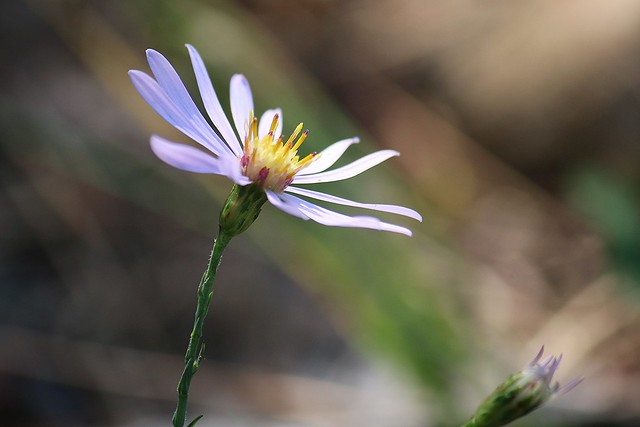 Beautiful is that which is good, that which is undefiled, that which is pure. Beautiful is that which gives evidence to God’s created order. Beautiful is that which gives evidence to God’s love and care. Beautiful is that which gives evidence to God’s power and His might. Beautiful is that which points to God’s knowledge and wisdom. Beautiful is that which honors God.
 The Psalmist wrote: “One thing have I asked of the
  Every time I go on a hike, or take a drive through the Hills, I am confronted with the beauty of the LORD. Some days, I am more sensitive to it than others, more aware or willing to wonder. He draws my eye to those things of beauty that He has showered through His world, and my heart aches. I am struck by the beauty of the LORD, the glory of His creation, the love He has lavished on us in giving us so beautiful a world to live in, to taste, to see, to hear, to touch, to smell, or in giving us senses at all. Everything we see, including the fact that there is even such a concept as beauty, is evidence of Someone who is greater than I am, evidence that Someone instilled in each human the knowledge of a Creator God. We can suppress that knowledge. We can deny it. But that knowledge is there.
  Over the last year or so, ever since arriving in the Black Hills and beginning to attend church in Custer, I’ve been learning more and more about God’s sovereignty, even over the little things. I think as Christians we often forget the little things, even though it is those little things that are so often present for us to enjoy, reminding us of the goodness of our Savior. If every good and perfect gift really is from God, and if God truly is the standard of beauty, then those delights I enjoy while marveling at the sunlight caught in flower petals or the shimmering gold of early yellow leaves or the spots on a fawn, then those delights are gifts from the loving hand of God. If something draws my mind to Jesus Christ, then that is a gift and should be cherished.
  For the Christian, we should set our minds on those things that glorify God, those things that cause us to consider Him. We should cultivate eyes that see His beauty, a heart that yearns for His beauty, and lips that speak of it. Philippians 4:8 commands: “Finally, brothers, whatever is true, whatever is honorable, whatever is just, whatever is pure, whatever is lovely, whatever is commendable, if there is any excellence, if there is anything worthy of praise, think about these things.”
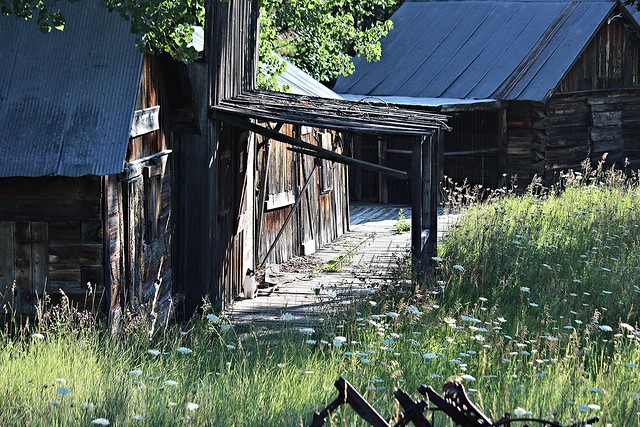 A forest of Queen Anne’s Lace sparkled in the waking light, and a cat groomed herself on the porch of an old tumbledown storefront. A few people still live in the area of Old Rockerville, and a single restaurant is a favorite local stop. The past and present mingle in this place.
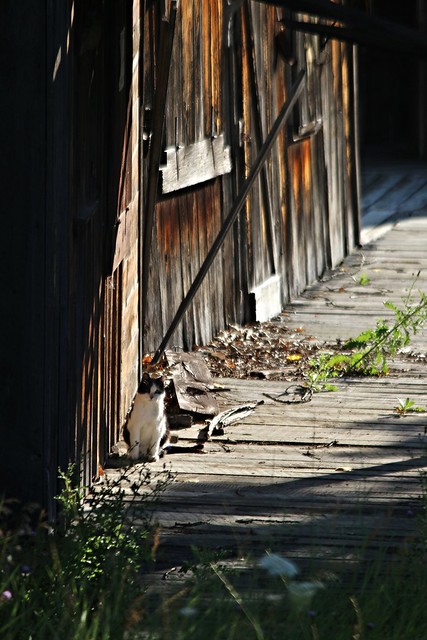 How many miners made and lost their fortunes in this place so long ago, yet not so long ago? What sort of men were they who spent their best years breaking their backs for a myth of easy riches, or breaking other men’s backs because the other men believed the myth? What professions did they leave to come mine placer gold at a rough and wild gold camp? How many drifted from one gold camp to another, and how many put their roots down and attempted to build up a life for themselves, and perhaps for a wife and children? Where were they born? And where did they die?
 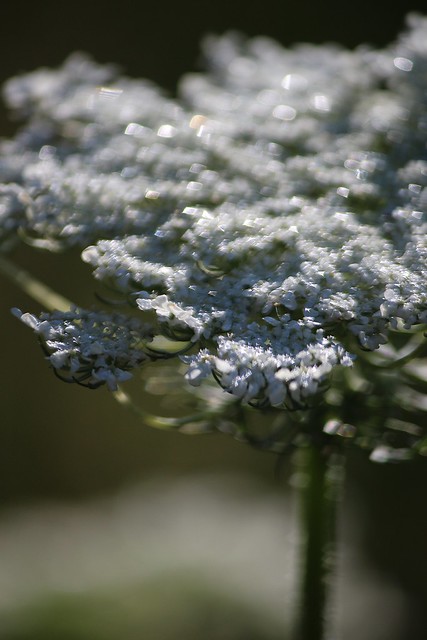 Where are they now? Where will you be, 100 years from now? Who will remember you, and what will you be remembered for? What will the point of your life have been? Whom are you serving?
 Cleo is a mature critter, compared with Ditsy Trixie, and actually kept Trixie in line for a day. Usually Trixie takes off at the first opportunity (or the first hint of boredom) and hightails it to a cabin-sized brushpile where rabbits live. Yesterday, though, she only ran off once, even though she was off leash for hours. I was impressed.
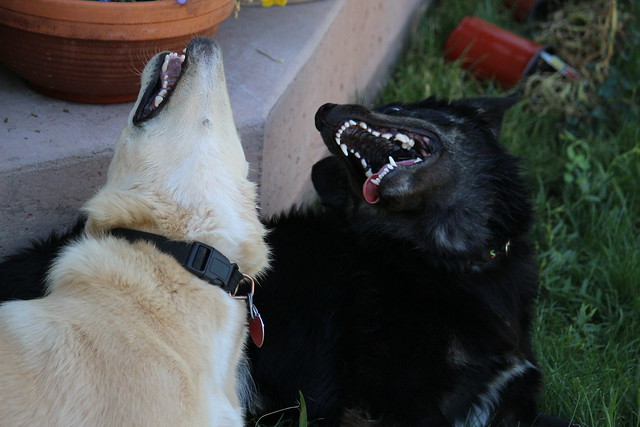
 Those two pups were a hoot to watch. They ran pretty much without ceasing for probably two hours, stopping occasionally for a short breather, plopping down exhausted and panting, until Trixie would pester and Cleo would bolt. Then the games would resume. If they weren’t running, they were tussling, nipping at each other’s faces and feet and jumping all over each other.
 One good thing we learned is that Trixie has almost no territorial instinct. While it would be nice to have a dog with some guard-dog tendencies, it is nice to know that she is entirely unaggressive. Our old dog, Baby, would actively protect her space. Somehow, Trixie has no space. Or no personal space. Or both.
 The temperature was reading in the 90s, and those girls were still zipping around the yard, sometimes stopping for a dip in the pool, then dashing off again. Trixie plunged her whole self into her pool, submerging her face and blowing bubbles. Cleo was much more dainty and ladylike.
 During one of their “breathers,” I got this series of photos where they look like they are laughing uproariously. Every time I look at the pictures, I can’t help but giggle!

 I always enjoy watching animals interact with one another. Whether it is watching calves playing on dirt piles, or horses frisking around a pasture, or laughing at the dog and cats as they try to work out their differences, or watching these two pups tear around the yard, I love seeing the interactions of God’s creatures. What a marvelous Creation God has placed us in!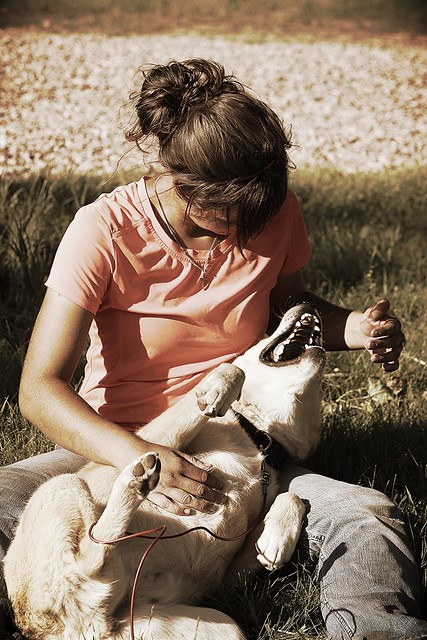

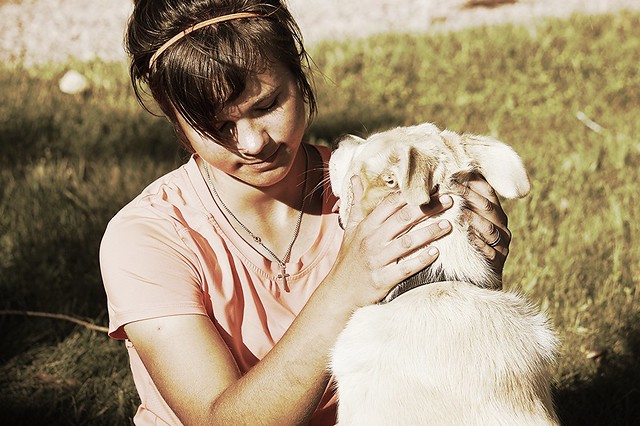 Pets are one of those little blessings that as children we instinctively know are a gift from God. We pray about them, thanking God for them, asking Him to keep our pets safe. But when we grow up, we lose something of that delight. “More important things” take up our thoughts, and we can lose sight of those little blessings and gifts from God that we experience every day. We thank God for what we might consider the “big gifts” (family, church, promotion at work, scholarships, financial security, the new car) but we neglect to thank Him for His little gifts, daily evidences of His goodness to us (the first breath we take each morning, the feel of a puppy’s fur, a cat’s purr, a baby’s smile, dewdrops on grass, fresh air, clean water). If God’s goodness is manifest in Creation, which it is, isn’t it also manifest in those little or individual things of His Creation, be it a flower or a rolling landscape or a waterfall or great creatures or small creatures?
 Our flag is a symbol of those things that America stands for at her core. Although the colors didn’t have significance at the time of our first flag, the colors became significant when the Great Seal was designed in 1782. White stands for purity and innocence. Red stands for hardiness and valor. Blue stands for vigilance, perseverance, and justice.
 Song Dog Journal