Pasques and Pines

Originally printed in the May/June issue of Down Country Roads Magazine

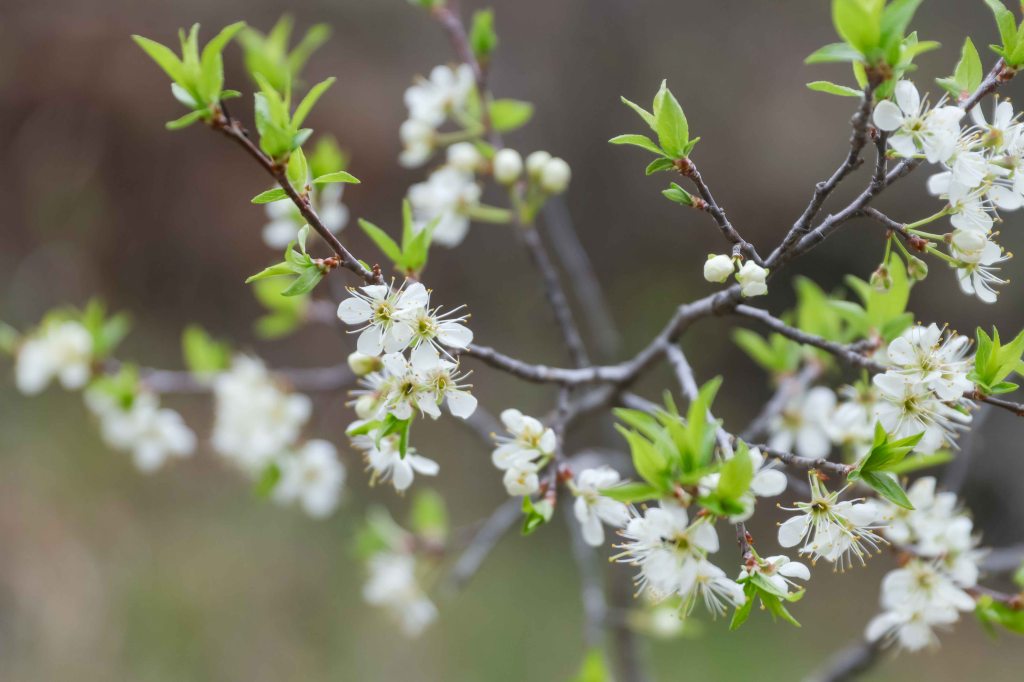
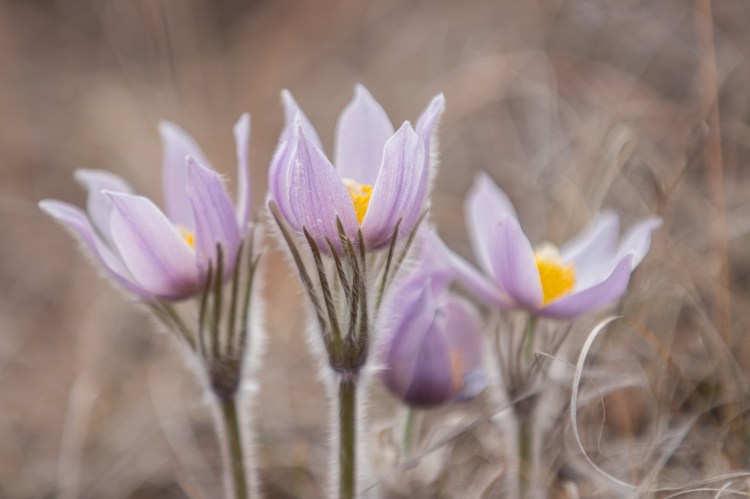
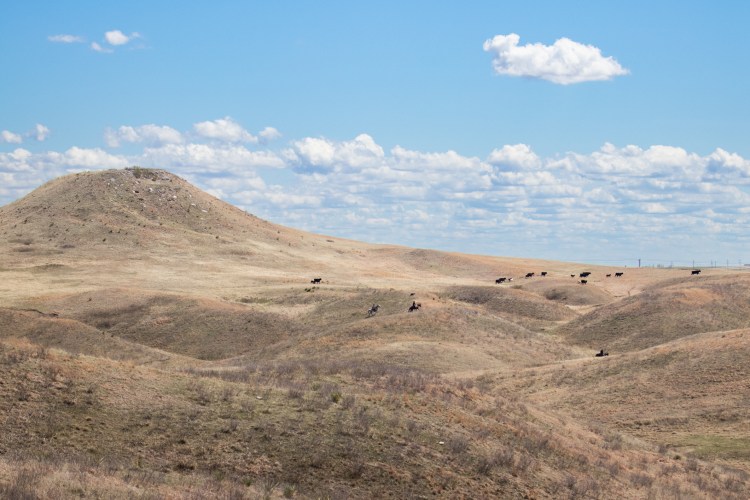
The pasqueflowers bloomed early this year. Perhaps they were tricked by the unseasonable weather, like the plums and the crabapples. Dandelions have tried to spring up, but haven’t been overly successful. But the pasques! How could they bloom with no moisture over the winter? So delicate-appearing, so insignificant visually, the first to bloom and the first to fade, but incredibly resilient. They thrive in disturbed areas, like recently logged terrain, and some of the best I’ve seen have been in old wildfire scars. The ones on our place bloom on the north slope of Potato Butte, a rather rugged and blighted prominence, and in the draws around it, where the wind blows the worst. They fight their way up through the rocky ground, rivalling yucca in toughness, spreading their little leaves and opening their petals in a tangle of old grass and bracken. They survive frosty days and wretched conditions no other wildflower is brave enough to face. When the sun is just right, they light up, their transparent petals like stained glass, and the silky hairs catching the sun. Little beacons of hope they become. They don’t bloom when and where it is easy. And they aren’t easy to cultivate. They thrive in adversity.
Fire is on our doorstep. From the burning of the Sandhills, to the fires that have lit the skies and eaten up pasture as near as two miles away, the drought is oppressive. Most have never seen it this bleak this early. There is no telling how the next weeks and months will play out, no telling how much harder things will get, or how beautifully they may turn around. They’ve done so before. The uncertainty makes us feel so very small. But a recent drive took me through an area burned by a devastating fire a few years back and my heart, heavy right now, lifted and soared. The entire forest floor was green. Not the green of grass, but the green of hundreds and thousands of seedling pines. So very small. Little beacons of hope. Thanks to the flames of the fire, the forest is reseeding itself. They thrive in hardship.

A few weeks ago, the sandhill cranes flew overhead like they do each spring, without fail. I love watching them fly together, wing to wing, and their wonderful wild call pierces the heart. “Fly on! Fly on!” they seem to cry, one to one another, in chorus.

Perhaps the bleakness isn’t so all-consuming after all.

The meadowlarks have returned, sitting on fence wires and the tops of fence posts, and they still have things to sing about, raising their melodious voices in solo song.

Perhaps we do, too.

The bluebirds are homemaking as always and the Eurasian collared doves are romancing in the pine trees, cooing lovingly together, laughing and trilling. A lusty little starling, drab and unimpressive, sat outside our window, somehow managing to whistle a glorious ditty around the blade of grass in her beak, singing while she built a nest for her family. What a delightful sound!

If the birds can go about their mundane tasks and their quiet little lives with a song in their hearts, perhaps we can, too. We can tend our homes, we can break bread with our families and neighbors, we can bear one another’s burdens, and hold our loved ones tight and tighter. We can find joy in a smile or a warm embrace, in the bubbling laugh and sloppy kisses of a baby.

And like the pasqueflowers, perhaps we, too, can thrive even in hard frosts and snowless winters and rainless springs. Perhaps we can thrive in churned up earth and on rocky, windblown hillsides, or in the ashy, deadened landscape after a rangeland fire. Like the pine woods, perhaps we can weather a fire and the heat that burns and clears and cleanses, and in its aftermath a whole new forest will grow.

The birds, the flowers, the forest – They were not made for ease. Are we so different?  
Ranch Wife Musings | Hard Times

Originally printed in the Custer County Chronicle on April 22, 2026

It is the same look on everyone’s faces, the same careworn expression. I would guess the same pit sits in everyone’s stomachs right about now. Mornings should smell damp and fresh. We should be wearing muck boots and watching mists and fog drift across pastures at first light. Those lacy spiderwebs that appear overnight should be studded with dewdrops. We should be seeing the start of green grass. But there is no grass.

The corrals and calving lot are 6 inches of dust, and the pastures are bone dry and chewed down. It hurts your heart to look at them. Every little movement of every living thing, every breath of wind, kicks up dust. And goodness knows we’ve had our share of wind.

Calving season should wrap up with the eager anticipation of what comes next, but right now the “next” is uncertain.

All winter long, we remind ourselves that December and January, and even February, tend to be dry here, and that’s fine and normal. We remind ourselves that there’s plenty of time for the needed moisture. Plenty of time. Then March rolls through bringing no snow and we look to April, saying to ourselves, “We’ve gotten great snowstorms in April.”

And then April passes by. “It always rains. Eventually,” we remind ourselves. And then when cynicism creeps in and you think, “Well, at least there’s nothing to burn,” a spark lights off a 5000-acre grassfire. Apparently, there was something to burn.

“Please, God, make it rain.”

The inner monologue changes as the situation worsens, and as optimism gives way to reality.

There is no grass. Dams are dry pits. We haven’t really had measurable precipitation since October. The greenest spot on the whole ranch is the patch of lush grass around the septic tank in the yard.

Tough questions are being asked. Questions regarding the best interest of the livestock and the best use of the land. At this point, any answer will be a tough answer, most likely.

What do we do now? That seems to be the question everyone is asking.

You can’t ranch without grass. You can only feed so much hay, and where does the hay come from? You can only truck it so far, with the price of fuel. And fundamentally, regardless of how the media and four-letter organizations like to characterize those in agriculture, ranchers want what is best for the livestock and the land.

It is times of uncertainty that force us to acknowledge God. It is hard times that drive us to our knees in prayer. They are a reminder that we don’t live in a perfect world. They remind us that we don’t in fact govern the weather. Generally, in agriculture, that’s a pretty easy fact to grasp, but bad years are an extra dose of reality, that the weather is not subject whatsoever to our whims or desires. Hard times invite us to revisit God’s Word, and to be comforted in His sovereignty, and His purposes, which are always greater than ours. Uncertainty invites us to be reminded of His promise in Genesis that, “While the earth remains, seedtime and harvest, cold and heat, summer and winter, day and night, shall not cease.” Hard times invite us to marvel at His created order. God built incredible resilience into this world.

There are so many extremes of thought when it comes to the environment. There is the extreme to one side that seems to think we are constantly teetering on the brink of total annihilation, with a fixed date of destruction that surreptitiously gets moved, again and again, when the annihilation doesn’t happen. Then there is the extreme of exploitation without concern for the future, a using up of resources without concern for the next five years, let alone the next generation. There is the incredible arrogance and short-sightedness of weather manipulation, as if we actually can, or have any business trying, and truly could without making a total mess of things. And then there is a whole host of varied viewpoints somewhere in the middle of the mess, who can at least agree to the overarching idea of stewardship, if not the fine points. Stewardship being a caretaking of nature and our natural resources, neither the abandonment demanded on one side or the exploitation of the other, neither harnessing nor manipulating, but a partnering with and stewarding of the world around us.

And stewardship as mandated and defined by the Bible leads us to acknowledge that God as Creator has put in place an incredible created order, that allows regions to suffer drought and heat and natural disasters, and somehow, beautifully, amazingly rebound. The fresh green grass in recent burn scars evidences this, as well as the wonderful biodiversity in places like Hell Canyon, in the area of the Jasper Fire. It is a kind of stewardship that recognizes our responsibility but also God’s control.

If not even a sparrow falls to the ground apart from the knowledge of God, then not a raindrop falls, or doesn’t, without God’s permission either. If He clothed the fields then, 2000 years ago when the Gospel writer recorded the words of Jesus, He who is the same today clothes the fields today.

Pray for a miracle. Please, do. Pray for the skies to open and for rain upon a dry, parched earth. Pray for fruitfulness and life and safety.  I know I am. But my greater prayer, the prayer growing in volume, is for faithfulness. That we would have eyes to see God’s faithfulness displayed, and that we would be faithful to Him.

Because God is not primarily about the business of our comfort. In fact, our comfort doesn’t even make the priority list of eternity. God is about the business of fitting saints for Heaven, and fitness for Heaven rarely is accomplished through comfort and ease. It is accomplished through difficulty, testing, trials.

When we reach a point of breaking and holy mending, or breaking and holy sustaining.

When our best-laid plans and our smug self-sufficiency wilt away like last season’s grasses, and we are forced to actually wait for the rain of God’s providence.

Oftentimes, God’s most poignant and lasting work in us is done in hard times when we are brought to the utter end of ourselves.

Ranch Wife Musings | The Best Rain

It slowly, sweetly rained for the better part of 36 hours, filling every bucket and pan and tub that was out in the yard, making the corral blessedly muddy and every little slope a running stream. Each and every step was a splash and splatter of water and mud and the pups endlessly tracked into the kitchen, and further into the house if I wasn’t quick enough. It was the best rain. The kind that comes when we need it most. The best.

The longer the winter, the sweeter the spring. The harder the work, the better the rest. The hotter the day, the greater the refreshment of the evening coolness. The longer the loneliness, the sweeter “I love you.”

The greater the need, the greater the relief when the need is met.

So rain, any rain when it is needed desperately, is the best rain. And the longer it comes, the better it gets. I love to see it streaming down the windowpanes, a sight we haven’t seen in so long, running in rivulets down the driveway and making ruts and mud and such a mess, such a wonderful, beautiful mess! It came slow enough that the thirsty ground was able to drink it almost all up, and any that is left will put water in our dams.

I see relief in the landscape, the animals, the trees and grasses and other plants. The calves looked happier, playing in the rain rather than choking on dust. Cheerful little ducks bounce around in the puddles along our driveway. Cows are glad not to be walking a mile to get to water, and the dogs are just always happy. In a matter of 24 hours, the grass was greener, taller, thicker, and it seems that the alfalfa began to spring up in that short time as well. The fruit trees and the perennial garden look better and better, and the ponderosas are rich and dark, with none of the sickly, yellowish cast they had in the later part of the winter. I can’t wait to see what everything looks like in a week, after we get a little heat and sun on the watered ground!

The rain tapered off yesterday, but we have still had periods of mist and light showers, and the dampness is refreshing and glorious. An answer to so many prayers.

Yes, indeed. It was the best rain.

Listening to the Storm Roll In

It didn’t take long for all the wonderful moisture we got with those last few snow storms to be just a memory. The muddy ruts all too quickly turned cement-hard, and every trail is dusty and dry. All the corrals are dirty, especially with a little wind, and we have been praying – hard – for the moisture we so desperately need. Moisture totals are low and the drought has not broken. Dams that had water a week ago are now dry. The grass is promising, but without moisture it will head out and mature, and basically stop growing, even if we get later rain. It becomes rather disheartening, seeing the green spring up so eagerly but to see storm after predicted storm disappear off the radar, or split and go around us, or dissipate in a little scattering of raindrops.

But we pray and watch the weather and pray some more, and encourage each other with the fact that God is in control. How often it is that I remind my own weary heart that God is a loving God Who knows what we need and will provide, even if it isn’t ultimately the way or the thing we think we need! So it goes with the weather.

Over the last hectic week or so, as we have wrapped up calving season and all the craziness of branding season has begun, we have hoped and prayed and anticipated, as the meteorologists began talking about some significant rainfall this week. Little storms popped up here and there, with un-measureable amounts of rain, but what seemed to be a “priming of the pump,” as some would say. We have had some hot, muggy days, some strange, foggy ones, and the atmosphere all day today seemed restless, with a heavy morning sky that cleared to a too-blue afternoon sky with summer-warm temps and looming clouds. We are supposed to brand a small bunch of calves tomorrow, and at this point don’t know if that will happen. I can’t tell you how thrilled we’d be to have to cancel due to rain!

The night was quiet when we went to bed, but about an hour ago the thunder began, and a little lightning flickered in the south. Then it intensified, and the thunder was constant. I finally got up to throw sheets over my perennial garden in case of hail, and the air was warm and sweet with the smell of distant rain.

So now I’m sitting here by the window, the only one in the house awake, listening to the sound of thunder and drops of rain on the roof, as an occasional gust of wind squeaks a gate or wakes up my wind chime. What wonderful music, listening to the storm roll in.