Ranch Wife Musings | Cow-Calling

Originally printed in the Custer County Chronicle on April 3, 2024

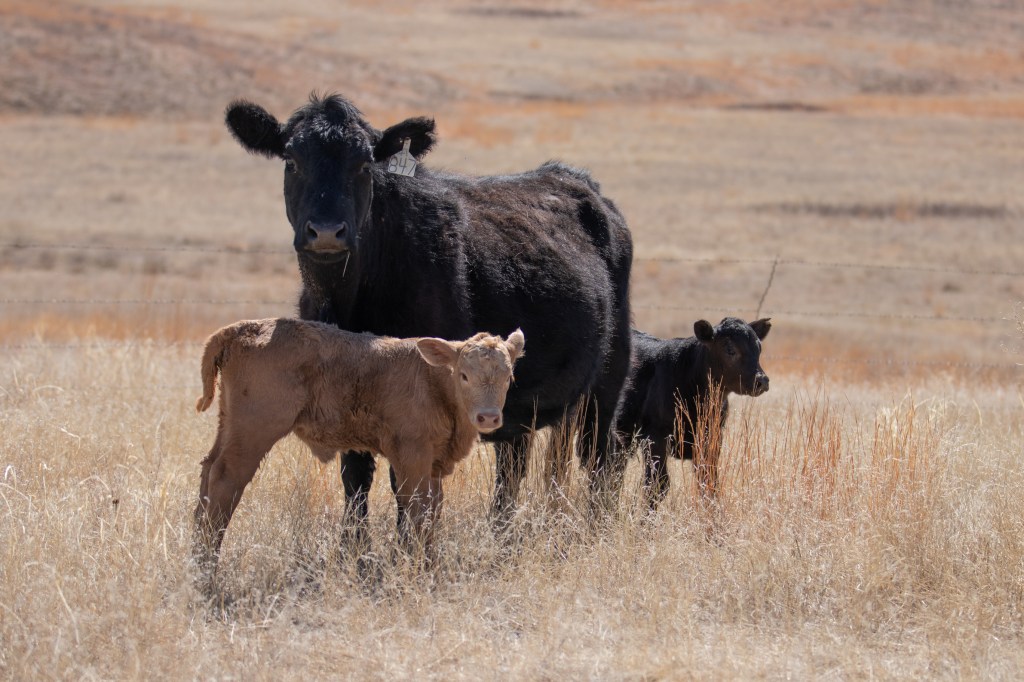
The miracle of life is front and center during calving season. It is amazing to watch a heifer birth her first baby, looking in vague confusion at the squirming, slimy creature that made its sudden, un-asked-for appearance, and then, prompted by God-given instinct, begin to clean the baby off. The baby is up off the ground in a matter of minutes, his little legs wobbly and knock-kneed, and then he finds the life-giving udder and his little tail goes to wagging, just like a dog. What a sight to see.
The excitement of the first calf of the season is followed by weeks and weeks of chaos, confused young mother cows learning the ropes, babies everywhere, unmixing mixups, and the satisfaction of watching maternal older cows do everything on their own.

It isn’t just instinct that drives a cow, but a fascinating melding of instinct and education, and the first-time mamas are kept under pretty close watch for the first few days, and kept in the nearest pasture for the first month or so. These first-time mamas are prone to wandering off and leaving their calves, forgetting they have calves, forgetting which calf is theirs, forgetting where they left their calves, and can often be seen chasing helplessly after a sprightly baby, entirely unsure how to control the unruly child.

The second-time mamas are a little less helpless, instinct and education both more fully developed, but there still is a tendency towards some of those pitfalls of early motherhood. They are given a little more freedom than the first-timers, but are still able to be supervised. Eventually, cows figure out the concept of nursery groups, where one or three mothers are left in charge of a dozen or so babies, giving the other mothers a chance to go in to water or eat. I don’t know how they figure out shifts, but somehow they do, but early on they forget about the need for a babysitter and just wander off, until something jogs their bovine memories.

And nothing jogs the bovine memory like the sound of a calf bawling. Nothing reminds a mama cow of her maternal responsibility like the sound of the baby she forgot about or misplaced. Some calves are obliging, squealing like stuck pigs if you just look at them wrong, let alone if they are being sat on by a wiry rancher, but other calves are stoics, and won’t make a peep, which is inconvenient if you’re trying to identify them.

Thus, the necessity of the fine art of cow-calling. Although ranching is a lot of science, there are a number of things that definitely fall into the “art” category, and cow-calling is one of those things.

I remember being seated behind my now husband, bundled up against the cold, enjoying the view as we bounced around the hayfield on the ATV, looking for unmarked calves to ear tag and vaccinate. The ear tag given matches the one in the mother’s ear, so they can be easily paired up later on and a good inventory kept. The frozen hayfield wasn’t much fun to drive over, but I was having a dandy time, my arms wrapped snugly around my handsome not-quite-husband, and having been granted the official role of keeper of the vaccine gun and ear tagger. Without warning, an absolutely uncanny sound issued from my not-quite-husband’s lips. Seated as I was right behind him, arms wrapped around him as stated, I experienced the full force of this incredible and unearthly sound. It was truly awe-inspiring, unlike anything I had ever heard before.

And I burst out laughing.

I honestly thought the demonstration was for comic effect. Until I saw fifteen mother cows practically stand to attention, heads flying up from complacent grazing like they’d been stung by wasps, then leave their breakfast and take off in all different directions, whichever direction they thought they remembered having left their calves. For the record, they don’t always remember, the telltale sign being a mother cow walking around bawling until she stumbles across her baby, which is (almost) always right where she had left it.

Anyway, the cow-calling had the intended effect and the mother of the baby in question presented herself, the calf was identified, tagged and vaccinated, and we went on our merry way.

Such was my introduction to the fine art of cow-calling.
I have since had my education on this topic broadened and have learned that this useful skill can be employed not only to quickly identify an unmarked calf, but to mostly accurately separate the cows that have calved from those that have not, to bluff a cow into looking around for the purpose of reading her ear tag, or to keep a flighty cow from running off without her young baby. I’m sure there are other uses for it, but those are the main ones I have identified.

Calving season. By turns hilarious or heartbreaking. Life and death are often juxtaposed. It is the sweetness of new life and baby animals that know no fear, the enjoyment of watching them learn to play and take their first running steps in the wide open, crow-hopping on their spindly legs. It is incredible to see a cow looking for somewhere to calve, and twenty minutes later to find not only that she has had the calf but that it is up and nursing already. It is miracle after miracle after miracle.

But cow-calling still makes me laugh.

Ranch Wife Musings | Distracting in Coveralls

Originally printed in the Custer County Chronicle on February 7, 2024

I still remember the look on my now father-in-law’s face when he rattled up in his blue ranch truck to the middle of the pasture we call Hidden City. His dogs piled out, then he climbed out, and then he just looked at me. Brad and I were scooping muck out of a stock tank, getting it ready to cement the bottom. Dave had brought the sacks of cement. And to my knowledge he had no idea I’d be out there helping. We had been dating for about six days. Maybe ten. You know, the time in a relationship when the guy is trying to impress the gal?

I was sunburnt, covered in mud, and grinning.

“Boy, I bet you’re impressed,” he said.

“I volunteered,” I replied.

And that dynamic characterized our whirlwind four months of dating, and our whirlwind six months of engagement, which spanned fall cow work, preg testing, shipping calves, calving, and branding. Whenever I wasn’t on shift at the fire department, I was out at the ranch, sometimes truly helping, sometimes there “just in case.”

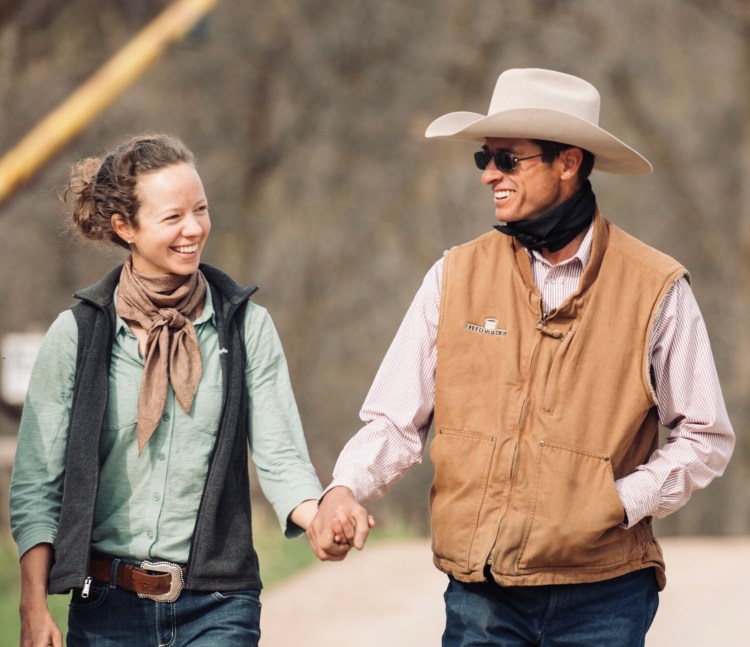
Honestly, it was pretty handy. A lot of our dating was spent with me riding behind him on the ATV, a convenient place to be. Not only was the view nice, but it was a great excuse to have my arms wrapped around him for extended lengths of time. I’m not sure who invented the fabricated “date” as the best way to get to know someone, but give me an afternoon riding double on a four-wheeler or perched next to him in the tractor any day.

And it prepped us for life together. We learned to work together from the get-go. We learned what each of us was like at our best and at our worst, when having fun and when frustrated, when things went well and when things fell apart. Anyone can pull it all together to go out in public, anyone is on their best behavior when other eyes are observing, but it is the day-to-day that truly reveals a person’s character. We both learned how much better, sweeter life can be with a suitable companion, that 1+1 is way more than 2, and I learned that I truly loved to play the role of the helper. If all I did was make things a little easier, that was enough.

Valentines Day is approaching, with all the wildly unrealistic expectations set primarily, I believe, by women, aggravated by Hallmark and Hollywood and romance novels, of flowers and fine wine and fine dining, and with all the myriad opportunities for men to fail to meet these unrealistic expectations. How certain things became culturally accepted as the pinnacle of romance and the standard expressions of love, I sure don’t know, and I don’t know anything about those things either.

But what I do know is I wouldn’t trade reality for those things. I guess I see real romance as something altogether different.

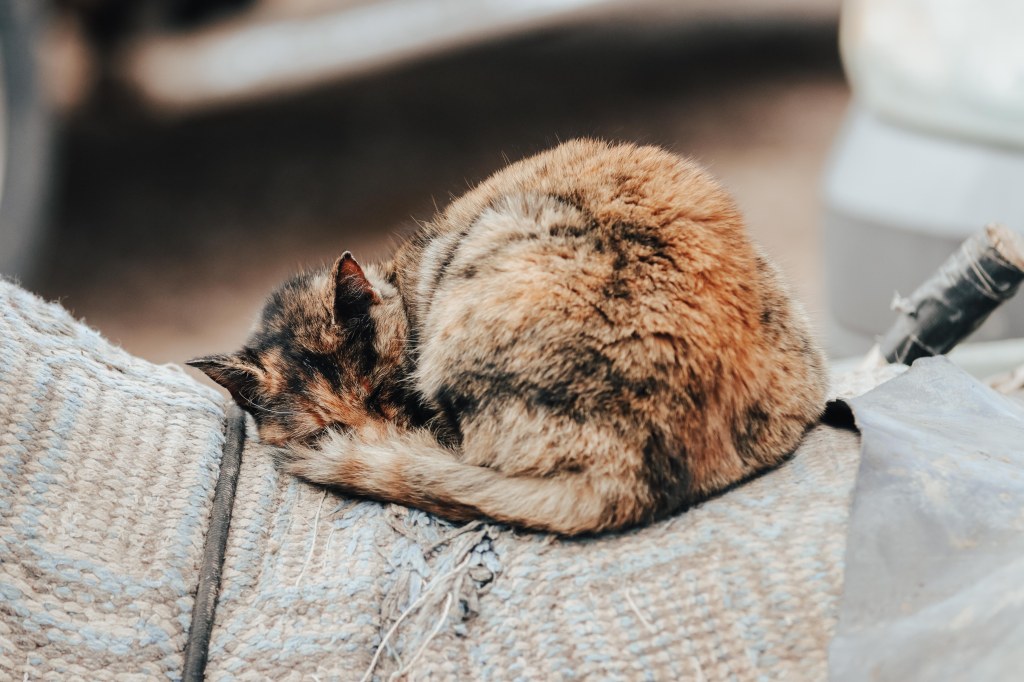
Real romance comes in the form of bouncing over frozen ground on an ATV to tag calves together during a snow squall. Real romance is gingerly kneeling down on the heaving flank of a 650-pound steer choked out on the ground when your husband looks at you and says sweetly, “Do you want to sit right here, honey?” and hands you the manure-crusted tail. Real romance is the satisfaction of a long day of working together. Real romance is a quick break over a cup of coffee before heading out into the cold again. Real romance is rattling along in the feeding pickup or the tractor, tagging along to be the gate-getter and net wrap cutter, encumbered by coveralls and heavy chore coat and drifts of snow. Real romance is having that strong shoulder to cry on when a cherished cat dies, or life just feels heavy. Real romance is time together over a home-cooked meal, or holding hands walking into the feed store. Real romance is hearing your husband’s voice next to you in church, even though he can’t hold a tune. Real romance is winning (almost) every single game of cribbage, even though he taught you how to play specifically because he thought you wouldn’t be any good at it (true story). Real romance is a disagreement followed by an exchange of apologies. Real romance is trust in your spouse’s faithfulness, and learning to understand someone else’s love language. Because how often is your spouse communicating love? All the time.

I love the shared experiences that are knitting our lives together into one. I love catching his eye over the backs of 200 cows, or pouring him a cup of hot coffee in the scale shed, or our exchanged smiles as we go our individual ways during chores. It doesn’t look like the movies. It sure isn’t always mushy and sweet. Life is life. It doesn’t look like the Hallmark version of a romance. A lot of the time we are covered in muck and sweat and don’t smell great. It might be routine, normal, and mundane.

But he still says I’m distracting in coveralls.

Ranch Wife Musings | The Gratitude Cup

Originally printed in the Custer County Chronicle on November 8, 2023

What a month is November! Not as spectacular as October, not as festively-inclined as December, but with its own spice and savor. We’ve been dazzled by the first of many frosts sparkling in amber-rose sunrises; we’ve seen the first winterish stars appear in the pale blue of a clear-cold sky, with the slivered moon hanging just above the horizon. Winter is approaching.

Fall cow work is wrapping up, calves are being weaned, and cows are being pregnancy tested, giving the first indication of how the next year might go. It is a month of completion, evidenced by the cattle pots thick on the highways, heavy with the fall calf crop. Year by year, it can be a month of joyous excitement, or a month of the doldrums, and we in our own heads and hearts have a lot to say about which of those it is. Will we let the time blur past in a meaningless whirlwind, or will it be a poignant time of reflection and joy?

Have you ever sat around after a wonderful Thanksgiving dinner, with plenty of turkey and stuffing and corn casserole, and the host instructs his captive guests into a participatory activity, with the dreaded words, “So now we will go around the table and everyone will say something he or she is thankful for!” It is deliciously uncomfortable and the host is always gleefullychipper, but a covert glance reveals a herd of deer-in-the-headlights expressions. Everyone follows the instructions like they’re taking a spoonful of something that won’t kill them but will make them stronger, and the first individual to walk the plank usually meekly murmurs something like, “I’m thankful for my family,” to which wholly expected but somehow flat answer everyone smiles and nods obligingly. Another quick glance around the room, and more deer in the headlights as everyone desperately hunts for a new answer. The most obvious (and weightiest) choice taken, suddenly there seems to be nothing left. Finally, mercifully, the exercise is over and everyone eats pie.

Is this scenario even remotely familiar? 

Goodness.

Why in the world is this? Why, for people who have so much, is our thanks and gratitude so flat and lifeless? We can conjure up expressions of gratitude for the most obvious things, but struggle to express gratitude outside of that. We of all people should be simply bursting with gratitude, so aware of our blessings, that expression of it just pours out of us!

Could it be that we fail to prime our hearts to be thankful, failingto cultivate a day-to-day gratitude for the many mundane things we truly cherish but often overlook?

Could it be that our thankful-meters are poorly calibrated? We wrack our pitiful, gratitude-starved minds for something obvious, like a raise or a promotion or a new baby or a new house or a life-saving medical procedure, and we come up empty. If those are the sorts of things I’m looking for, I’ll come up empty a lot. Because in general for many of us life actually stays more or less the same from year to year. We kind of count on it. So, if we don’t have a heart of gratitude in and for the little things, we will feel empty.

Daily graces. Those things we take for granted and would profoundly miss. Evidences of God’s kindness.

Like waking up next to your spouse in the morning. Or like waking up at all. 

Like a glorious sunrise – Isn’t it amazing that we have a sunrise every single day? Or the sunset—We have those every day, too! 

Like the first cup of coffee, steaming in the early morning light.

Like fresh, cold air in the lungs, and sunlight on the face, even as we bundle up against the chill. 

Like the amazing transformation rendered by frost thick in the grass and on the trees. 

Like work to do, whatever one’s occupation, and the shape and purpose good work gives to our lives.

Hands that are able to be busy at a task. 

Newly-weaned calves, healthy and fat. 

Baskets of fresh eggs. 

The aroma of oven-hot bread. 

A book to read and a mug of tea, and warmth flowing through fingers cold from being outside. 

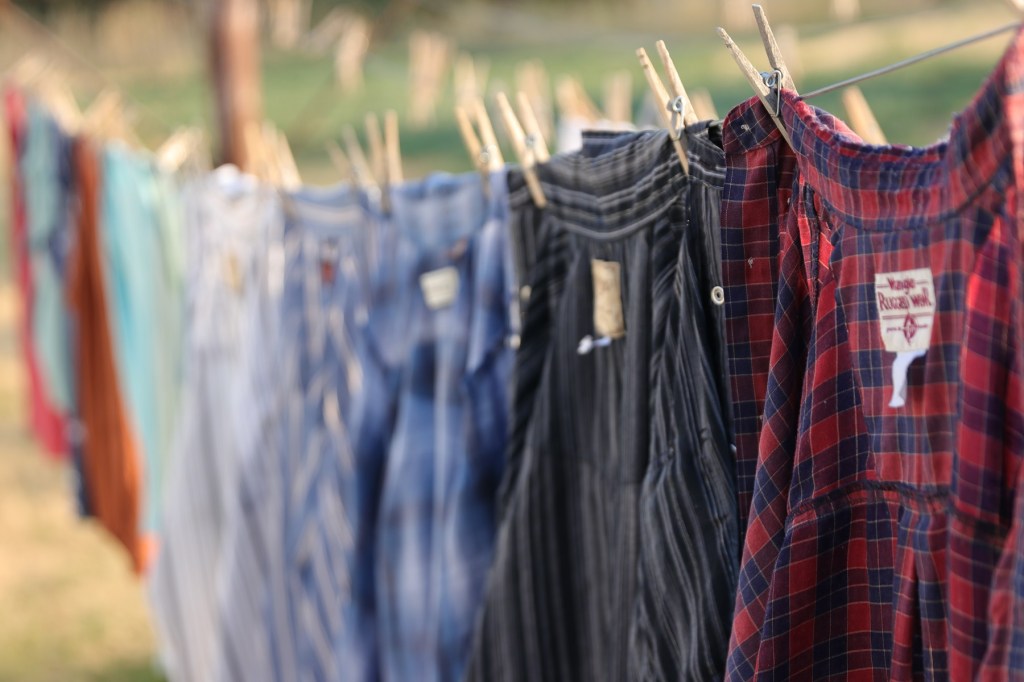
Those pesky piles of laundry to do—it means we are well-clothed!

Stacks of dishes in the sink—it means we are well-fed! 

Muddy footprints on the floor—someone or something loved made those prints. 

A friendly smile from a stranger. 

Laughter and humor to lighten life. 

The joy of bringing happiness into someone else’s sorrow or loneliness or weariness. 

Like voice in song. Anyone’s voice. Your own voice. 

Like warm socks and long underwear. 

Like companionship in family, friends, neighbors. 

Like joy after tears—because there is. There always is. 

Like those million little graces that are present even in the hardest of times. Even when life is at its bleakest or boringest. Even when it seems like this year wasn’t any different than last year. Even when things went wrong, dreadfully wrong, or what we hoped would happen didn’t come to pass. Even when life feels like a grind, when relationships are tough, and the roads are bad. 

So, find something. Something tiny. It doesn’t have to be profound. One of those daily graces that we experience and don’t think twice about. And put it in your gratitude cup. And then find something else. And something else. And before long, that cup of gratitude will overflow.

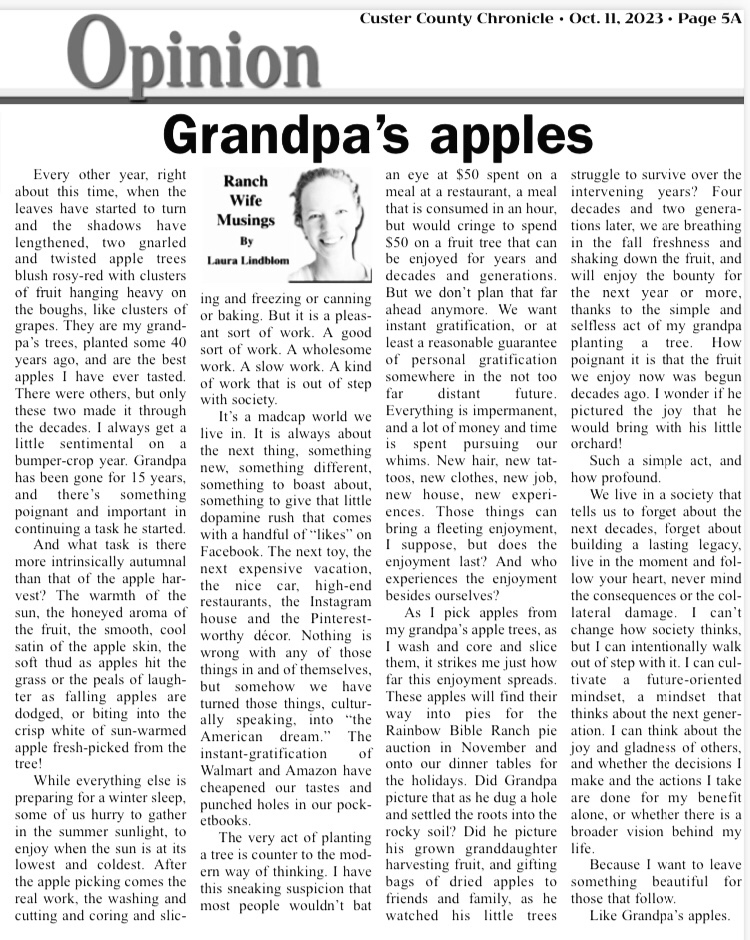
Ranch Wife Musings | Grandpa’s Apples

First printed in the Custer County Chronicle, October 11, 2023

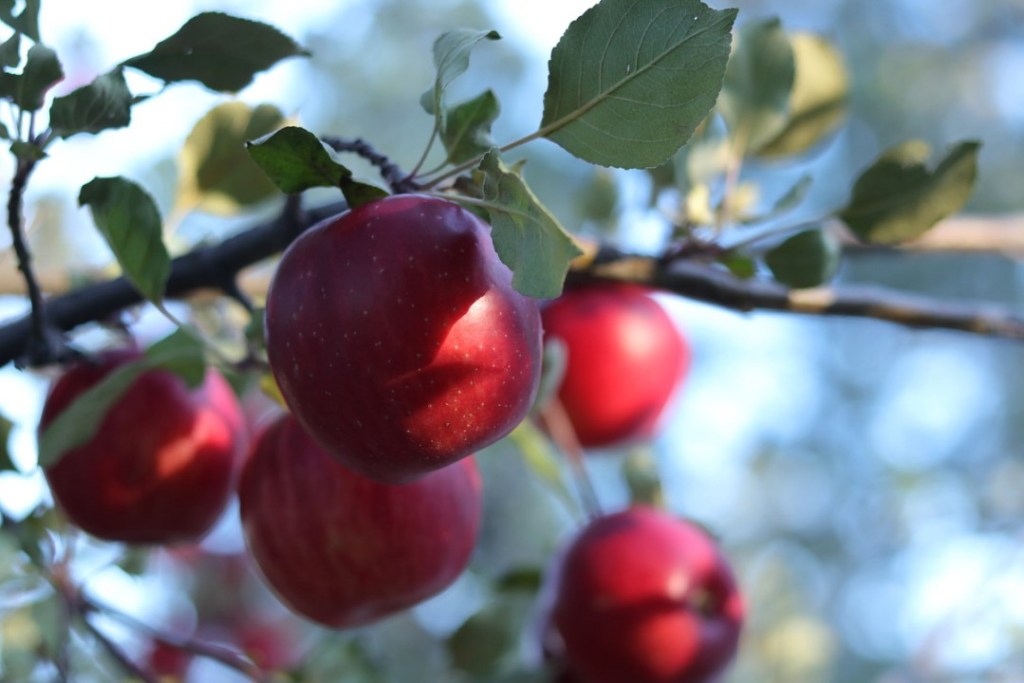
Every other year, right about this time, when the leaves have started to turn and the shadows have lengthened, two gnarled and twisted apple trees blush rosy-red with clusters of fruit hanging heavy on the boughs, like clusters of grapes. They are my grandpa’s trees, planted some forty years ago, and are the best apples I have ever tasted. There were others, but only these two made it through the decades. I always get a little sentimental on a bumper-crop year. Grandpa has been gone for 15 years, and there’s something poignant and important in continuing a task he started.

And what task is there more intrinsically autumnal than that of the apple harvest? The warmth of the sun, the honeyed aroma of the fruit, the smooth, cool satin of the apple skin, the soft thud as apples hit the grass or the peals of laughter as falling apples are dodged, or biting into the crisp white of sun-warmed apple fresh-picked from the tree! While everything else is preparing for a winter sleep, some of us hurry to gather in the summer sunlight, to enjoy when the sun is at its lowest and coldest. After the apple picking comes the real work, the washing and cutting and coring and slicing and freezing or canning or baking. But it is a pleasant sort of work. A good sort of work. A wholesome work. A slow work. A kind of work that is out of step with society.

It’s a madcap world we live in. It is always about the next thing, something new, something different, something to boast about, something to give that little dopamine rush that comes with a handful of “likes” on Facebook. The next toy, the next expensive vacation, the nice car, high-end restaurants, the Instagram house and the Pinterest-worthy décor. Nothing is wrong with any of those things, in and of themselves, but somehow we have turned those things, culturally speaking, into “the American dream.” The instant-gratification of Walmart and Amazon have cheapened our tastes, and punched holes in our pocketbooks.

The very act of planting a tree is counter to the modern way of thinking. I have this sneaking suspicion that most people wouldn’t bat an eye at $50 spent on a meal at a restaurant, a meal that is consumed in an hour, but would cringe to spend $50 on a fruit tree that can be enjoyed for years and decades and generations. But we don’t plan that far ahead anymore. We want instant gratification, or at least a reasonable guarantee of personal gratification somewhere in the not too far distant future. Everything is impermanent, and a lot of money and time is spent pursuing our whims. New hair, new tattoos, new clothes, new job, new house, new experiences. Those things can bring a fleeting enjoyment, I suppose, but does the enjoyment last? And who experiences the enjoyment besides ourselves?

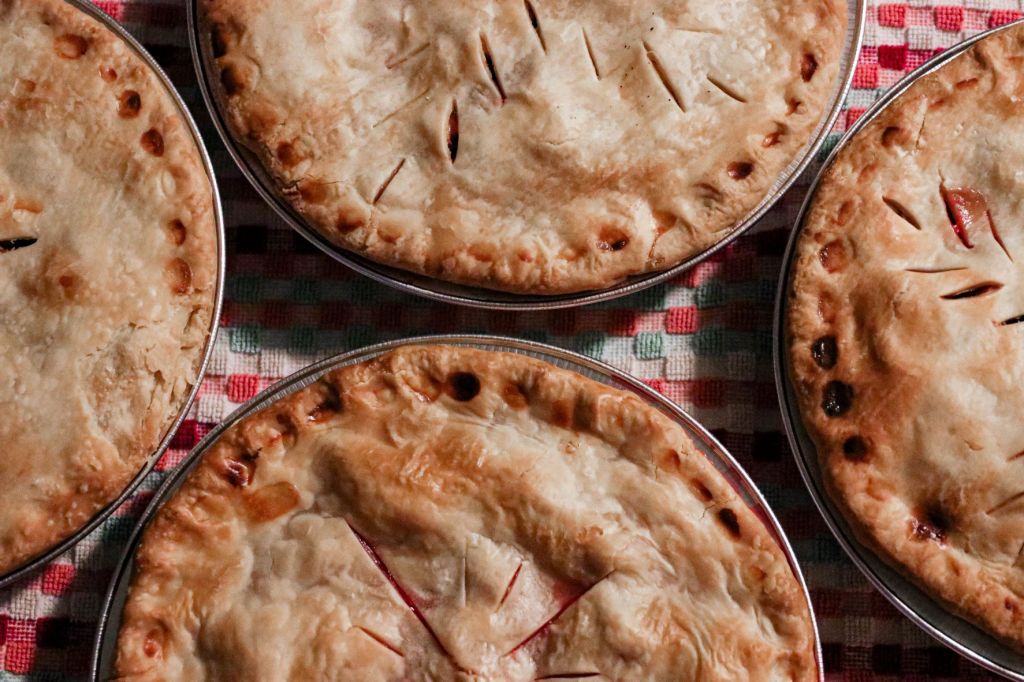
As I pick apples from my grandpa’s apple trees, as I wash and core and slice them, it strikes me just how far this enjoyment spreads. These apples will find their way into pies for the Rainbow Bible Ranch pie auction in November, and onto our dinner tables for the holidays. Did Grandpa picture that, as he dug a hole and settled the roots into the rocky soil? Did he picture his grown granddaughter harvesting fruit, and gifting bags of dried apples to friends and family, as he watched his little trees struggle to survive over the intervening years? Four decades and two generations later, we are breathing in the fall freshness and shaking down the fruit, and will enjoy the bounty for the next year or more, thanks to the simple and selfless act of my grandpa planting a tree. How poignant it is that the fruit we enjoy now was begun decades ago. I wonder if he pictured the joy that he would bring with his little orchard!

Such a simple act, and how profound.

We live in a society that tells us to forget about the next decades, forget about building a lasting legacy, live in the moment and follow your heart, nevermind the consequences or the collateral damage. I can’t change how society thinks, but I can intentionally walk out of step with it. I can cultivate a future-oriented mindset, a mindset that thinks about the next generation. I can think about the joy and gladness of others, and whether the decisions I make and the actions I take are done for my benefit alone, or whether there is a broader vision behind my life.

Because I want to leave something beautiful for those that follow.

Like Grandpa’s apples.

Ranch Wife Musings | Legacy in a jelly jar

Originally printed in the Custer County Chronicle, August 16, 2023

Chokecherry season crops up at the most inconvenient time. It’s hot outside, hot inside, and even hotter standing over a boiling pot of almost-jelly, stirring and pouring and fishing hot jars out of hotter water, burning fingers and creating chaos in the kitchen. It isn’t as if there’s not enough to do or the summer hasn’t flown by fast enough. The branding irons are hardly cooled and we begin the late summer work of preconditioning calves. The bulls hardly start their summertime gig before we gather them up for their 10-month vacation. Teeny little seedlings hardly pop up in the garden before the tomatoes are towering over my head, zucchinis the size of small dogs hide under every leaf, and I’m trying to find my strawberries in the dill forest. Just when I think we might catch a break, the chokecherries (which I’m pretty sure just bloomed yesterday) are suddenly ripe in Gobbler Knob and we’re picking them by the bucketful. And the more we pick, the more work there is to do. Funny how that goes. And this year is a bumper crop year.

So, I find myself wondering…why? Why in the world do I go to the trouble of picking chokecherries and processing them, or canning anything for that matter?

To be quite honest, no matter how madcap the summer, I love the chokecherry harvest, inconvenient as it may be. The task itself is pleasant, the rhythmic stripping stem after stem of berries, the sweet-astringent tang on the tongue, the sunlight and fresh air, a forced slow-down. Sometimes that inconvenience is a disguised blessing. Then there’s the aroma in the kitchen as the berries cook for extracting the juice, the jewel-like color of the juice itself, and finally the jelly in gleaming jars set out in proud rows on the countertop, or, better yet, spread generously on a slice of fresh bread. Oh, boy. A person can founder on that.

Several years back, before she passed away, my grandma gifted me her recipes, and those two worn boxes of handwritten cards have become cherished possessions, especially the one for chokecherry jelly, dirty and smudged as it is with age and use and love, scratched out in her spidery handwriting.

Chokecherries were plentiful on my grandparents’ little ranch near Hermosa, and they were diligent in utilizing them. As far back as I can remember, chokecherry jelly has been a family tradition, and I don’t know that there was ever a meal my grandma served that didn’t feature a little dish of the ruby-red jelly in a crystal bowl, with the obligatory tiny jelly spoon.

I picture that little bowl of jelly and vividly remember family gatherings packed around the long wooden table Grandpa built. I can remember how good their house smelled, built of rough-cut lumber. I remember cousins and Christmases and sweet summertimes, our twice-yearly pilgrimages to the Black Hills. I can remember Grandpa’s simple blessing over the meal: “We thank you again, Lord, for the many good things You give us…” And I can see the blue enamel plates Grandma served lunch on, and the brown stoneware for suppertime. And Grandma, always the picturesque wife and homemaker and hostess, with permed silver hair and a cardigan, seated next to my jovial, plaid-shirted Grandpa, who was the life of that house.

All from a little bowl of homemade jelly, and a smudged recipe card. Reminders of the best parts of the past, the happiest memories of my childhood, and my lifelong love of the Hills.

But beyond that, that simple, smudged recipe card and my jars of jelly foster a broader connection to a whole era and a way of life that is in danger of passing away.

It is an era of family gatherings around a dinner table. Before cellphones and social media intruded into every aspect of our lives. Before Walmart and online shopping reduced the need for self-sufficiency. An era of recipes passed hand to hand, not looked up on Pinterest. An era before “Ask Siri,” but rather “Ask Dad. He knows.” An era of mothers teaching tasks to daughters and granddaughters, and fathers to sons and grandsons. An era of taking pride and pleasure in doing by hand – whether that was a garden, or a meal, or a home, or a family. An era of multi-generational learning and sharing of skills and knowledge. An era of legacy-building through seemingly unimportant tasks. Like chokecherry jelly.

As a culture, we have segregated our societies by age, families have spread out geographically, and we’ve chosen again and again to prioritize convenience over relationships (especially generational ones), over community, and over self-sufficiency. As a culture, we are losing skills and knowledge that used to be passed down, generation to generation.

Chokecherry jelly isn’t just about chokecherry jelly, or how much better homemade is than storebought.

It is so much more than that. It is about those little things that remind of us who we are, and where we came from. It is about connecting to the past in tangible, meaningful ways. It is about preserving a way of life, a dying art, a heritage skill, and cultivating a mindset of capability and productivity. A mindset of choosing to not dollar out every action, every decision, but rather intentionally choosing to sacrifice convenience for things that are of greater importance.

Besides, you just can’t beat chokecherry jelly on homemade sourdough toast.

Ranch Wife Musings | The times that make us

Originally printed in Custer County Chronicle, July 19, 2023

“It is a year for the books,” a lot of people are saying. Looking down from the house towards the barn, the yard is a peaceful chaos of color and activity, a stark contrast to the dull and lifeless landscape of last year. The smell of fresh-cut hay is heavy and sweet, the birds are noisily serenading themselves, and the two roosters down by the henhouse are just full of it and sharing it with everyone else. My little flock of pullets started to lay in the last few days, adding their pretty eggs to the basket and joining the ranks of the laying hens. A robin ruffles his feathers in the spray from the sprinkler watering the flowers, and the vegetable garden is a fruitful jungle: bright yellow dill towering above the hail netting, the zucchini and yellow squash overflowing from the stock tank they’re growing in, zinnias and poppies shining their bright faces up at the sun. The little greenhouse is bursting at the seams. A few of the horses below strike up a heated conversation for a moment, and one of the puppies harasses the steer or barks at a buzzard. A delightful chaos. And there, soft in the background, is the comfortable whirr of the rake and the baler, the hayfield in the distance studded with bale upon bale of hay.

What a sight.

What a year.  

This time a year ago, we were just trying to keep everything alive. A tough calving season was followed by bleak drought, the worst that a lot of folks around here had ever seen. Pastures basically stopped growing in June, if they ever really grew to begin with. Hay crops were devastatingly low, and we didn’t even try mowing half of our hay ground. Driving across the ranch or down Highway 79 left a little knot in the pit of the stomach, seeing the dust and the cured-out grasses. And if it wasn’t tough enough already, the grasshoppers moved in, demolishing gardens and thinning the already thin pastures. The summer became a game of just trying to stave off some of the effects of the drought, struggling to keep water in front of thirsty cows, and at the end of it all there was very little to show for anything. Stackyards were empty, dams were low, herd numbers were forced to dwindle, and pastures were worn out. Winter, then, was the struggle of trying to keep weight on hungry cows, and then trying to keep calves alive in the snowstorms. It was a tough year. A tight year. One of those years where the inputs and outputs were wildly disproportionate, where all the best efforts and the gallons of sweat didn’t mean a thing. Or they sure didn’t seem to.

I love talking to people who have been around the sun a few more times than I have, people who have seen their share of drought and storm and life in general. They have a longer perspective than I often have, a longer perspective than I am able to have. They’re the ones who can say, with the voice of experience, “It’s just what it does.” The ones who have seen the brink of disaster, but who have also seen what followed. They have weathered the worst without breaking.

Because those best efforts and gallons of sweat do mean something.

Maybe the effort felt wasted, or the sweat dried and everything was still the same or even worse, but days, weeks, months, and years of challenge and difficulty prime us for receiving the good years, or months, or weeks, or days. Sometimes, because we have stubborn hearts and blind eyes, we don’t see the good or fully appreciate it, until and unless we have something to compare it to. Last year gave us something to compare to.

So even as I take a break from chores and look down over the greenness and fruitfulness of the garden and hayfields, and see the sleek cows, well-summered, and soak in the peace that is this year, the sense of relief seeing water in Spring Creek and hay in the stackyards and water in the dams, even as I enjoy the satisfaction of a fruitful harvest without a fight, I’m thankful. Thankful for this year, of course, for answered prayers and work that is fruitful. But it isn’t just this year I’m thankful for.  I’m thankful for last year, for the struggle that it was, for the difficulty and challenge that makes this year that much sweeter.

The years like this one might be the pleasantest, and they are certainly the kinds of years we pray for. But it is in those tough years where faith is strengthened, where resilience is born, where endurance is built, where the ability to cling tight to the things that matter is cultivated, and where strong individuals, families, and communities are made. That effort, that sweat, is never wasted. Those are the times that make us.