A Hand to Hold

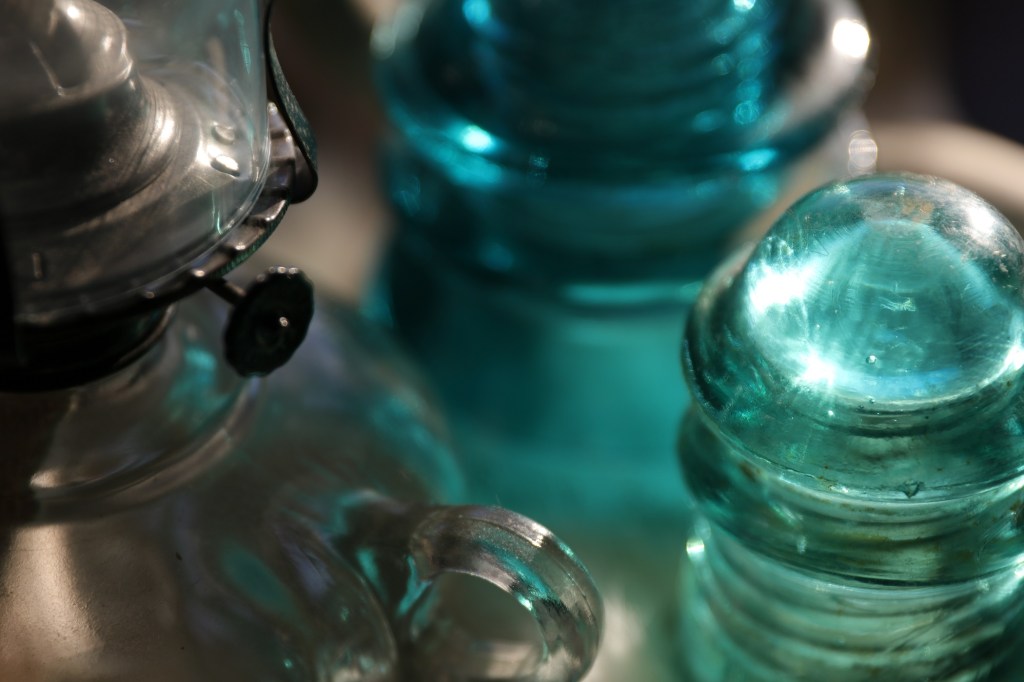
My heart has always been drawn to and touched most by those simple things. Those moments of pure sweetness. Those sights of pure beauty. A flower just so in the sunlight. An arrangement of old lanterns and colored glass on an end table. One single brightly-colored autumn tree in a sea of pines. A summer hike. A starlit snowy night. A warm cup of coffee and a cat on my lap. Wild fruit on tangled branches. A shelf lined with bright, sparkling jars of hand-harvested, homemade jam. The smell of sweat or the pages of old books. A well-lived-in home. The comfortable, worn seats of a dusty old work truck. A simple, nourishing, homemade meal.
Sin has complicated our existence. It complicates everything. It complicates love.

Compromise complicates love. Selfishness complicates love. Desperation complicates love. Fear complicates love. Mistrusting God complicates love. We strive and weep and lust and wallow in our loneliness, and think that a relationship born out of those things will bear good fruit.

But this is key: God is a God who loves us. And He is a Father who gives good gifts. He doesn’t always provide what we want or think we need. And He often uses waiting as a tool to cultivate our dependence upon Him and His goodness. He tests us with loneliness, with waiting. Will we thank Him for what He does provide, or will we be angry for what He doesn’t provide? Will we trust Him in joy and not in sorrow?
God is a God who loves us. He is also a God who doesn’t owe us anything. Any good we receive from God is good we haven’t earned, given by a Father who loves us. And any pain we receive from His hand is meant to make us more like Christ, from the hand of a Father who disciplines those whom He loves. And that pain of waiting, the pain of loneliness, the growth and humility and triumph of contentment and Christ-dependence, all serve to make God’s blessings, both the expected and the unexpected, that much sweeter. I wouldn’t know how to truly appreciate the sweetness God’s gifts if I didn’t also experience the bitterness of want. The best things wouldn’t be recognized so clearly if I hadn’t also seen those hard things, loneliness and isolation and disappointment and heartache and loss.

And so when God withholds something, we are to rejoice, and trust that He is withholding the desired object out of love for us. And when He provides, we rejoice…And then marvel at His provision.

My heart is so thankful. I am thankful that God saw fit to replace my loneliness with companionship, and my longing with love. What God provided, He provided in lavish simplicity, in abundant peacefulness. Without confusion, or question, or complication.

And it would make sense, wouldn’t it, that this simple country girl would love a simple country man?

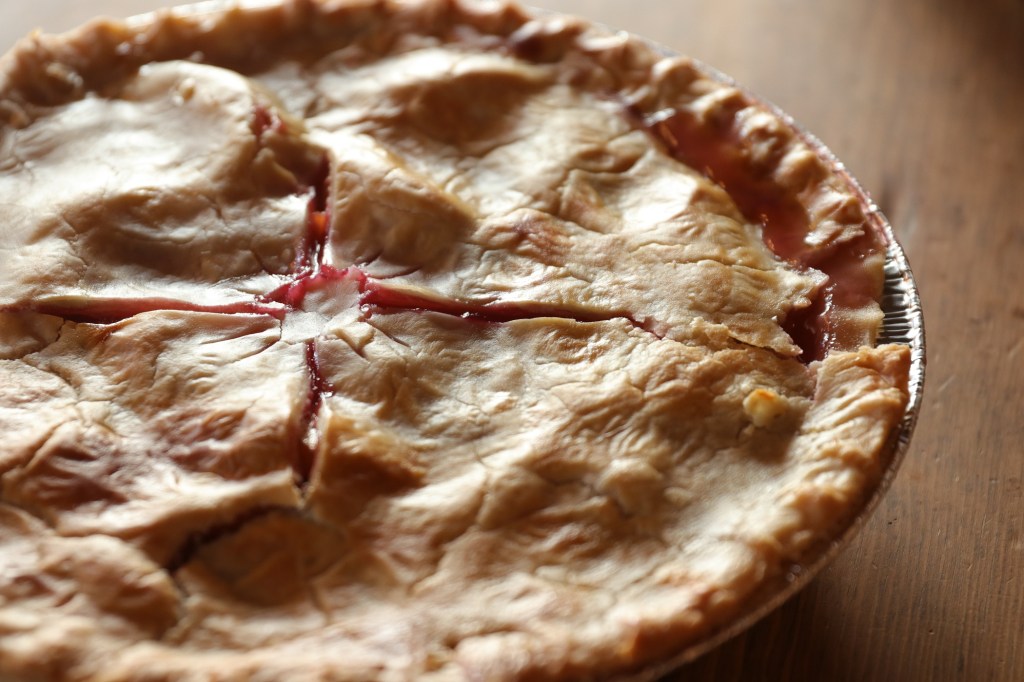
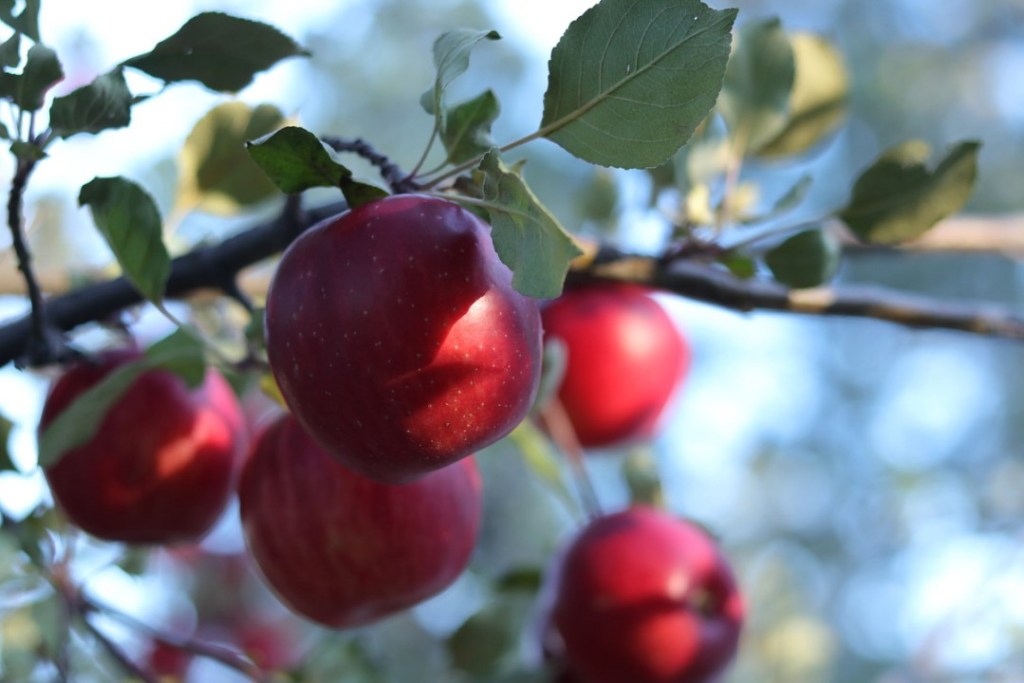
God brought love in those best things, those simple things. Seven gallons of chokecherries picked together. A freshly cemented stock tank and a little sunburn on a hot August afternoon. Countless home-cooked meals on chipped dishes. Laughter over a game of cards. Bushels of apples from my grandpa’s apple trees. Baking pies for a pie auction. Arms wrapped around me and a peck on the cheek while I’m washing dishes. A hasty cup of coffee together out of his battered Stanley thermos, with the sun just cresting the horizon. Lively banter. Tears of sorrow and of joy. Companionable, comfortable silence. Tuneless whistling from under my car as he changes the oil. His smile at me over the backs of a hundred cows. His voice beside me singing hymns in church. The warmth of his strong hand in mine, that calloused, work-weathered hand.

So this simple country girl said Yes.

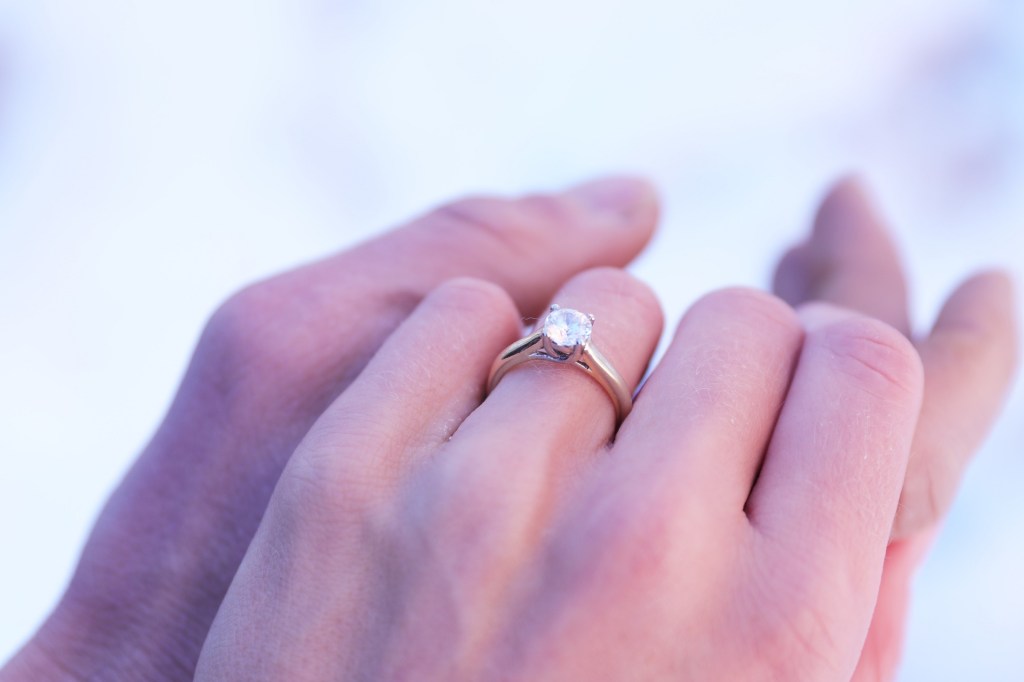
Yes, to a simple rancher man. Yes, to the best and kindest man I know. Yes, to a strong, gentle man. To a peaceful man. To a Godly man. To a flawed man with a perfect Savior. To a man who offers me his shoulder to cry on, his arms to hold me, his heart to love me, and his wisdom and faith to lead me. To my favorite person. To my best friend. To a hand to hold.
What simple love. What a kind God. What undeserved abundance.

Recipes | Ricotta Cheese

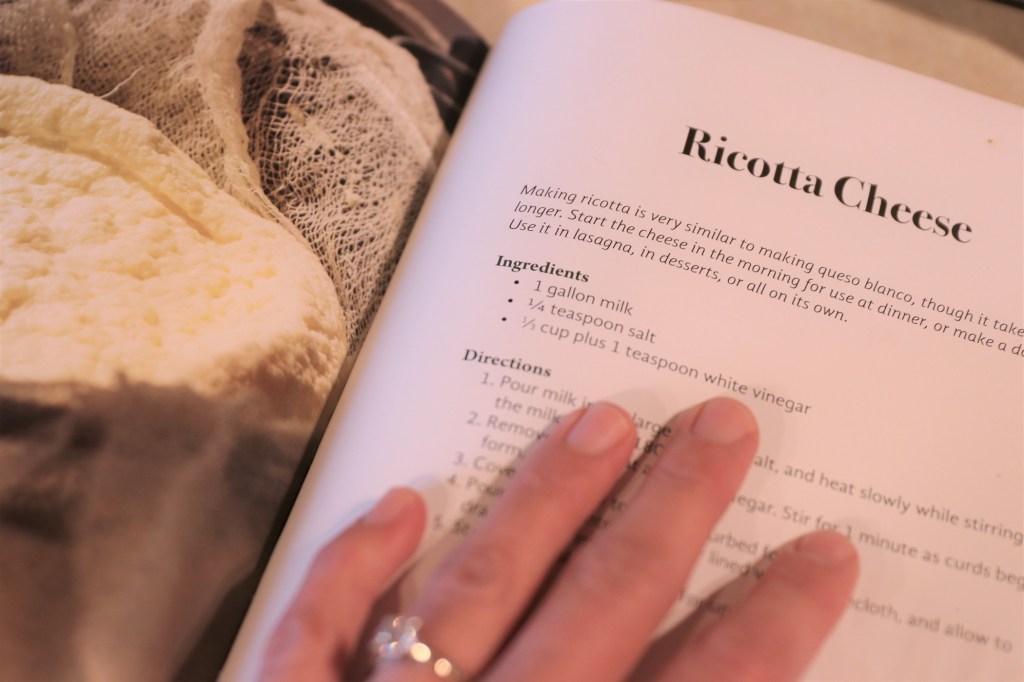
I was leafing through a book I picked up at a shop in Custer, titled The Essential Guide to Self-Sufficient Living, by Abigail Gehring. It is a beautifully curated little book, full of excellent, simple recipes and project ideas. Due to a positive Covid test yesterday, I’m now in quarantine with some time on my hands, so it was the perfect opportunity to try this easy recipe for ricotta cheese! Ricotta cheese is pretty pricey at the store, so I rarely buy it, but it is my favorite filling for crepes. Homemade crepes and ricotta cheese will be the perfect Christmas morning breakfast!

Ingredients:

1 gallon of milk
1/3 cup plus 1 tsp. white vinegar
1/4 tsp. salt

Directions:

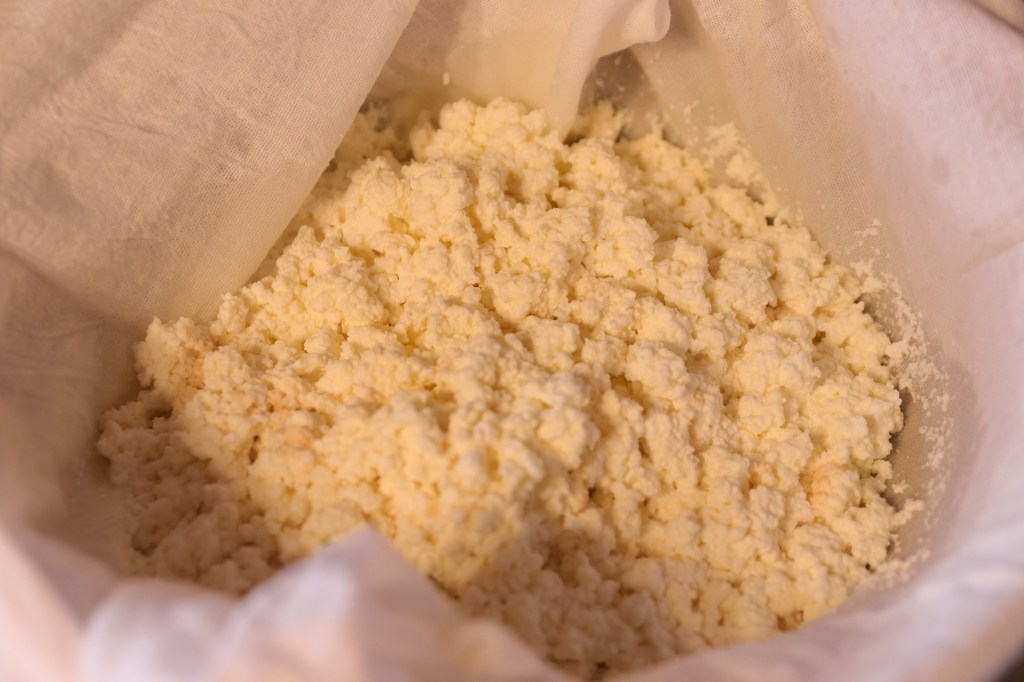
In a large saucepan or stockpot, combine the milk and salt and heat it slowly to 180 degrees Fahrenheit. I used a candy thermometer to watch the temperature. When it reaches 180 degrees, remove it from heat and add the vinegar, stiring for about a minute. Curd will begin to form and the whey will start to separate out. Cover the pot and let it sit for about 2 hours. After two hours, ladle or pour the milk mixture into a cheesecloth-lined collander. Allow it to drain for about another 2 hours. After that, it is ready to use!

Tips and Notes:

This was a very fun recipe to throw together, especially with some time on my hands, and yielded about a quart of ricotta cheese. The resulting fresh ricotta cheese has a very nice mild flavor. However, I should have drained it for less time. I think I let it sit a bit longer than 2 hours, and the curds are much firmer than I was expecting. Next time, I may let it sit for as little as 10 minutes, just to get the bulk of the liquid off, but to keep the cheese softer.

I hope you enjoy this recipe!

Sunburn and Bliss

Although I kept a great habit of hiking this winter, and getting outdoors quite a bit regardless of the temp, something magical happens when the warmth arrives. The line between inside and outside becomes deliciously blurred. I can eat outside, sleep outside, and stay outside as long as I wish to. The wind no longer bites, the cold no longer burns, and the sun no longer sets at 4pm. There is a gentleness in the wind, even when it is blowing mightily. The sun-warmed, pine-covered slopes are sweet with their resiny perfume, in a way that evokes memories and impressions of my childhood.

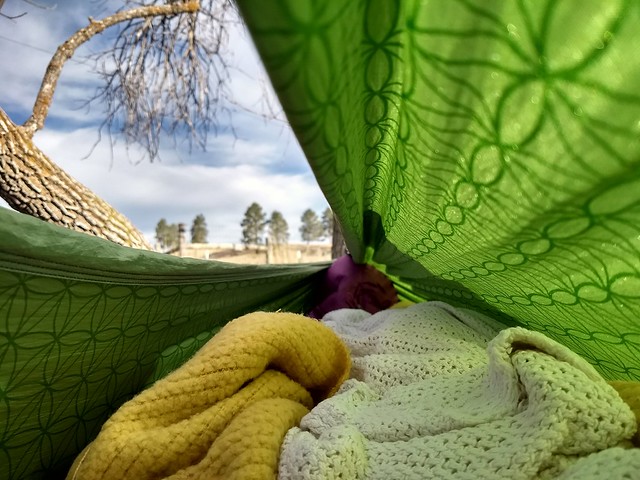
The frogs are singing in the dam, we’ve enjoyed our first thunderstorm, and I’ve fallen asleep to the sound of rain on our roof. I’ve woken up with sore muscles from strenuous hikes, sore shoulders that got a little too much sun, and taped blisters on my feet. I’ve hung clothes on the line to dry, and hammocked under the stars. Spring is finally here.2019-04-23_06-41-05After wintertime and never venturing out with fewer than what seems like a hundred layers, it is delicious to wear a tanktop and feel the breeze and sun on my arms, and get a little sunkissed, or even a little toasted. The days are longer, the nights are warmer, and it becomes more of a struggle to stay indoors.

But summer is almost here! And what means work at the greenhouse will start, teaching will be done for the season, and my life will be lived more and more outside. Which is what I love.

So I nurse my sunburns and sore muscles and wind burnt face as glorious symptoms of bliss.

Winter Gear

Over the last few years, my winter wardrobe has grown substantially and I’m just tickled pink. I tend to get cold very easily, but I also warm up very quickly once I’m moving around. It doesn’t matter how cold it is, I warm up fast when I’m moving, and over the last few years have learned some tricks of layering that have greatly increased my enjoyment of winter recreation. I thought I’d do what I’ve never done before on this blog and share some non-expert enjoyment of some gear that I’ve found that I particularly enjoy!

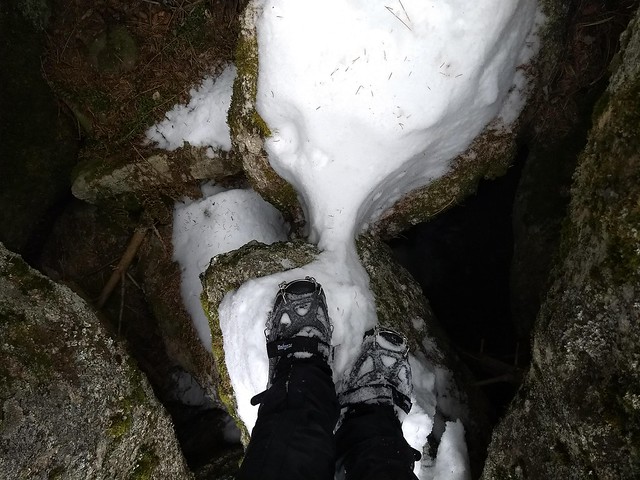
  1. Ice cleats. Last winter, I bought a pair of YakTrax walkers because I was cheap, and found out why they were cheap. Because they weren’t meant for the kind of hiking I like to do! By the end of the season, I had broken them, not beyond repair, but they were broken. So when this winter rolled around, I knew I wanted something sturdier and, as I thought about it, more aggressive. So I found a pair of ice cleats by Unigear. They aren’t as expensive as the Kahtoola brand ice cleats, and they might not be as durable, but they’ve stood up great to some of the ridiculous terrain I’ve hiked in over the last couple months, from ice covered AND bare boulders, rocks and rocky terrain, and normal winter conditions. The metal links aren’t welded, so I have had to to a minor fix job on them once, but that’s it. Their one limitation I’ve found so far is deep, sticky snow. They quickly form snowballs under the ball of the foot and the heel and make walking a little awkward, and they get heavy and fall off, in spite of a velcro tape holding them on. But I’ve used them on a number of hikes where they were indispensable, including a search and rescue effort where I was the only one on my team with cleats. Yes, people were jealous. I also have some hip issues which seem to crop up mostly in the winter, either in deep snow (because of having to step so high) or on slick surfaces (when the hips experience extra torque). Traction is very helpful in minimizing that torqueIMG_20190119_153606333
  2. Gaiters. In addition to ice cleats, another piece of gear I’ve thoroughly enjoyed this year is a pair of gaiters, also indispensable for winter hiking. Not only do gaiters keep your lower legs and boots dry, and keep snow from getting into your boots, they’re an extra layer of insulation and wind protection. I love them. They’ve made my regular hiking boots be quite sufficient for winter hiking, including in frigid temps!
  3. Balaclava. This one I discovered on a hike where temperatures hovered around 0-5 degrees Fahrenheit all day. What a difference a balaclava makes. Not only does it keep all cold air from reaching your neck and ears, but the Carhartt one I have pulls all the way up to the eyes, keeping chin, cheeks, and nose warm, and allowing you to breathe warm air. I had no idea what a difference that could make, both in terms of comfort and in terms of (for a lack of a better word) survivability.
  4. Wool socks. Most hikers already know the joys of wool socks. I just want to briefly state that the hype isn’t just hype. Its true. Wool can absorb much more water than cotton and still feel dry and warm. A great option for winter hiking. However, I’d like to bust the myth that Smartwool is the only way to go. I bought a few pairs on discount last winter, and honestly didn’t think they were that great. I found my feet to get too sweaty in them, even in the winter. The wool socks I’ve fallen in love with are the Cabela’s brand wool blend crew socks. They’re excellent. Just the right amount of insulation, and my feet don’t over-sweat.
  5. Wool mittens. When it is really bitterly cold outside, wool mittens are the way to go. I have two pairs that I found at Menards and I love them. They’re inexpensive, which is a huge plus. They’re convertible, mittens and gloves, which I like because of my photography and needing to have my hands or at least fingers free. I’ve worn them comfortably down to 0 degrees, probably colder, definitely colder with windchill, and my hands were toasty warm. And they’re roomy enough that when my fingers did get cold, I could just pull my fingers all into the body of the glove and warm them up.
  6. Waterproof pants. This is a very new one for me, but they’re super effective. Often, the snow out here is dry, rendering waterproof pants completely unnecessary if you know how to layer. But on a recent 9-day Wilderness First Responder class, we did a lot of sitting in snow and being outside in frigid temps. They recommended bringing waterproof pants or snowpants, which I was very glad I did. It made sitting in the snow and being relatively inactive in cold temps much more manageable. Waterproof often means wind resistant, which is a huge plus in frigid temps. 2019-03-16_10-56-04
  7. Hiking pack. The only reason I include this one is because of the issue of size. I bought an Osprey Sirrus 24 pack a year ago, thinking it would be sufficient for day hiking. It is. But not during the winter. It is just enough too small that for a long hike or a cold enough hike, I’d either have to skimp on water or skimp on layers. I’d rather not skimp on either. So with some Christmas money, I bought the Osprey Mira 34, which is 10 L bigger than my Sirrus 24 (and was on clearance), and really is the perfect size, AND can be cinched way down if the extra space isn’t needed.

So there you go. A non-professional’s top seven items of winter gear, which I have found to be either indispensable for winter excursioning, OR to make winter excursioning much more enjoyable! Feel free to share your favorite winter hiking gear in the comments section. I’d love to hear what others do to enjoy the outdoors in the winter!

This Fine and Pleasant Misery

Sometimes I think so long about a blog post that it becomes irrelevant. But this is one I pored over for so long, and really got such a kick out of writing it, I really do want to share it. So even though the summer is pretty much over, and temps these days are hovering in the 70s in general, or lower, I remember the following events from this summer keenly. And even though the summer is over, the sentiment still remains. I hope you enjoy the article!

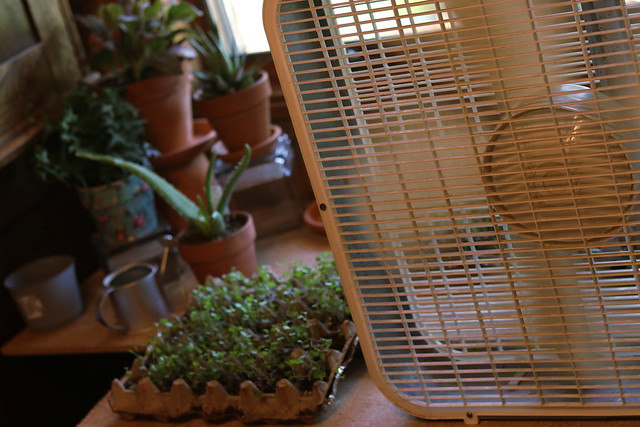
When the indoor thermometer is reading 85 degrees and the humidity is somewhere near 70% and I’m about to head to bed, or I’m dripping sweat (literally) while washing the dishes, it is awfully tempting to complain. And it has sure been tempting to complain. The last few days haven’t been just hot (for the Black Hills), they’ve been muggy. I’m a cool weather person, but eighty-five degrees is generally pretty nice, and even 90 degrees isn’t terrible, but with the current humidity, 85 indoors feels like a sauna. It is ridiculous. Miserable, actually. We make good use of our box fans.
IMG_9013eIn spite of the heat and the exquisite misery of working or even just walking around in said moist cloud of heat the last few days, I have found myself thankful for our lack of air conditioning. It is a whole lot easier to put up with exertion in summer heat when one is unaccustomed to air conditioning. Truly. My truck lacks it, my cabin lacks it, my church lacks it, and I work (and play) outside. It is also a lot easier to convince myself to stay outside when it isn’t much better inside. Sometimes it’s worse.

But those aren’t the only reasons I’m thankful for lack of air conditioning.

(“Why in the world is she writing about air conditioning?” you’re probably asking yourself by now. Fair question. Keep reading.)

I’m thankful because comfort is so prosaic and lack of air conditioning is such a trivial discomfort.

(“Okay, prosaic? What does she mean by that?”)

Prosaic: unromantic and commonplace. Yes, I’m a romantic at heart. And by romantic, I don’t mean a chick-flick kind of romantic. I mean more…I don’t know…a Lord of the Rings or Master and Commander kind of romantic.

Think of your favorite book. If the protagonist had stayed comfortable, the story would never have happened. Think of the most exciting times in history, when change was happening and people were adventuring and exploring and discovering new things. If they had chosen comfort, physical or otherwise, those events never would have happened.

Air conditioning isn’t just about our temperature preference. Sixty or seventy years ago, air conditioning was essentially nonexistent. And people dealt with the heat. But we’ve changed. Being comfortable has become a priority.

Our culture idolizes comfort. And of course I’ve fallen victim to this myself. We like to be comfortable, and we like to be comfortable now. (Too hot? Turn on the air. Too cold? Turn on the heat. ) But it goes deeper. We don’t like the discomfort of being inconvenienced (I’ve written about this before in my post “The Freedom of Inconvenience”). We don’t like hurting. (Headache? Here’s a Tylenol.) We don’t like being exhausted. (Coffee, coffee, coffee.) We don’t like being hungry or thirsty. (Easy access to food and water all the time.)

Something about how comfortable we are in general makes me uncomfortable. Because we as a culture have gotten soft. Terribly soft.

But it isn’t just physical discomfort we avoid. We don’t like being afraid. We don’t like feeling or looking foolish. We don’t like being wrong. We don’t like people thinking we are wrong. We don’t like being uncertain. We’re afraid of having too little, failing too hard, hurting too much, sweating too profusely, and of feeling too much.

In general, we don’t know what it is to struggle or to face real fear. We read stories of deployed service members, or missionaries in third world countries and we shake our heads in sympathy, but we are so disconnected from the reality of their struggles, we can’t relate! We value comfort and pleasure and those are what we pour our energies into achieving. We’ve lost our enjoyment of or appreciation for or satisfaction with doing hard things that leave us exhausted and hurting, or emotionally drained. We’ve lost our satisfaction in sweating and working with our bodies.

So we take no risks, we don’t push ourselves, we don’t try new things, and we avoid situations that have the potential to cause any of those fears or feelings I just listed.

Because in a nutshell: we don’t like being uncomfortable.

How much we miss.

This year has been a growing time for me in this regard. I’ve faced some fears head-on – fears of being uncomfortable (physically, mentally, emotionally), fears of being thought to be foolish, fears of looking stupid and failing, of hurting, of exhaustion, fears of being out of place and out of my league and in over my head. I’ve faced my natural dislike of discomfort and embraced it, only to discover that the discomfort I feared has been significantly overshadowed by the satisfaction of doing something hard and doing it with enthusiasm.

If you’ve never read any Pat McManus, now is the time to change that. Some dear friends of mine introduced me to his book, A Fine and Pleasant Misery, in which he writes with clever dryness in Chapter 1 about how the point of camping used to be the misery, and being able to share misery stories afterwards. It used to be the roots in the back, the smoke in the eyes, the mosquitoes and cold and waking up wet. It was miserable, of course. That was part of the fun. Yet camping has evolved to be something where people leave their comfortable homes in their comfortable cars to go on a comfortable camping trip, somehow trying to avoid all the discomforts that naturally should crop up when leaving the comforts of home.

When did we as a culture collectively lose our taste for misery, our tolerance of discomfort, our enjoyment of the hard challenge? When did comfort become the priority? Now, maybe to a certain extent I’m romanticizing the 19th century, my favorite time period, the era of pioneers and mountain men and cowboys and explorers and miners….But think about the pioneers. Those were average families, they weren’t adventurers by trade. They packed up what few belongings they had and their whole family into a rattletrap covered wagon which became their home. For months. They slept on the ground. They walked hundreds of miles. They sweated. They were hungry. They went without. They were sunburned and windburned and freezing cold. They were uncomfortable, in ways most of us can only try to fathom. But they did it. Because there was something they desired more than comfort.

I’m tired of comfortable. I want to sweat, to be sore, to feel, to fear, to ache, to be bone-tired, have burned skin, a messy ponytail, a muddy, sweat-streaked face, dirt under my fingernails, and strong muscles. I love doing something abnormally strenuous and waking the next morning feeling like I’ve been hit by a truck. I love the sense of satisfaction when I realize what I’ve put my body through and that I actually survived and feel better for it. I could have avoided the discomfort, avoided the risk, and missed out on that delightful taste of satisfaction.

And so I come in from the garden, mopping sweat from my face, I look at the thermometer outside and the thermometer inside and groan a little, and see all the little nasty bugs swarming around our kitchen light (they migrate to my bedside table as soon as the downstairs lights are off and my bedside light is on), I feel the trickle of sweat while doing dishes, and I smile wryly. I’m thankful for discomfort.

Thankful for this fine and pleasant misery.

$5 Date

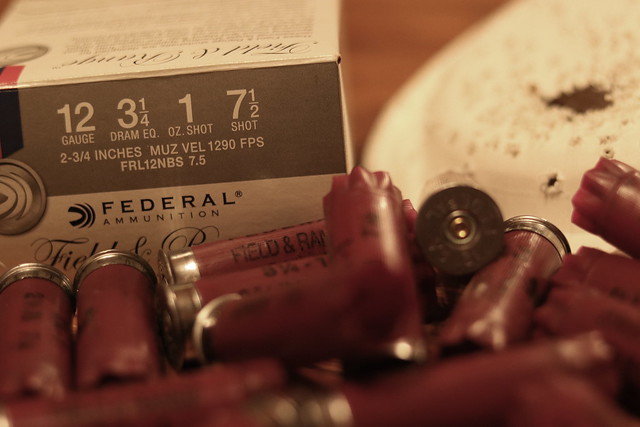
We don’t need to go far to have a daddy-daughter date. I may be grown up, but my dad is still my man. A $5 box of shotgun shells, Dad’s 12-gauge shotgun, some paper plates, and an old, dead tree made for a pleasant end of the evening. Kind of felt sorry for the tree, but it was dead already.
IMG_9030eGrowing up in Illinois, we never got to do much shooting. Gun ownership is kind of a hot topic, and firearm ownership is complicated by the FOID card, which is an Illinois-specific form of gun registration. Living in town was an added complication. Opportunities to learn the fine skill of marksmanship were essentially nil. And any use for self-defense would probably have resulted in jail time. And I’m only kind of kidding.

South Dakota is another story. Open carry is permitted, concealed carry permits are easy to come by ($10 cash to the sheriff), and gun ownership and firearms proficiency are well accepted in this independent, rural, conservative state. So I’m slowly working my way towards proficiency. And for two single girls living rurally, that’s a good feeling.