Let it Snow

Originally printed in the Jan/Feb 2026 issue of Down Country Roads Magazine

In the dreary midwinter months, I can’t ever quite put my finger on it, on what makes it so special, but there is something about a snowfall day that feels like a holiday. Having left the brightness of December behind, the series of festivities that leave the heart merry, January and February can stretch on eternally into an expansive dreariness, hard on the eyes and heavy on the heart. But at the first light sight of a fresh, heavy snow sifting down, gently swirling in a lightening sky, something in me lightens as well.

Yes, there can be the dreaded storms that are termed “calf killers,” particularly in March and April (which also happen to be the storms that fill dams, and ready the ground for growing grass, and do a world of good on a ranch), and there can be the similarly deadly or just plain miserable cold snaps, where temperatures plummet for days or weeks on end.

But then there are those midwinter storms, with the grey, heavy sky, clouds seeming to rest in the tops of the trees, and the million flakes tumbling, floating, whirling earth-ward, like downy feathers or falling stars, without wind, with a friendly sort of cold. The settling peace is almost overwhelming, the whiteness dazzling, as a transformation happens to the dreary, midwinter world.

Maybe it is simply the welcome interruption to the daily, winter routine – From dusting the vehicles off to shoveling the deck to stomping a trail down to the barnyard to do chores, snow creates an interruption, and jars us out of routine.

Maybe it is the complete and utter transformation of a bleak midwinterscape – Brown hillsides are beautified, with snow to soften the contours; dirty corrals and calving lot are made momentarily clean, with snow to keep the dust down; barren branches of oaks and cottonwoods, piled with snow to hide their barrenness – All is made gentler, softer by a fresh layer of gleaming white.

Maybe it is the heightened awareness of the otherwise invisible – Winding ribbons of a deer trail that appear in that first dusting; drab little birds dipping and diving around the feeder, feathered acrobats that normally fade into a weary, winter backdrop; the tiniest trails of tracks in the snow, from clump of grass to stump to rockpile, evidence of the invisible lives of field mice and rabbits and other mundane critters; bright blue of a jay, cheerful against the white; shreds of threads of the autumn’s last spider webs under the eaves, gathering flurries.

Maybe it is the recollection of the enchantment of childhood, hours spent outside as the snow piled up, snow angels and snowball fights, snow forts and snowmen, until fingers and toes were numb and nose was red.

Whatever it is, whatever the cause, there is magic in a midwinter snow.

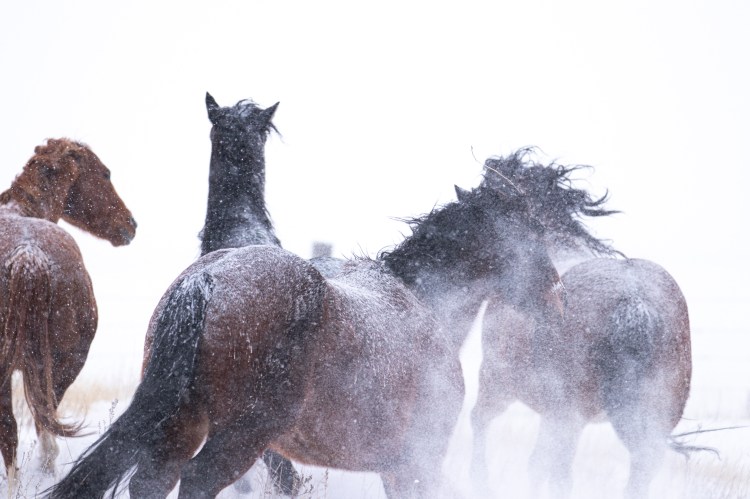
Swirling eddies dance against the barn and the shop and the chicken coop, depositing drift upon drift upon drift, and heavy chore boots swish softly through the fresh-fallen snow. Chickens wade comically through the snow as it deepens, breaking their own little path to the water tank down below, or their favorite spots around the yard. The geldings kick up their hooves and create a ground blizzard, dashing through the snowy pasture, a little extra vim and vigor, a little extra fire smoldering cheerfully in the mild-mannered critters. Such a snow transforms everything.

And from the indoors looking out, at the snowglobe world, shaken and all stirred up? Warmth feels warmer, coziness feels cozier, and an hour with a book is sheer delight.

Spring will come soon enough. So, let it snow!

Ranch Wife Musings | The Things that Never Change

Originally printed in the Custer County Chronicle 12-3-2025

At possibly no other time of the year than now does the whole of society seem to move faster, more frantically, with hardly the time to stop and catch a breath. Shopping malls are a zoo, parking lots are packed, and the post office is drowning in an endless stream of packages shipping to people who don’t like shopping malls and packed parking lots. There is constant pressure to fill the schedule, to overspend, to one-up last year’s festivities with something new and exciting.

No sooner do we finish bowing our head in gratitude on Thanksgiving Day than a frenzy of consumerism takes over – not just material consumerism, but consumerism with regards to entertainment, food, anything that tickles our fickle fancies. We are pressured by advertisements and billboards and social media influencers and the comparison game to chase after those things that are novel and new, that next dopamine hit, the next picture to share on social media, the next experience to boast about.

None of which can infuse meaning into life, or a season, or a holiday. But we try, don’t we? And where does it get us?

Not that there is anything wrong with new experiences, and I enjoy Christmas shopping and wrapping gifts, and gifting to loved ones things that are special or needed. But in my experience, it is never the “new” that makes the season memorable. It is the same things, again and again, that make the season memorable and special. We are indeed creatures of habit, and something in us needs that sweet sameness.

The sound of a bell ringing and the red kettle at the door of the grocery store.

The same outing to cut a Christmas tree.

The same ornaments as last year, familiar and comforting, maybe a little worn and faded.

The same Christmas songs we’ve been singing for decades, generations, and longer.

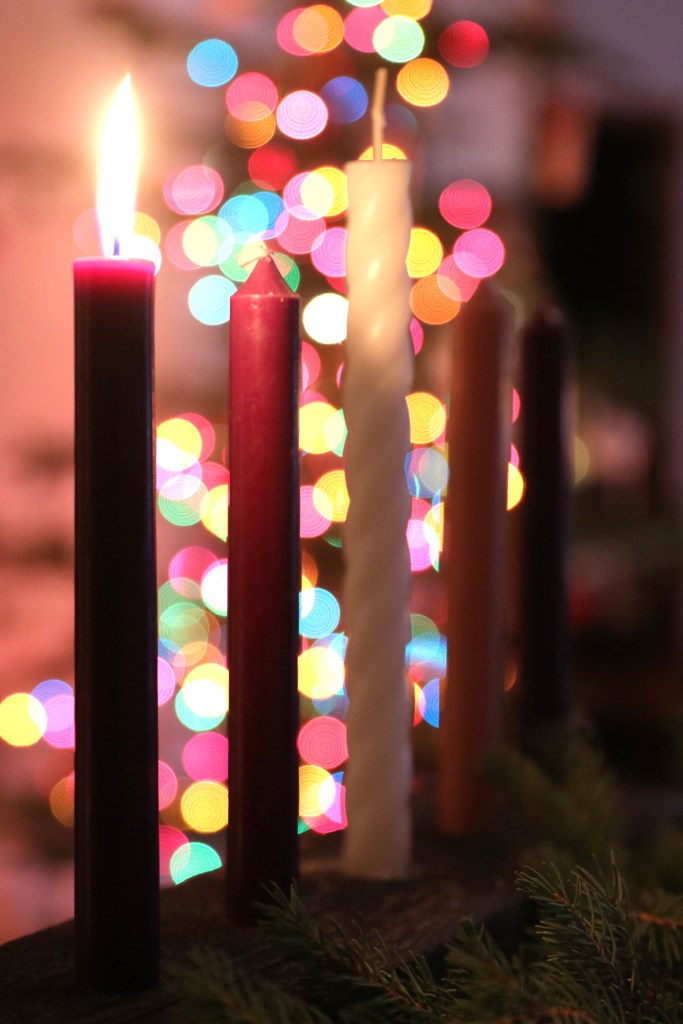
The Advent candles, the same ones that we burned last year, and the year before, and the year before.

The same handful of traditional gatherings, whether it is caroling or that certain Christmas party, or a live Nativity, or a candlelight service.

The same hodge-podge, maybe even shabby, costumes in the children’s Christmas pageant.

The same foods as every year, traditions handed down generation to generation – pfeffernusse, pickled herring, oyster stew, turkey, gingerbread.

The same faces around the table.

The same enchanting stories, the same handful of favorite Christmas movies.

And of course, last but certainly not least, the same Story. The story of the greatest rescue ever launched, the greatest love story ever told, with those wonderful details that can become mundane and overlooked if we aren’t careful. The obedience of Mary. The faithfulness of Joseph. The humility of the birth of the Savior. The excitement of the Shepherds. The wonder of the Magi.

In a season of chasing new and different, it is the steady and same that keeps us grounded, connected to reality, and connected to truth.

This last month has been something of a time warp for me, with a fresh newborn and life already going faster than I want it to, in a slow mornings and baby snuggles kind of a way. This Christmas and Advent season will look a little different than it has in the past. It will be simpler. Quieter. Softer. Fewer bells and whistles. But the things that stay will be the things that truly matter, the things that point us Heavenward, and pull us closer together as a family, but also closer to our community and church.

It takes intention. It takes deliberate thought and action. But this time of year doesn’t have to be an overwhelming whirlwind.

So find those things that help you to slow down and savor the time, rather than simply surviving it. If you don’t have family traditions, make a few, carefully and with thought. Read a book for Advent. Let Christmas music play in the background throughout the day. Find a live Nativity to go to, or a Christmas Eve service. Bake cookies for your neighbors. Call your aunt and get that favorite recipe from your younger years. Read Luke’s account of the birth of Christ.

It isn’t the newness that makes Christmastime special. It is the sameness. The steadiness. The unchangingness of it all. Dig in to that sweet sameness.

We need those things that never change.

Ranch Wife Musings | The Little Things More than Ever

Originally published in the Custer County Chronicle on December 4, 2024

We cut our Christmas tree over the weekend, a cherished tradition that ushers in the Christmas season, and which brings more delight, not less, the older I get.

As we decorated the tree, the various ornaments brought to mind family members and friends, special occasions or notable years. “Our first Christmas as Mr. and Mrs.” Wooden disks with music notes burned into them from my sister. The yarn ball ornaments that an aunt brought back from her travels in South America, and an adobe Nativity ornament. The little stocking with “Brad” written down the front. There are dozens of tiny brass bells from our wedding—our kissing bells. Lace-like snowflakes remind me of the crocheted ones that hung on the tree in the sanctuary at the Little White Church as far back as I can remember, back when my grandparents were alive and we all went to the candlelight service together.

Each year of adulthood, and more so since getting married, it is the little things come to mind, always the little things, seemingly insignificant threads in the celebratory tapestry. And it is the little things more than ever.

Our cultural observance of Christmas tends to get lost in a sea of haphazard attempts to create meaning and artificially bolster the spirits, with a full schedule that empties us, a helter-skelter array of engagements and efforts that lack real significance, parties and shopping sprees and things meant to create memories but become part of a holiday muddle that everyone is relieved to see end, if not on December 26th, then for sure by January 1. Christmas becomes nothing more than a consumeristic free-for-all, spending money we don’t have for gifts no one needs trying to create a happiness no one really feels. What has fallen by the wayside or out of fashion or favor are those traditions and rituals that effortlessly made up the Christmas season, things that you did because your parents did them, because their parents did them. The repetition through the years is what creates the beautiful memories, not the novelty of them, not the monetary value or the social capital.

It is the little things, more than ever.

The cherished recipes, like the pfeffernusse my Grandma made, now a staple in my Christmas baking and gifting, a tin of which was passed around the long wooden table after every meal at Christmastime.

The old-fashioned heirlooms, like the Fontanini creche that was my Grandma’s, identical to the one my mom had when I was growing up, and is now a treasure in my home.  

The rituals, like watching It’s a Wonderful Life, the first movie my now husband and I ever watched together, or observing Advent, through devotional readings and lighting candles and special services at church.

The music, like the beloved carols and hymns, or the Mannheim Steamroller CD that we listened to a million times growing up. I found a used one last month, the same album, and listening to it takes me back to my teenage years, and the 1000-mile Christmas drive to visit my grandparents here in the Hills, crammed like sardines into our minivan, finally coming to rest at the top of a ponderosa-covered hill, where sat my grandparents’ rustic home. I can still see Grandma waving from the deck as we tumbled out of the van, I can see the lights wrapped around the railings and banisters, and can hear the precious, rather electronic-sounding carols from the bells hung above the door. And I can still hear Grandpa’s signature, “Hello, old scout!”

The simple expressions of love, like the brown paper packages tied up with strings, humble gifts tucked beneath the boughs of the tree, handmade, practical, heartfelt.

The fellowship and worship, like sitting in the glow of 100 little candles on Christmas Eve, feeling their soft warmth, gently singing “Silent Night” with 99 other voices, and being transported to a dozen other candlelight services over the years, recalling faces now absent, hearing voices long silent, feeling the shoulder-to-shoulder comfort of long drives in the dark before finding ourselves in the brightness of a celebratory church.

Those things – the trees, the favorite foods or the cherished decorations, the music, the celebration and the memorialization – mingle to create a wholeness this time of the year, and continuity from year to year. They aren’t novel, they aren’t new or unique, but those things can’t be replaced, because it isn’t about the things themselves, but how they connect us to our families here and gone, to our communities and churches, and ultimately how they draw our minds and hearts to the meaning of the Christmas season.

Children are eager for Christmas morning, for obvious reasons, and would I think happily skip from now to Christmas Day. But age teaches you something. It teaches that it is the little things that give the meaning and the joy and the delight to the season, as to life itself. The little things, because they remind us, over and over again, of the true meaning, the Person to whom this season is owed, for Whom this season is celebrated. It is the little things, more than ever.

Advent 2023 | The Joy Candle

Adapted from last year’s devotional article.

Joy. It is impossible to read the Christmas story without being struck one overarching emotion in the text of the Gospels, one overarching response to the birth of the long-awaited Messiah. He was looked forward to with joy. He was awaited with joy. And for many, he was received with joy. Joy is just bursting out of the pages of Scripture.

The third candle of Advent, pale pink, is the Joy Candle.

But what is joy?

Built right into the fabric of our culture is the familiarly stated “pursuit of happiness.” For too many, and in our modern and Godless understanding, it means a reckless chasing after pleasant emotions, and it might be that Christmastime is the biggest evidence of that in our culture. “The pursuit of happiness” is used as the excuse for all kinds of excess, all kinds of self-gratification. The month of December is full of parties and gift giving and entertainment and good food and vacation and this, that, and the other thing, all with the excuse of “celebrating Christmas,” or maybe just celebrating “the holidays” in general.

People tend to conflate joy and happiness, and also to lean on happiness (and so in their minds, joy) as the end result, as the thing to be pursued. But the sad fact of the matter is, happiness is fleeting in this life. It is not an end in an of itself. If we make that our goal in life, we are going to fail, and fail miserably. We may be able to conjure up happiness that lasts for days or weeks or even a year, but something will happen that will shatter that sense of happiness, and then what?

For Believers, we need to have a more robust understanding of this all-too-misunderstood word. We need to understand that joy, Biblical joy, isn’t the flat and fleeting emotion of mere happiness, but it also isn’t a forced smile when the world is falling apart around us.

Joy isn’t conjuring up fluffy, giddy emotions in the face of horror. While there is nothing innately wrong with happiness, happiness is circumstantial, an emotional response to something, whereas joy is a heart-level contentment and peace and gladness and so much more. It is unrelated to circumstances.

For the Believer, it also is worth stating, joy shouldn’t be the goal. If joy becomes the aim, joy will be ever evasive. The goal is Christ. The goal is the pursuit of righteousness and holiness. The old catechisms nailed this from the outset of their questioning: “What is the chief end of man?” they ask. “To glorify God and to love Him forever,” is the reply.

For the Christian, joy is a fruit that comes when we are viewing God, ourselves, and our life correctly. “Count it all joy, my brothers,” James writes, “when you meet trials of various kinds. For you know that the testing of your faith produces steadfastness.” (James 1:2-3) Joy is independent of and contrary to circumstance. Joy happens in the hearts of those who can look beyond the painful circumstances they are in, and see the expected result. Steadfastness. Greater faith. Ultimately, perfect fellowship with God in Heaven. A joyful heart is a hopeful heart. And a hopeful heart is a joyful one.

Biblically, we see joy as a response to God, to His blessings, and to His salvation in our lives, and we see it paired again and again with thanksgiving to and worship of God. We see joy as a gift, given by God to those He loves. The Psalmist credits the LORD with the joy in his heart: “You have put more joy in my heart than they have when their grain and wine abound.” (Ps. 4:7) And we also see joy as a fruit, a natural result of faith. “The fruit of the Spirit is love, joy, peace, patience, kindness, goodness, faithfulness, gentleness, self-control; against such things there is no law.” (Gal. 5:22-23)

But I think there are two facets we fail to really understand.

First, that joy, while it is a gift and a fruit and a natural response, is also a command. Throughout Scripture, God’s people aren’t asked or recommended to rejoice. They are commanded to do so!

Rejoice in the Lord always; again I will say, rejoice! (Phil. 4:4)

Rejoice in the Lord, O you righteous, and give thanks to his holy name! (Ps. 97:12)

Be glad in the Lord, and rejoice, O righteous, and shout for joy, all you upright in heart! (Ps. 32:11)

“You shall rejoice. You shall rejoice. You shall rejoice!” echoes through the Old Testament Law.

The command to rejoice is similar in tone to the command to give thanks, sometimes happening simultaneously, but both overflowing with a sense of overwhelming wonder and awe and exuberance: “Give thanks to the LORD, for He is good and His steadfast love endures forever!” is a refrain that occurs numerous times in Scripture and should be the refrain of the Believing heart.

A joyful heart is a thankful heart. And a thankful heart is a joyful one.

The second facet I believe we miss is that while it is a gift, a fruit, a response, and a command, it is a decision. Sure, there are times in our life when joy just comes naturally. There are times when we are joyful and the only reason we can give is that God put that joy in our hearts and it is just overflowing. But more often than not, in my experience, we aren’t just bubbling over with joy we can’t explain. I love this passage from Habakkuk, such a gritty and beautiful and realistic picture of what joy often looks like for the Believer:

Though the fig tree should not blossom,
    nor fruit be on the vines,
the produce of the olive fail
    and the fields yield no food,
the flock be cut off from the fold
    and there be no herd in the stalls,
yet I will rejoice in the Lord;
    I will take joy in the God of my salvation.
God, the Lord, is my strength;
    he makes my feet like the deer’s;
    he makes me tread on my high places. (Hab. 3:17-19)

I can just hear him saying, “I will. I will. I will rejoice. I will take joy. Though everything around me should turn to dust and ashes, I will rejoice. God is good.”

This is a decision we make with intention, starting when life is going well, but to the end that we are tuned to rejoice so when life gets hard, as it will. “Come thou fount of every blessing,” the song goes, “tune my heart to sing thy grace.” We make a decision to rejoice, and over time we can tune our hearts to a song of rejoicing that holds its sweetness even in the midst of the worst of circumstances.

But how? How do we do that? How do we listen to the command to rejoice and then truly rejoice? And why do we fail?

All too often when we fail to accept the gift of joy, or fail to produce the fruit of joy, when we fail to respond with joy to our Heavenly Father, and fail to accept His gift of joyfulness…it is specifically because we are failing to lift our eyes above our petty circumstances, failing to see beyond our own fickle emotions, failing to look above these circumstances that are so temporary to something sure and certain. We let our gaze be pulled down from of Heaven’s glory and into the mire and muck of this world that can be by turns so ugly and so beautiful, and we fail to count it all as filthy rags in comparison with beholding Christ the King in His beauty.

Whatever is true, honorable, right, pure, lovely, whatever is commendable and excellent, let your mind dwell on THOSE things! (Phil. 4:8) Christ is true! He is honorable and right and pure and lovely! He is excellent and commendable! We must set our minds on Heavenly things, not earthly (Col. 3:2), “looking to Jesus, the founder and perfecter of our faith, who for the joy that was set before him endured the cross, despising the shame, and is seated at the right hand of the throne of God.” (Heb 12:2)

Because joy isn’t about circumstances. It isn’t about persuading ourselves to feel happy. It is about a Person. It is about that king, humble, bringing salvation, the one who rode into Jerusalem on a donkey’s foal. It is about that king, not yet born, whom Mary was carrying when she rode the donkey to Bethlehem and there gave birth in a stable. It is about answers to prophesy and longing hearts restored, it is about God choosing to redeem a broken world for His glory. It is about that God, who humbled Himself to be born our Savior. It is about that Savior, that Baby, that angels proclaimed and shepherds rejoiced to see, whom Magi worshipped with kingly gifts, rejoicing that they had found Him. It is about receiving a gift, and responding in praise and thanksgiving, and growing in our contentment and confidence in our King. It is about obedience, it is about choosing to wake up every morning with these words on our lips: “This is the day that the Lord has made; let us rejoice and be glad in it!” (Ps. 118:24)

Rejoice greatly, O daughter of Zion! Shout aloud, O daughter of Jerusalem! Behold, your king is coming to you; righteous and having salvation is he, humble and mounted on a donkey, on a colt, the foal of a donkey. (Zech 9:9)

So look to Jesus, friends. If your heart is heavy, look to Jesus. If your soul needs comforting, look to Jesus. If joy seems fleeting, look to Jesus. The same King who numbers the stars and knows their names is the same who heals the brokenhearted and binds up their wounds. (Psalm 147:3-4) He is the same King who taught that those who mourn are blessed, because they will be comforted. (Matt. 5:4) And as we approach Christmas Day, look to the Child in the manger. Marvel with the shepherds. Rejoice with the Magi. And then look forward confidently to a Second Advent, when

the ransomed of the Lord shall return
    and come to Zion with singing;
everlasting joy shall be upon their heads;
    they shall obtain gladness and joy,
    and sorrow and sighing shall flee away. (Isaiah 35:10)

Advent 2023 | The Peace Candle

Originally published for last year’s Advent season.

The second Sunday of Advent finds us lighting the second candle of the five, the second purple candle, the Peace Candle. What a word for such a time as this. What a desperate need. What a hunger. People long for peace. I long for peace.

Internal, personal peace.

Relational peace.

Peace within my family.

My community.

My state.

My country.

The world.

So much of the brokenness I see around me can be described as a lack of peace. People experience brokenness in their relationships and instead of mending the relationships they shut people out. People turn to “spirituality,” or “mindfulness,” or “self-care” for some sort of peace. People turn to drugs and alcohol. People turn to disordered sexual relationships. Countries try to legislate peace by quenching dissenting voices. Churches try to have peace with the world by compromising on God’s standards. Wars are fought in an effort to find some sort of peace internationally. Treaties are made and broken. Relationships are cut off and destroyed. Where is the peace we so desperately want and need? And why can’t people find it?

Jeremiah 6:13-15 reads:

“For from the least to the greatest of them,
    everyone is greedy for unjust gain;
and from prophet to priest,
    everyone deals falsely.
They have healed the wound of my people lightly,
    saying, ‘Peace, peace,’
    when there is no peace.
Were they ashamed when they committed abomination?
    No, they were not at all ashamed;
    they did not know how to blush.
Therefore they shall fall among those who fall;
    at the time that I punish them, they shall be overthrown,”
says the Lord.

This lack of peace is thousands of years in the making. When Adam and Eve sinned, when they listened to the lies of Satan and took forbidden fruit in the Garden, spitting in the face of God, their Creator, Master, and Friend, they ushered sin and unrest into this world. Their peace with God was destroyed. Their peace with one another was destroyed. The most perfect marriage of all became fraught with blame-shifting, anger, and unrest. How they would have longed for peace. And ever since then, we as the human race have experienced the peace-killing effects of sin, both our own sin and the sin of others.

This passage in James sums it up succintly:

What causes quarrels and what causes fights among you? Is it not this, that your passions are at war within you? You desire and do not have, so you murder. You covet and cannot obtain, so you fight and quarrel. You do not have, because you do not ask.  You ask and do not receive, because you ask wrongly, to spend it on your passions. You adulterous people! Do you not know that friendship with the world is enmity with God? Therefore whoever wishes to be a friend of the world makes himself an enemy of God. (James 4:1-4)

We cannot have peace if we are at enmity with God. Period. And without peace with God, we won’t have peace within our own hearts. And enmity with God can look as unremarkable as unrepentant sins in our lives or as horrifying as mass-murder. Sin, our own sin regardless how “big” we deem it, causes our lack of peace.

Ultimately, the peace we need is peace with our Creator.

People look at our world and the chaos contained in it and imagine that we can just pull ourselves together to muster up peace, or that we can legislate it, or evolve into it. But we are so broken, we don’t just need an attitude adjustment. We need a radical change in our very nature. The peace that we need is a peace that can only come through the Holy Spirit’s work in our hearts, regenerating, restoring, and renewing.

Over and over in the New Testament, we see peace as a work of the Holy Spirit, as a fruit of faith in our lives, and we see it paired with love, with joy and thanksgiving, with a “putting on” of righteousness and a “putting off” of those things which displease God. Look at the following passages:

Rejoice in the Lord always; again I will say, rejoice.  Let your reasonableness be known to everyone. The Lord is at hand;  do not be anxious about anything, but in everything by prayer and supplication with thanksgiving let your requests be made known to God. And the peace of God, which surpasses all understanding, will guard your hearts and your minds in Christ Jesus. Finally, brothers, whatever is true, whatever is honorable, whatever is just, whatever is pure, whatever is lovely, whatever is commendable, if there is any excellence, if there is anything worthy of praise, think about these things. What you have learned and received and heard and seen in me—practice these things, and the God of peace will be with you. (Philippians 4:4-9)

For where jealousy and selfish ambition exist, there will be disorder and every vile practice. But the wisdom from above is first pure, then peaceable, gentle, open to reason, full of mercy and good fruits, impartial and sincere.  And a harvest of righteousness is sown in peace by those who make peace. (James 3:16-18)

I love that passage. “A harvest of righteousness is sown in peace by those who make peace.” What a beautiful picture! Righteousness and peace being sown and harvested.

Put on then, as God’s chosen ones, holy and beloved, compassionate hearts, kindness, humility, meekness, and patience, bearing with one another and, if one has a complaint against another, forgiving each other; as the Lord has forgiven you, so you also must forgive.  And above all these put on love, which binds everything together in perfect harmony.  And let the peace of Christ rule in your hearts, to which indeed you were called in one body. And be thankful. (Colossians 3:12-15)

Through Jesus’s redeeming life and death, we can experience peace with God, and so we can, through God’s work in our hearts, experience peace in this life. As Believers, we are called to peace, to live peacefully with one another, to love one another and care for one another, in a beautiful earthly picture pointing forward to a permanent, perfect peace.

The wolf shall dwell with the lamb,
    and the leopard shall lie down with the young goat,
and the calf and the lion and the fattened calf together;
    and a little child shall lead them.
 The cow and the bear shall graze;
    their young shall lie down together;
    and the lion shall eat straw like the ox.
 The nursing child shall play over the hole of the cobra,
    and the weaned child shall put his hand on the adder’s den.
 They shall not hurt or destroy
    in all my holy mountain;
for the earth shall be full of the knowledge of the Lord
    as the waters cover the sea.

In that day the root of Jesse, who shall stand as a signal for the peoples—of him shall the nations inquire, and his resting place shall be glorious.

This passage in Isaiah 11 looks ahead to Jesus’s second coming, to His second Advent, and the picture it paints is one of the glorious, perfect harmony of Eden, perfect, unblemished peace, before Adam and Eve destroyed the peace that God had created. If you are feeling the effects of your sin this season, look to Jesus, who alone is able to reconcile you to your Heavenly Father. If you are feeling the effects of relational strains, look to Jesus, who perfectly bore and forgave the sins of those around Him. If you are fearful of the future, look to Jesus, who is your Friend and Brother and will not lose any of His own. If you are despondent at the sin of this country and this world, rest in Jesus, who will be the King we long for, upon Whose shoulders the government one day will perfectly rest. Let the peace of Christ rule in your hearts as we look forward to Christmas, and look a little further to a second Advent. For behold, He is coming soon!

Ranch Wife Musings | Worth the Wait

Originally published in the Custer County Chronicle on December 6, 2023

How is it already December! That last page in the calendar, the last 31 days of writing “2023,” the last few weeks of this year, with all of its successes and failures and joys and sorrows. On the ranch, it is tempting to begin to look towards spring somewhat impatiently: to the increasingly-longer days, the arrival of the first calves, planting the first seeds, harvesting the first early greens. The lull in the regular rhythm of ranch work can be frustrating for those who want to be busy all the time.

As humans, a lot of our life is spent waiting. We wait in line at the grocery store. We wait and pray for children, for recovery from illness, for that promotion or raise or perfect job. We wait for our dreams to be realized, to find the right spouse. We wait for gardens to grow, and trees to bear fruit, and chickens to lay eggs, and calves to be born. And we are conditioned to think that waiting is inherently bad, a thing to be avoided, a problem to be solved. We try to find ways to speed up the process, to be more efficient, to accomplish more faster, to achieve results in less time. But it doesn’t matter what we do, winter will last one quarter of the year (or more in South Dakota), gardens need rest, cows require 9 months to grow a calf, and it still takes at least seventy days to grow a tomato. And so we wait.

This is where the Advent season finds us. Waiting. Waiting for what comes next. In the coldest, darkest time of the year, we are waiting. And it can either be a burden, or an opportunity.

The older I get, the more the Advent season touches my heart, and the more this period of restful, watchful waiting resonates with meaning and purpose. Although it is observed with gravity and sobriety, I relish the undercurrent of celebration and joy, this time to remember God’s blessings over the last year and years past, looking forward with hope to whatever it is that comes next. It is a time to rest in the waiting.

Two years ago, almost to the day, my now husband asked me to marry him. I was 31, and had prayed and hoped for years that God would provide a husband, a good husband, a kind husband, a husband who loved Jesus. And each year that went by, I wondered. But in my loneliness, God gave me contentment, and then continued to give me years of singleness, years of waiting I realize now were not purposeless but were preparatory. And it was into this waiting that God provided a spouse. I remember how vividly I knew, beyond the shadow of a doubt, that all the waiting and hoping and praying had been worth it. The years of loneliness had been worth it. The man God had brought into my life was worth the wait.

But human nature wants to rush right through to “the good stuff,” rather than seeing the beauty and the benefit of the wait, and we short-circuit times of growth and preparation in our attempts to shorten the waiting. Rather than allowing the anticipation to teach us contentment, we allow ourselves to learn resentment. Rather than joy, we learn annoyance and frustration. Rather than celebrating what we have been given, we dwell on what we perceive that we lack.

We can choose to focus on what God has given, or on what He hasn’t given. We can intentionally choose joy, or we can choose discontent. 

Sometimes we wait, years or decades, finally experiencing a real and radical change in our situation, God giving us the thing that our heart desired. Sometimes we wait, and instead are given a real and radical change in our hearts, a change that allows for contentment and peace where there was once anxiety and resentment and worry. Sometimes the blessing is simply a heart with a greater trust in God’s ways, even the ways we don’t understand.

Advent remembers the change that God brought to His waiting world when He provided a Savior in the form of Jesus Christ. But there are a million other blessings that God brings, and the watchful waiting of Advent brings these things to the forefront.

So, I savor the lights and the decorations, the sweet traditions that bring warmth and color into the cold, bleak winter, traditions like cutting a tree and watching It’s a Wonderful Life, listening to Christmas music and baking my Grandma’s pfeffernusse, doing Advent readings and lighting the candles, and gathering with family. All the customs that grow one’s anticipation for the approach of Christmas Day, reminding us of God’s promises, His faithfulness, and of the beauty in the waiting.