Ranch Wife Musings | Getting Heavy

Originally printed in the Custer County Chronicle on Sep. 3, 2025

When you live and work on a cattle ranch, pregnancy and birth and mothering are just part of a way of life. Baby animals are nearly always underfoot, from the litter of kittens down in the barn to the pile of cowpuppies birthed in our mudroom, to the comical confusion of a handful of broody hens all trying to raise the same chick.

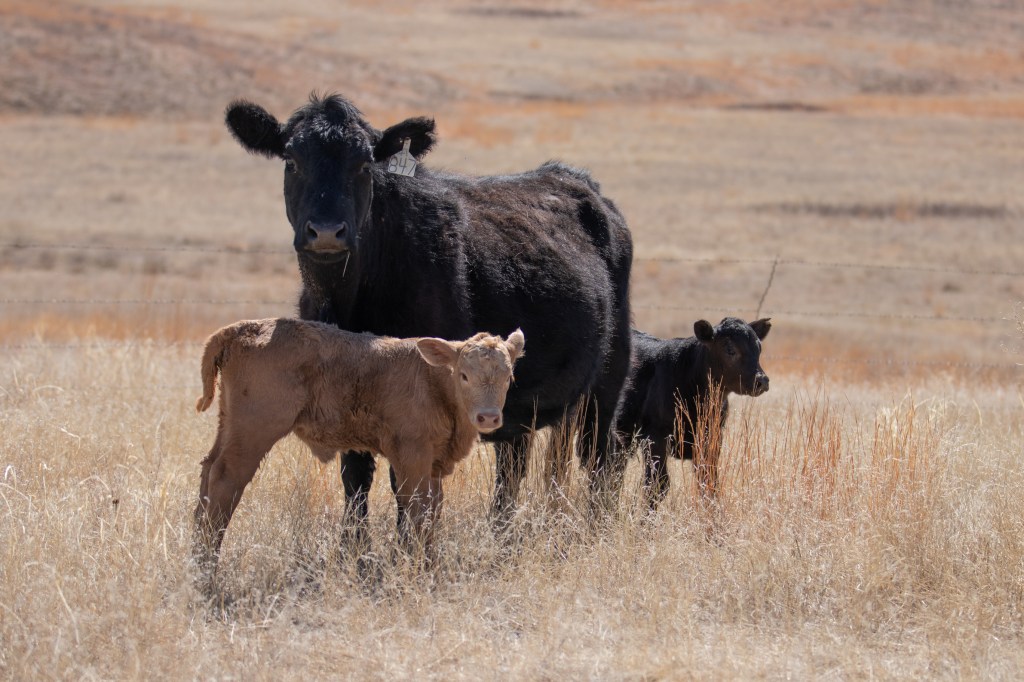
And of course, last but not least, there is the cowherd itself. At any given time, minus approximately 3 months in the spring, there are several hundred pregnant animals on the ranch relying on us for their wellbeing. Their prenatal care consists of ultrasounds and good feed, and their obstetrical care is based on age and risk factors. The heifer herd is watched vigilantly and with much anticipation in the days leading up to calving, while the older, maternal herd is allowed to calve on their own, unbothered and untouched unless absolutely needed, where instinct, nature, and nurture results in a wonderful success rate for live births and healthy babies. You get used to observing and remarking upon a cow’s mothering abilities, the state of her udder, and her maternal instincts. Pregnancy and birth are just a part of life on the ranch.

And it is fun, truly, to watch the cows put on a layer of winter fat over their round, pregnant bellies, as their due dates approach. A cow late in gestation is referred to as “heavy bred,” or, for short, “heavy.” So, you might observe a cow that has that giveaway waddle and maybe even a bit of an uncomfortable look on her bovine face, the cow with a spherical aspect if she is facing you head-on, and remark to yourself or your general audience, “Boy, she’s getting heavy.” 

I suppose everyone’s perspectives are shaped by what we know and what we see in our day-to-day lives, but I do recall being vaguely shocked when I first heard my husband refer to one of my expectant friends as “getting heavy.” This was a few years ago, and was one of those pivotal, eye-opening moments as to what sort of situation I’d married into.

It wasn’t long afterwards that I cornered the dear man and informed him in no uncertain terms that, if I ever was pregnant, if he ever had the absence of mind to refer to me as “heavy,” I wouldn’t be speaking to him for a very long time.

Yet another time, again keeping in mind that our perspectives are shaped by what we know, I was sitting in church next to my father-in-law, bless his heart, at a time when somehow just about every female at church between the ages of 20 and 40 was pregnant, and I heard that man mutter to himself not quietly enough, “Gosh, it’s like being at a bred heifer sale!” My eyes popped wide open and my jaw must have hit the floor. We had words.

So, let’s just say that by the time I found out this spring that I was pregnant, I wasn’t at all blindsided by the commentary I would be personally subject to, from not-vague-enough references to getting the calving shed ready or saving money on the ultrasound, or any other similar sort of comments that are accompanied by a provocative, irritating million-dollar grin from my husband and met with a narrow-eyed glare from me. So, I wasn’t blindsided.

Early on, though, I discovered what I refer to as “selective chivalry.” Pretty quickly I was grounded and not permitted on horseback anymore (a wise decision, I admit), and I found myself watched like a hawk, every move oh-so-chivalrously scrutinized, and hearing a warning or stern, “Laura…” if I did something that was deemed risky or “too much” for my “delicate condition,” as my father-in-law likes to say. He has a way with words. “Laura….” I can’t tell you how many times I heard my name uttered in that tone. “Laura…..”

However, if I was putzing along cautiously on a four-wheeler behind a bunch of cows, staying carefully on the flat and taking absolutely no risks, and the front of the herd got a wild hair and started running? Then I’d hear yelling and tune in to realize it was my name being hollered, very different from the cautionary “Laura…..”, and see some less-than-chivalrous flapping of arms way off to the side, that sent me zipping across the rock-strewn pasture like a skipped stone on a pond, to reach the front of the herd in time to turn them in, muttering to myself, “Sure, right, this feels WAY safer than being on horseback.”

Over the last few months, my husband has learned very personally and poignantly the reality of what happens when your best ranch hand gets pregnant, as tasks have been removed from my repertoire, one-by-one, starting with horseback work, and then close-quarters ground work with cattle, then certain vaccines, then all vaccines, and pour-on fly sprays and pesticides. Perhaps I resented or resisted the bubble wrap a little at the beginning, but I’m realizing it is actually kind of a nice gig, being the pregnant lady, poking cows into the chute for a couple hours (the only job remaining to me when we work cows), and then getting to eat snacks and call it a day. Not bad. Not bad at all.

But the more weeks roll by, the more I sympathize with that heavy-bred cow who has the telltale waddle and that bland, unimpressed, slightly-pained look on her face. “She’s getting heavy.” I feel it, deep in my cells.

But I’ll never tell my husband that. And he’d better not say it either. 

Ranch Wife Musings | The Need to be Needed

Originally published in the Custer County Chronicle on May 21, 2025

The month of May goes by in a whirlwind of fun and hard work, and there is much rejoicing when the last cow calves and the last calf is branded. The nonstop chaos of calving and branding is followed by the shortest of lulls, before the summer settles into its routine. A thousand prayers for rain have been followed up by a thousand thanks, as we’ve emptied the rain gauge not of tenths or hundredths of an inch, but inches. Whole inches. Inches of slow rain that was actually able to soak into the ground where it will do the most good. We aren’t likely to get a hay crop this year, or not much of one, but we should be able to grow grass, and that is huge.

One season blends and blurs into the next, but it is this spring season that is the highlight for many. After months of winter solitude, branding season feels like a family reunion but without the drama, with all the hugs and handshakes, laughter and jokes, stories and community gossip, finding out all the goings on and the comings up, the graduations and babies and engagements and lives well-lived.

And it is in the chaos of spring work that the ranching community shines as exactly that – a community. We branded our main herd on Saturday, an endeavor that is humbling in its scope, humbling in how many people it takes to actually get the job done, humbling to see how many are willing to help in any way they can. Brandings are like that.

As I handed out hot coffee at our mid-morning break, I was able to study the faces, some smiling, some serious, and all the different walks of life they represent. There are the cowboy ranchers, the true-blue, western-through-and-through, how-my-grandpa-did-it type. There are the dirt bikes and four-wheelers, we-can-do-this-faster type. There are the button-front shirt and cowboy-hat-wearing crowd, and the sweatshirt and ballcap wearing crowd. There are the ones with spurs jingling on costly boots, and those wearing comfortable and well-worn tennis shoes. There are the tobacco chewing ones and the straighter-than-straight-laced ones. There are the beer drinkers and the tea totallers. The coffee drinkers and the water drinkers. There are the ones who know cows as well as they know their kids, and ones who know horses and ropes but cows, not so much. There are those who grew up doing this, and those who learned along the way, and those who simply show up for the work, for the fun and the challenge and the sense of community.

And with all the differences, all the variety, the work is seamless. The fellowship is sweet. And none of those categories matter to anyone. It doesn’t matter if you’re wrestling or roping, branding or cutting, vaccinating or watching the gate, everyone jumps in to get the work done. Although some who come do get help in return with their brandings or cow work, the only repayment many want is a good meal at the end – and we do a good meal, if I do say so myself – and the satisfaction of a job well done, stories swapped, laughs shared, and for them that is plenty. And they’d do it again in a heartbeat.

What is it about agriculture, ranching in particular, that invites this? Or creates this? What is it about ranch work that brings out the best in so many, and fosters an enthusiasm for someone else’s work? When I look at other sectors of society, I’m puzzled and even disenchanted. Even sectors of society where lip service is paid to the importance of community are lacking significantly in this department. I see organizations struggling to recruit involvement from more than the barest percentage of people, and their lack of community reflects this.

I think one factor, maybe the most important factor, is need. Genuine need. Acknowledged need. Ranching families know that they can’t do it alone. They don’t have the luxury to hand-pick those who agree with them or look just like them or never irritate or annoy. They need this neighbor and that neighbor, even the neighbor who might think differently about this issue or that issue, or the neighbor who does things differently, or the neighbor who occasionally pushes some buttons and grates on some nerves. And that neighbor needs them right back.

Could it be that we need to be needed? And we need to need others? It might be that simple.

Our culture tells us, all of us, that we’re good on our own, autonomy is the ultimate state, blaze your own trail, follow your own heart, chase your dreams with no thought to anyone else, and you don’t need anyone but yourself. And too many people have bought into this in one way or another. Connections become optional. Connections become a matter of convenience or personal preference.

Real, genuine need erases so many of those devastating societal luxuries, where connections are based on pet interests and shared hobbies, curating one’s community like a museum curator curating art. When we handpick our community, we tend to reap surface-level connections, clique-like interactions based on emotions and how well we slept and what we ate for breakfast.

But, when community is picked for you, by proximity and history and shared needs, something much deeper forms and something much more lasting is reaped, something that extends beyond brandings and cow work, something that forms the family-like structure of a resilient community.

We need to be needed. And we need to need others.

Ranch Wife Musings | The Best Life We Can Give Them

Originally published in the Custer County Chronicle on January 29, 2025

Calving season on the ranch is a period of stark contrasts, a time of seeing some of the best of the best of God’s Creation alongside some of the saddest of the saddest. On the one hand, we revel in seeing mother cows birth and nourish and protect their young with such incredible maternal instincts, showcasing the best of God’s design for them; we search the pastures for newborn calves tucked away safely like little Easter eggs in long grass and sheltered places, waiting while their mamas graze or go to water; we see the fascinating natural formation of nursery groups by the busy mamas, so all calves are watched and all mother cows are fed and watered. But there is also the too-frequent reminder that we live in a broken world, the effects of which trickle down to the creatures we steward as well. Calves are stillborn or die afterwards, weather events challenge the best of our efforts, calving complications end tragically, and Nature takes its toll indiscriminately and sometimes it feels randomly.

Sometimes the bitterness and sweetness come by turns, first one and then the other. Sometimes they are mixed, inseparable. Sometimes they mix in the strangest sort of tragicomedy called a bottle calf that sticks around for weeks and months.

Granted, calving season for us isn’t supposed to start until the end of February, although neighbors of ours are already in the thick of it, or even are wrapping up. But we had a few, shall we say, incidents last year perpetrated by a yearling bull that was supposed to be a steer and wasn’t, and some dozen or so yearling heifers that he apparently found very attractive and which were not intended to be breeding animals. One calf showed up right before Christmas, and a few more showed up over the next month, one of which was orphaned more or less immediately. Of course, I had just dried up the milk cow.

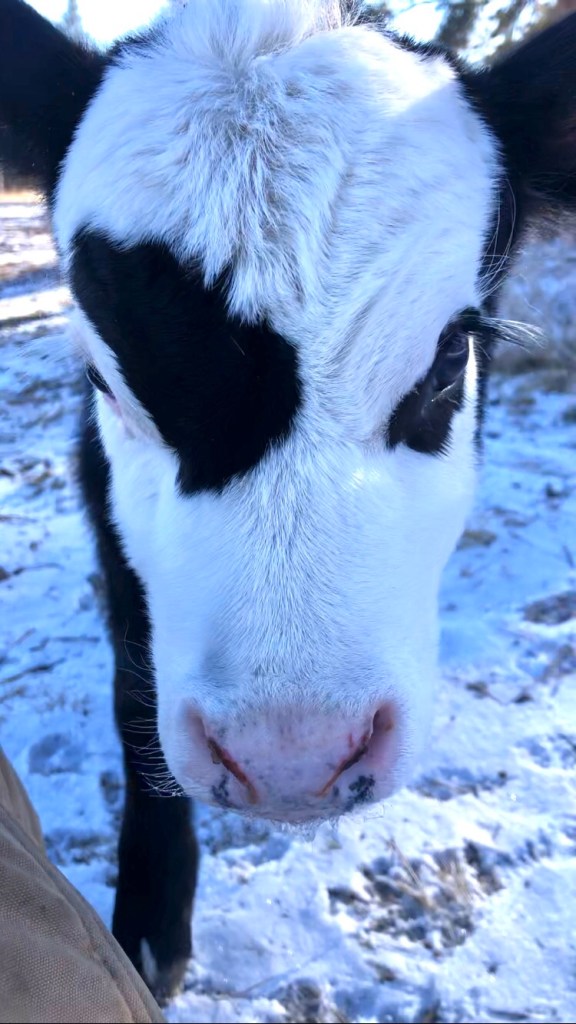
Bottle calves are supposed to be a nuisance. They’re supposed to be a hassle and, given the cost of a bag of powdered milk replacer, they are a financial nuisance, if nothing else. But clearly I’m not as wise and mature as other members of my family, because I’m afraid I don’t consider the three-times-daily feedings a nuisance, and really don’t object to calf bottles and pitchers for mixing the milk taking over the bathroom, or even the faint but persistent odor of soured milk. I don’t even mind trotting down in the dark to give Beckybell (my endearing husband named the calf after his mother-in-law – isn’t he charming?) her suppertime bottle. I’m afraid I don’t mind having my toes trampled by tiny hooves or my knees butted by the bony little head, or even the milky mess she somehow leaves all over my clothes. In fact, I thoroughly enjoy being mama cow. A few days ago, Beckybell managed to escape the nursery pen and was waiting for me and her evening bottle at the house when we got back from our walk. During the cold snap last week, her little ears froze, so she’s been wearing various ridiculous iterations of ear muffs to keep them from re-freezing, and I think we saved the ears.

But as much as I enjoy this critter and having close interactions with an animal that usually is only handled from a distance, it leaves a little sore pang in my heart. She is lacking her mama. God designed her to need her mama.

 As much bad press as ranchers get from climate activists, as much as the FDA and the CDC and whatever other three- and four-letter organizations there are that vilify cows as being a blight upon the earth and an alleged contributor to global warming (or is it global cooling, I can’t remember?), or as much as PETA has gone after ranchers for “cruel treatment” of livestock, there is so incredibly much that people in those organizations do not see. Good things. Wholesome things. The best things. As agriculture as an industry has increased in size, and as the number of people engaged in it has dwindled, people have lost their understanding, yet continue to pass judgements.

They don’t see the ranchers intently watching the weather ahead of a winter snow event, heading out on ATVs with sleet biting their faces to move 100 cows into a more sheltered pasture. They don’t see the heroic and futile efforts in sub-zero weather to save a calving cow. They don’t see the careful tending during a cold snap, keeping water open and food on the ground. They don’t see the desperate attempt to warm a nearly-frozen calf downed during a snowstorm. They don’t see the careful tending of a newborn calf and the new mother. They don’t feel the defeat when a young calf dies and the cow won’t leave its side. They don’t see the bleary-eyed rancher getting up every two hours to check heifers, and they don’t hear the pre-dawn phone call up to the house to ask his little wife to bundle up and come down to the calving shed to help turn a backward calf, since she has smaller hands. They don’t see the tears shed over a failed save or the teary-eyed laughter at a success. They don’t see the miracle of a calf taking its first steps with a sleep-deprived ranching couple looking on smiling, or chuckling as an overzealous mama cow knocks it over with her aggressive licking. They don’t see the ranch wife on the umpteenth feeding of a little white-faced bottle baby, tucking the calf in for the night, sorry in her heart that there isn’t a mama cow for the little orphan.

Because we care for the livestock that God has give us to steward. We hate seeing them suffer, we love seeing them thrive, and we do everything in our power to give them the best life we can give them. At no time is that more apparent than in that sweet moment when a newborn calf hits the ground, floppy eared and wet and sneezing up fluid, and mama cow turns and sees the little intruder. As she goes to work cleaning it off, instinct overriding her surprise, we watch in quiet awe, full of pleasant warmth on the coldest of days.

Clarity in a Cowherd

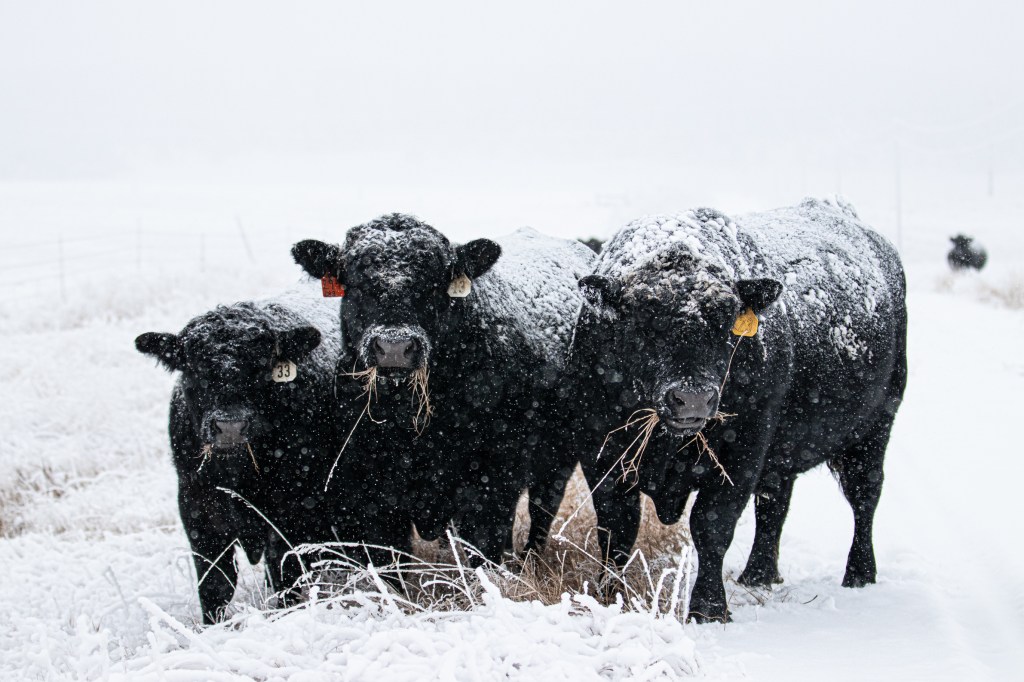
On those winter days when the temps plummet, I’m always amazed at the resilience of our livestock. With a heavy layer of frost or ice like a jacket over their hairy backs, and plenty of calories for heat-creation, they do quite well. These beautiful boys were entirely unbothered by the temps that send the rest of us scurrying for extra layers and hot things to drink.

There is a lot of brawn underneath that hide. You feel very small standing next to one of these beasts, which is why in general you don’t do it. They’re handled gingerly, respectfully, and generally from a distance.

These bulls are gorgeous specimens of breeding bulls, embodying what is needed for healthy herd genetics. Strength. Power. Masculinity. Which is exactly what is sought after in a bull, and are the traits that make them successful in their work.

Bulls should be masculine. And cows should be feminine. Pretty simple, pretty cut and dry. In the midst of a confused culture, there’s ample clarity in a cowherd.

Ranch Wife Musings | When the Irons Cool

Originally printed in the Custer County Chronicle on May 29, 2024

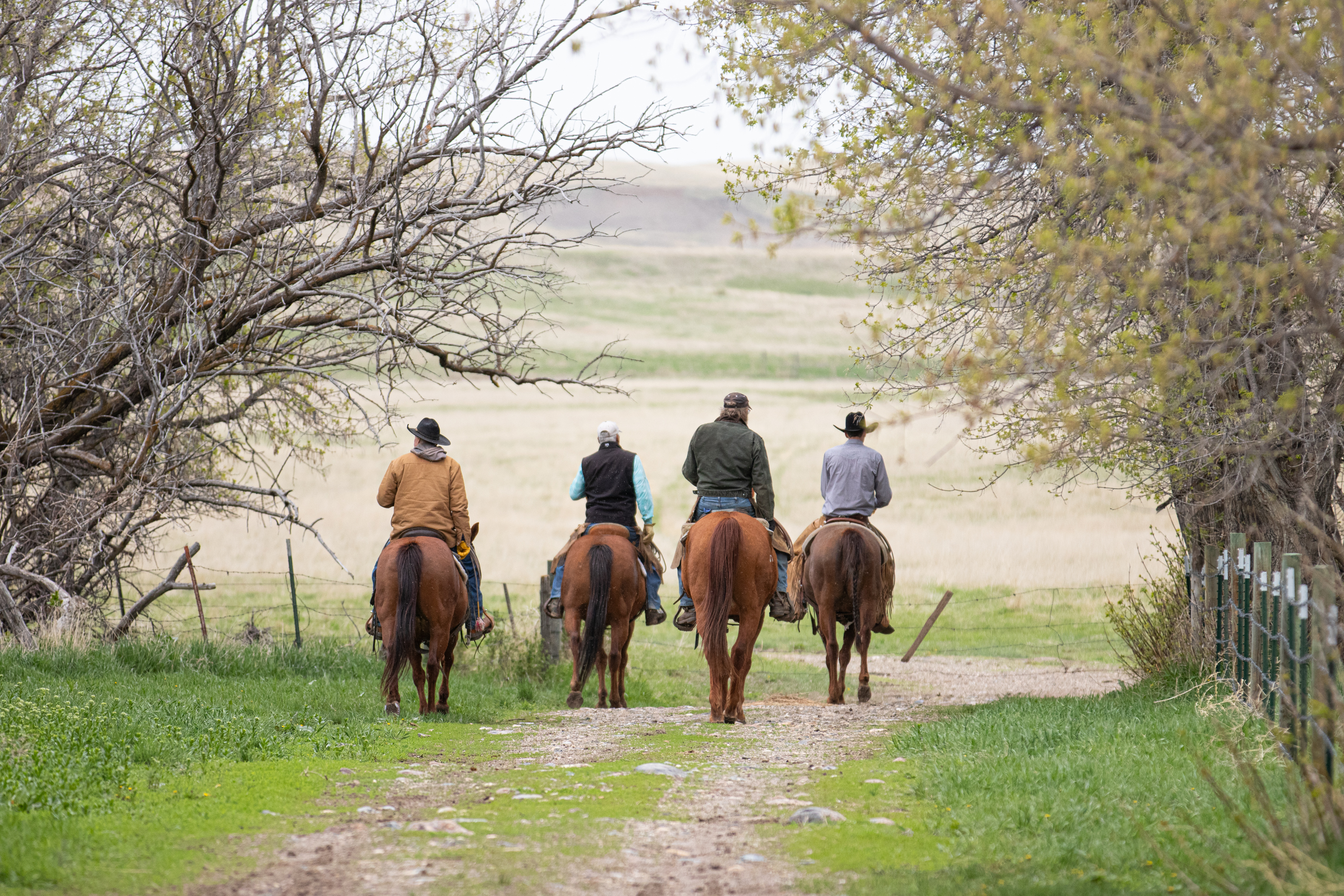
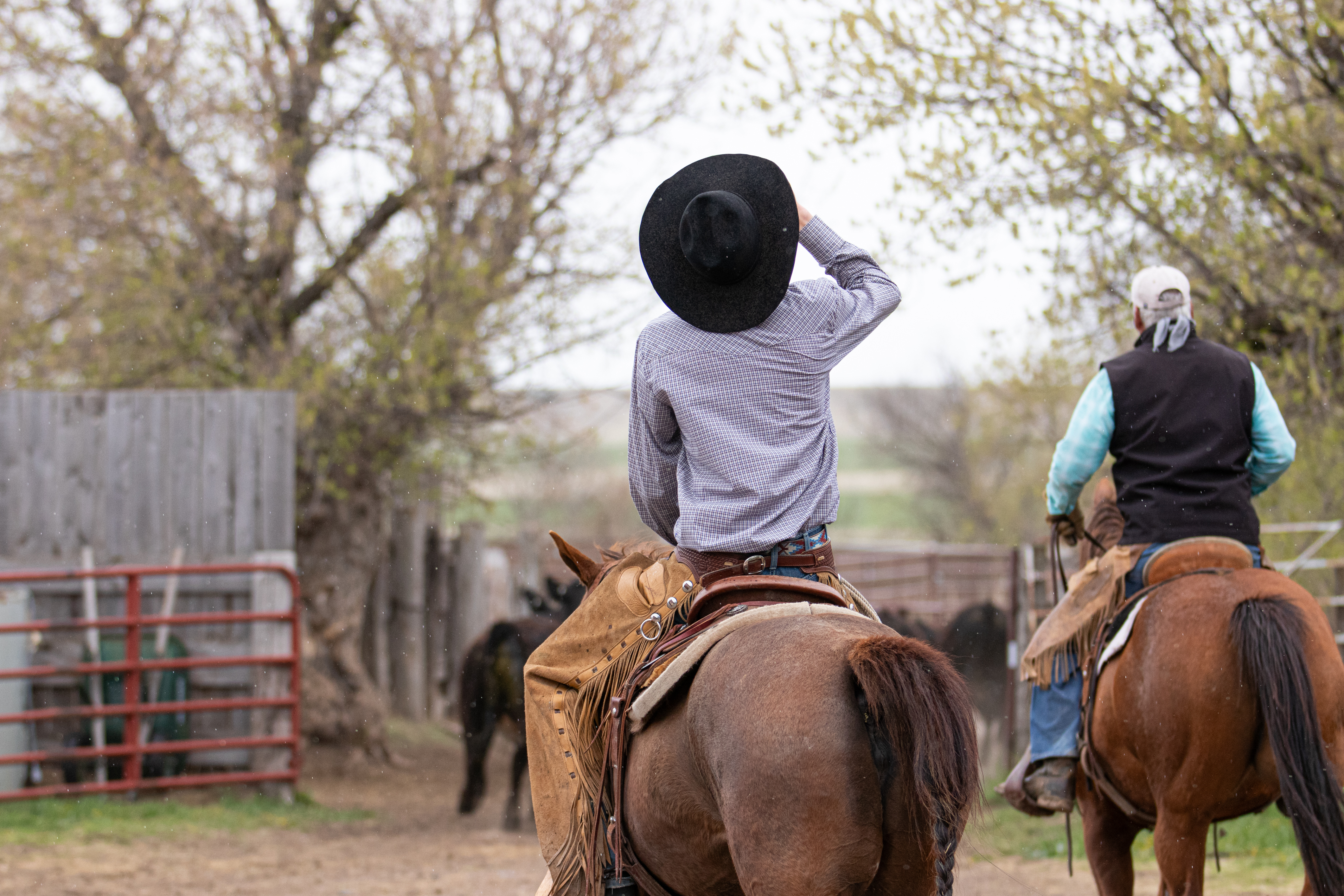
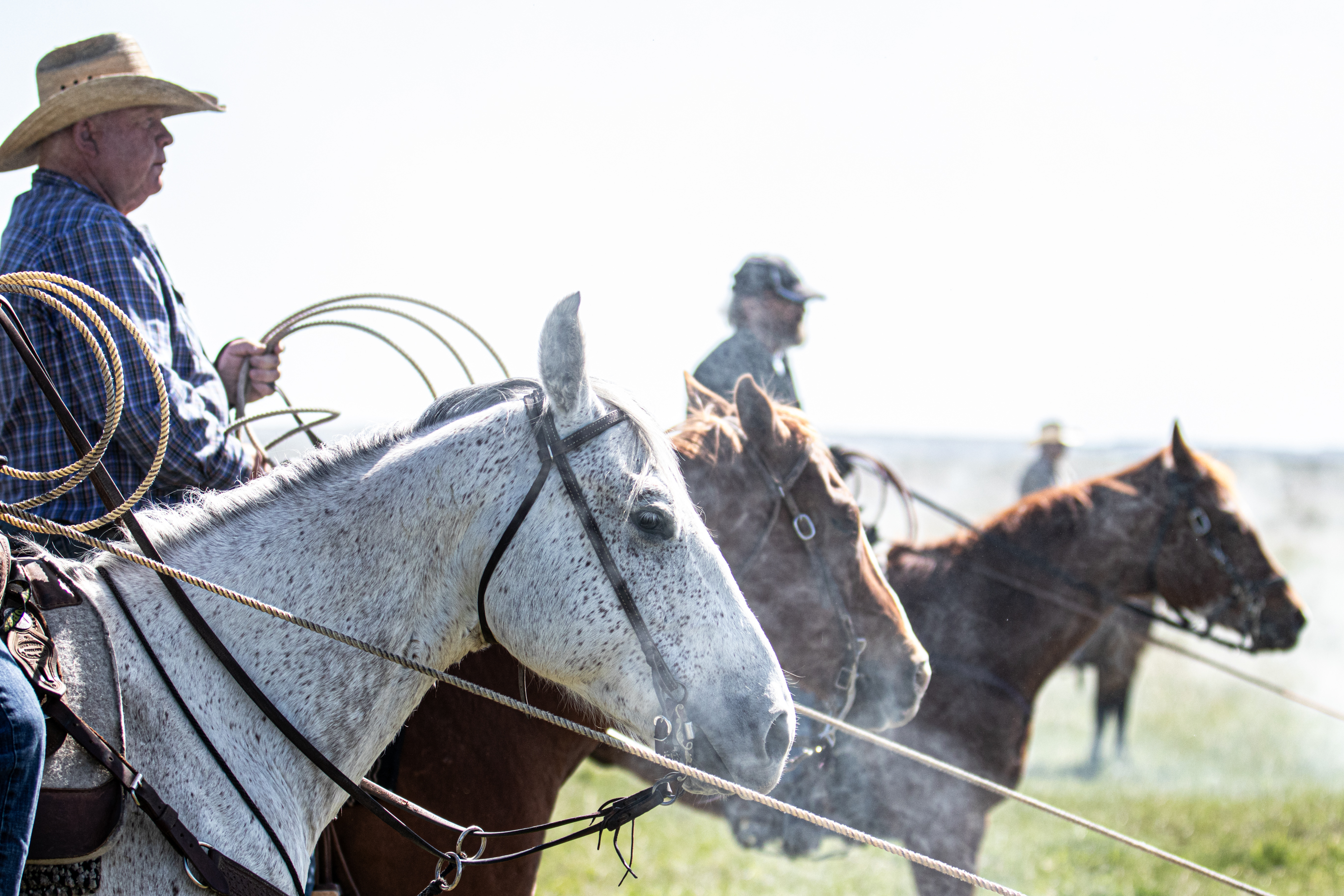
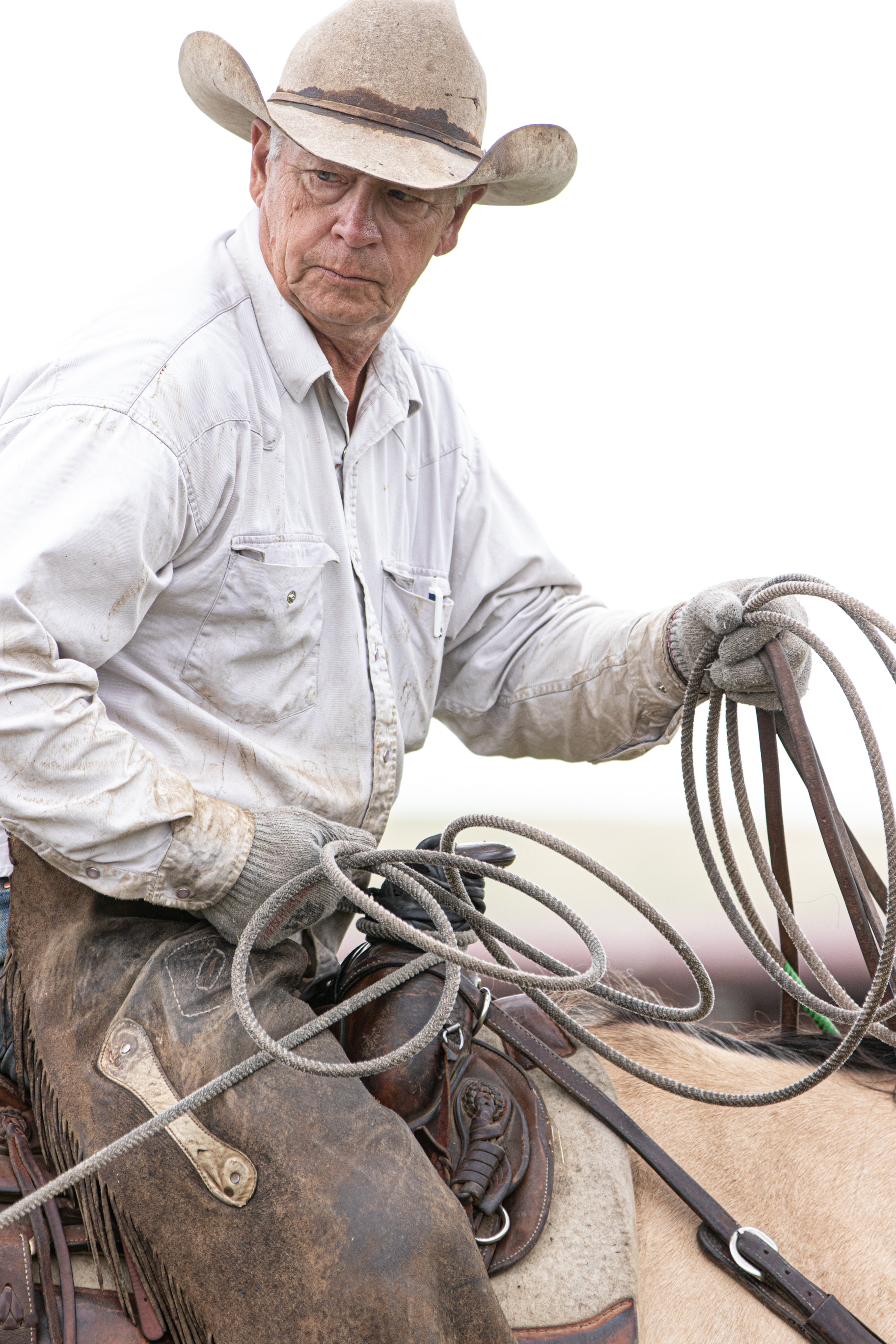
It is an exhilarating feeling, riding out in the cool of the morning with husband and family and neighbors, hearing a chorus familiar voices sing out gently in friendly conversation, the soft plodding of the horses’ hooves on soft earth, the occasional metallic ringing as a shod hoof strikes stone, watching the rolling hills fall away, the row of pickups and trailers get smaller behind us, seeing the cow herd stretched out over the entirety of a pasture. It is an exhilarating feeling, as we get further and further onto the prairie or into the breaks, and one by one, or two by two, riders are left behind until the herd is more or less encircled, and the gather begins.

It is an exhilarating feeling, to be behind a growing, moving, shifting bunch of cows, a bunch that gets joined to another, and another, until the whole herd is gathered, encircled by five or thirty horses and riders. The lowing of the cattle intensifies as they mill around, looking for their calves, and eventually the cattle trickle away from the pressure of the riders. The branding pens get nearer and nearer, and the net is pulled tighter and tighter. Instead of riders every 50 or 100 yards, it is riders every 50 or 100 feet, then every 5 or 10 feet, and then shoulder to shoulder for the last push to pen the herd.

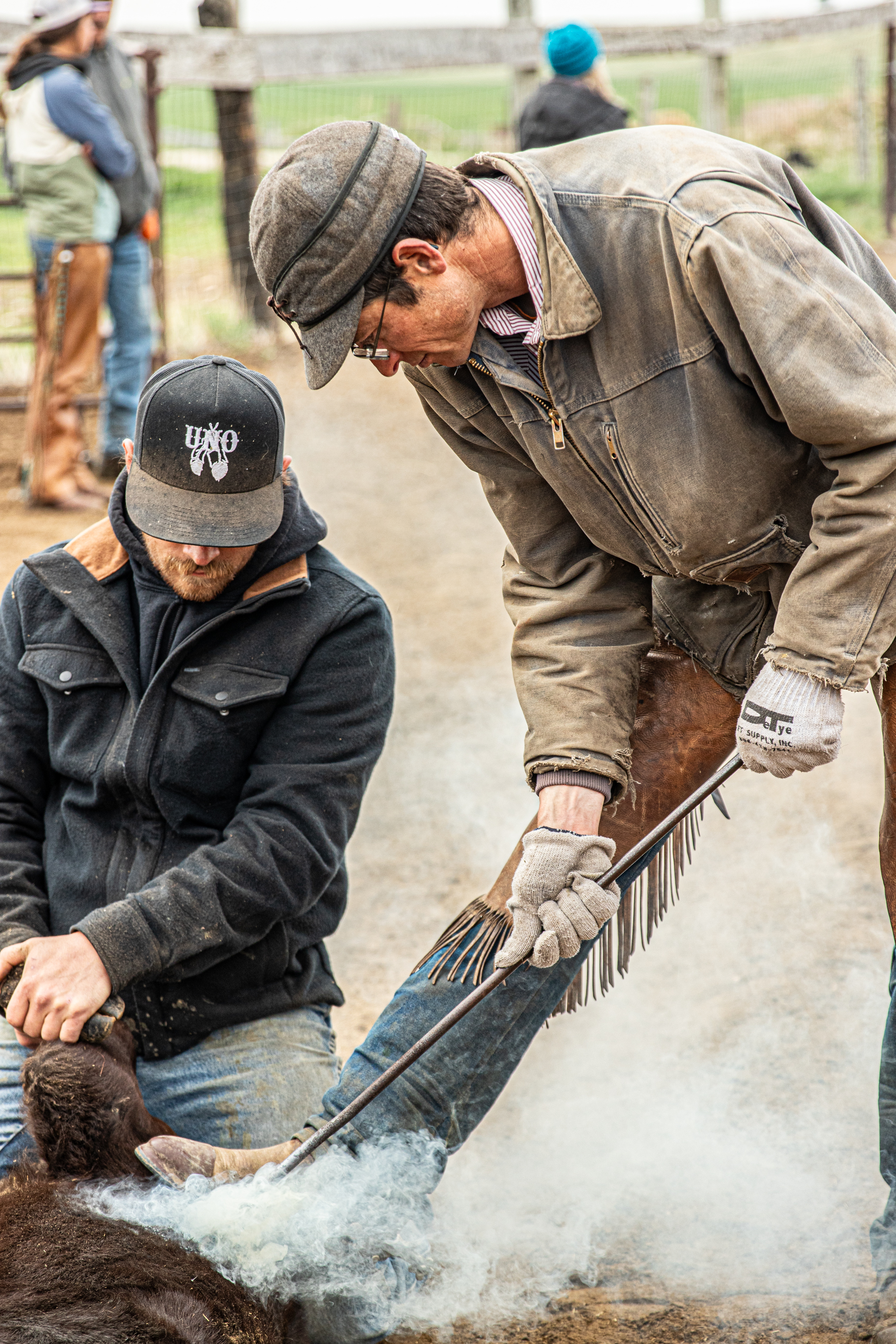
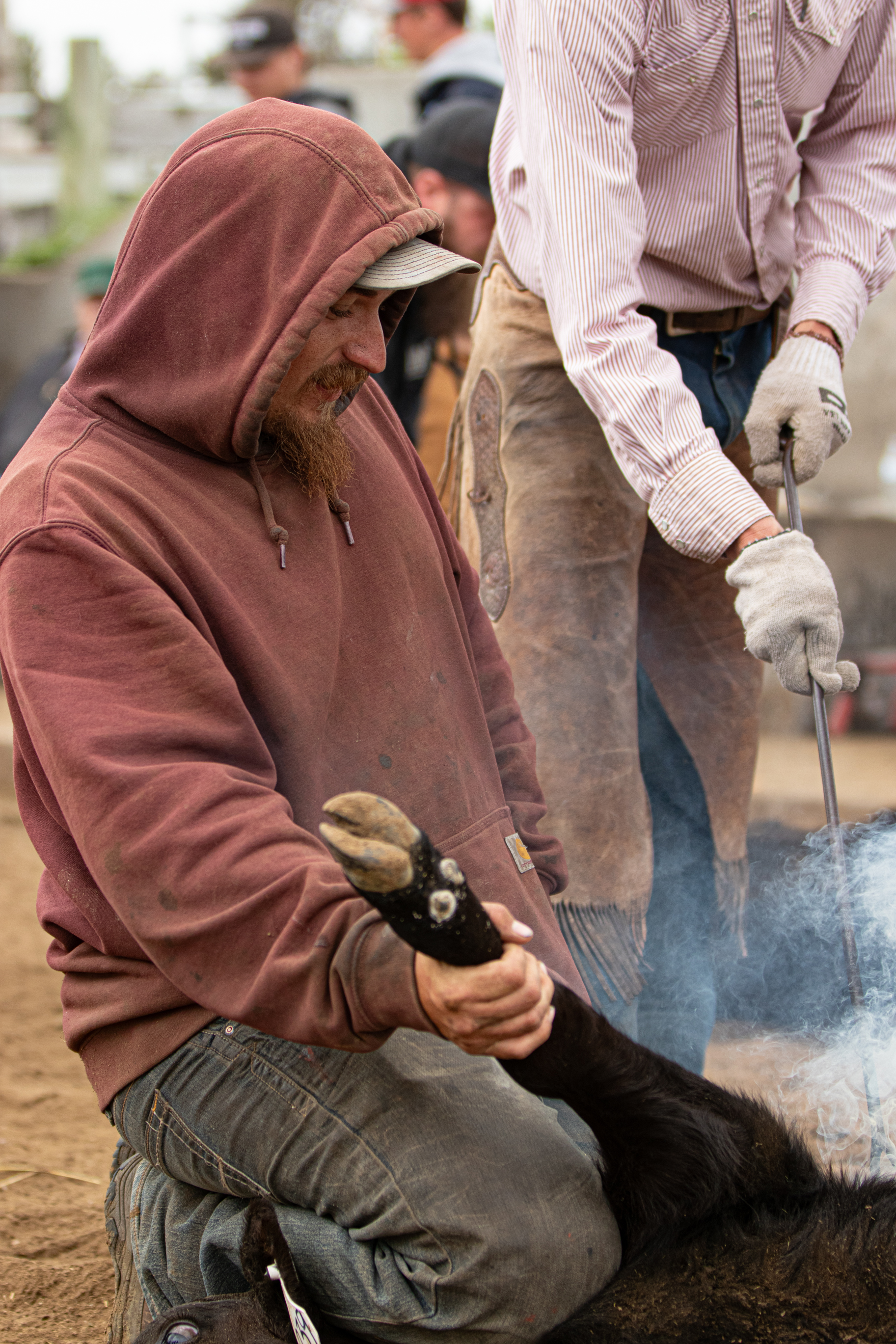
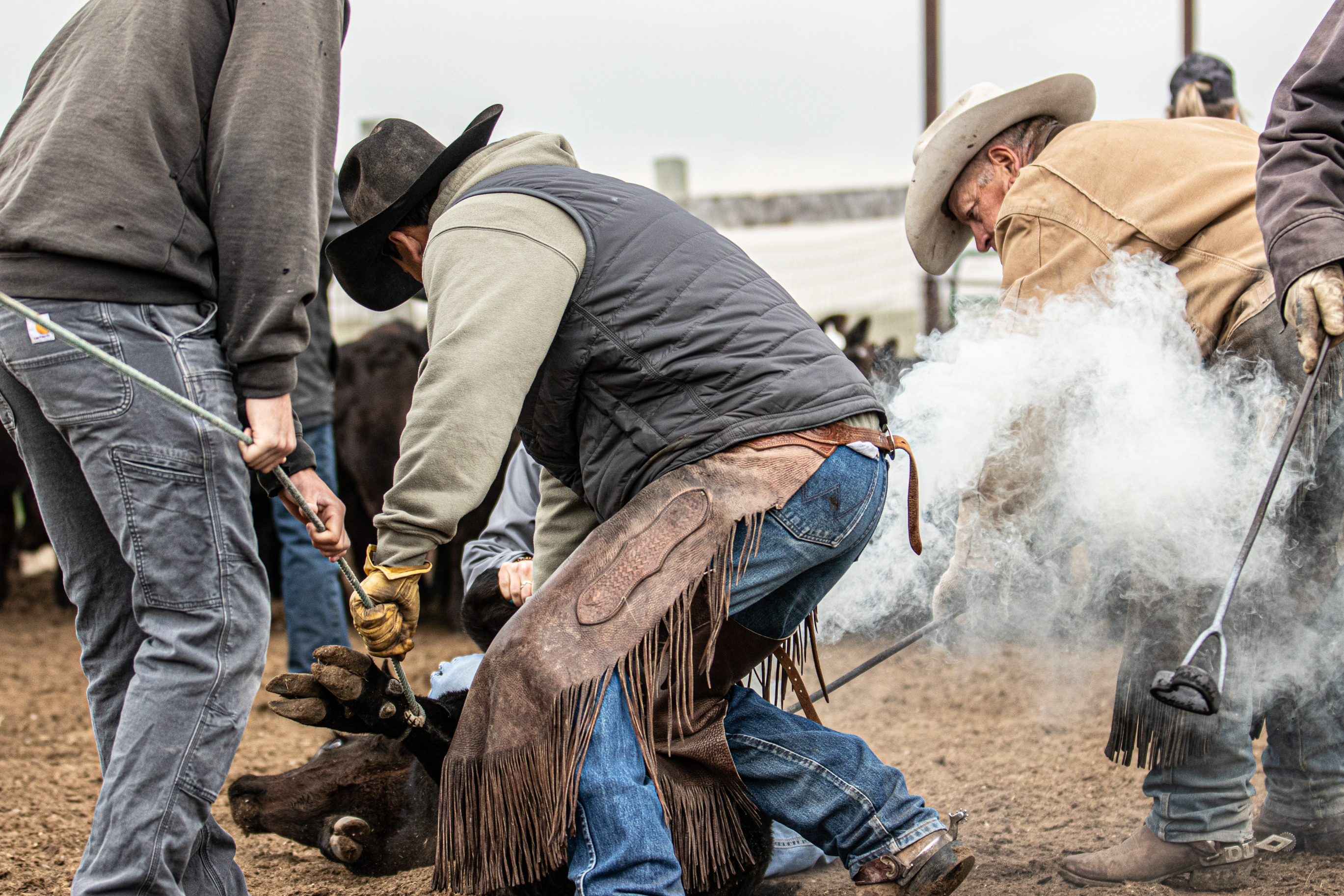
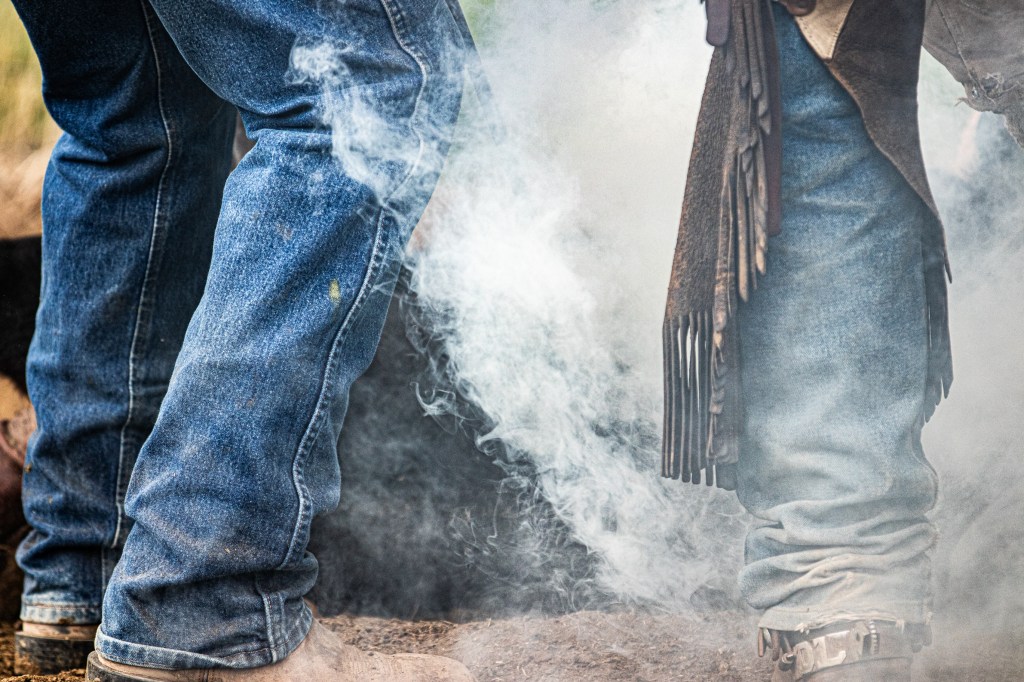
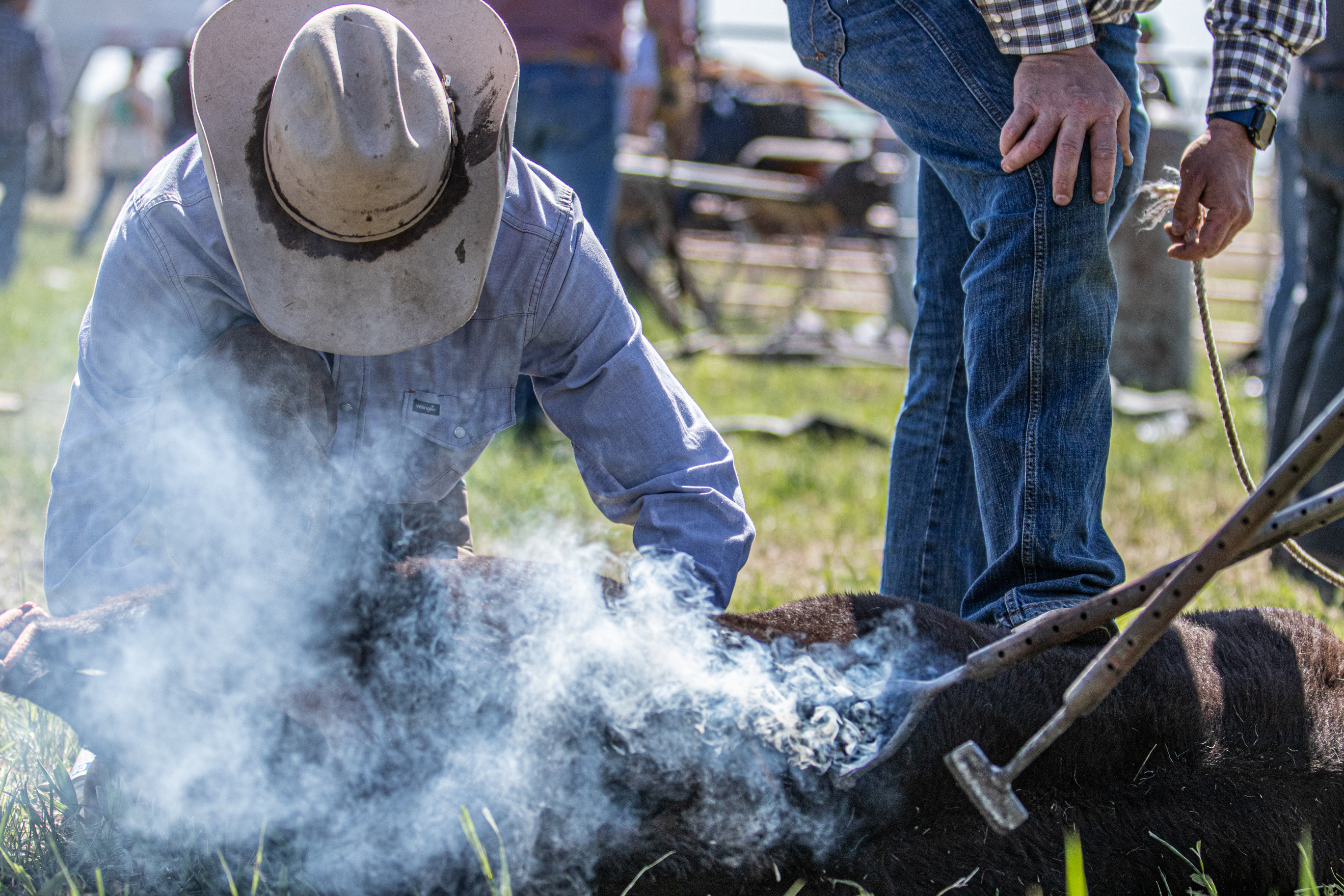
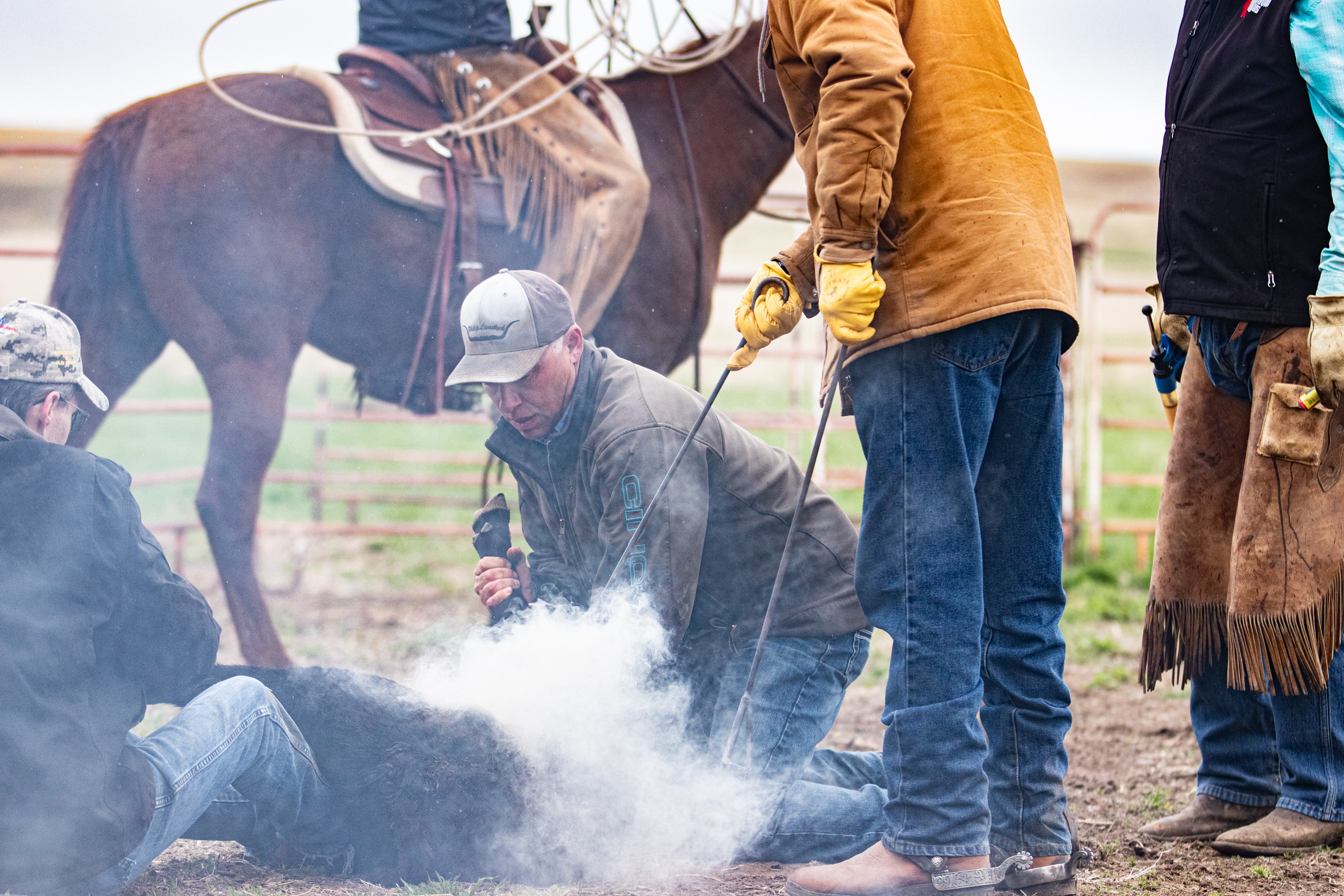
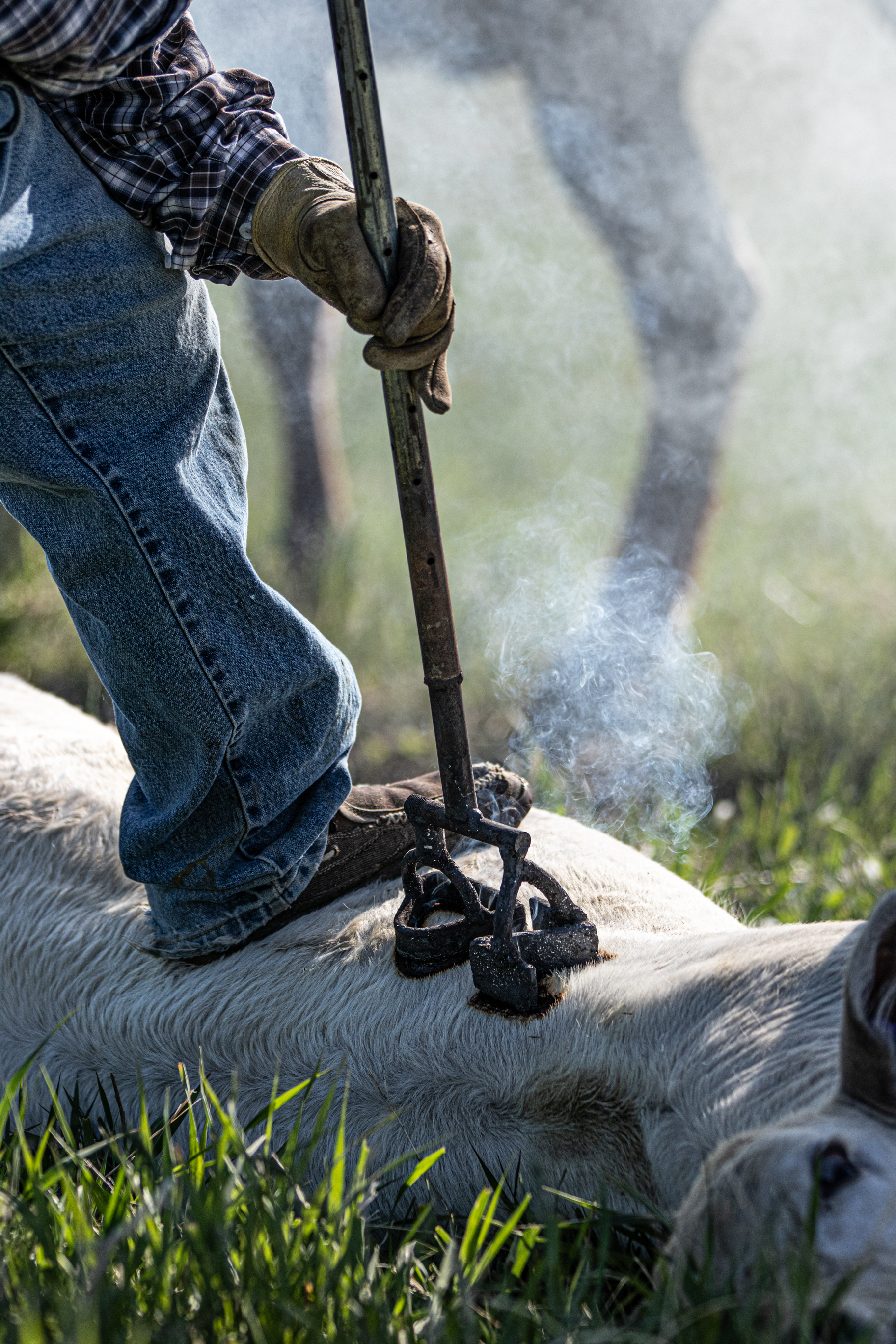
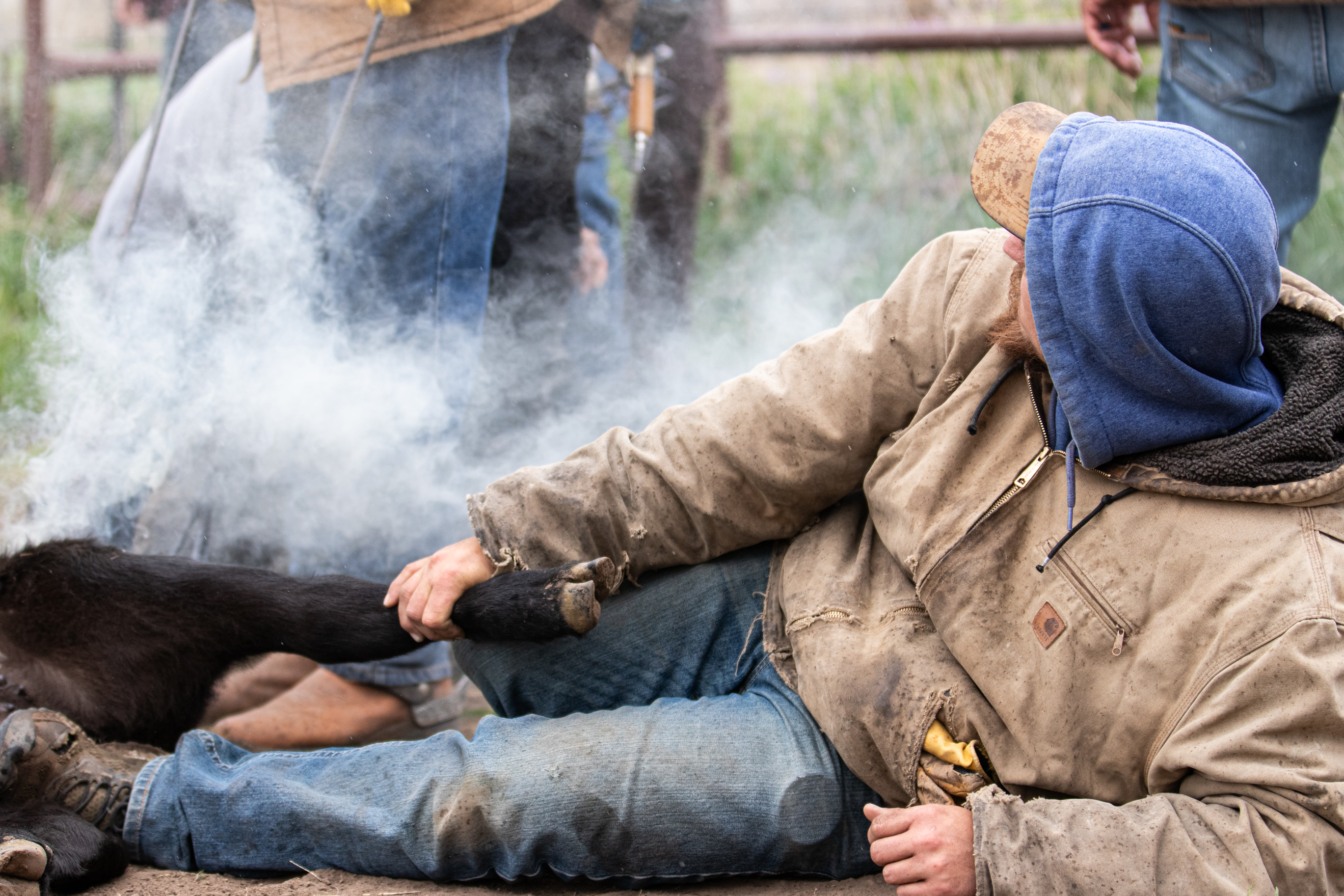
The cattle bawl at a fever pitch, like the deafening hum of a riled-up hornet nest, as mamas and babies are sorted and separated, the calves penned for branding, and cows released back to pasture. The perturbed mothers stand at the fence bawling for the calves, the calves bawl back, and the branding stove roars to life. Soon it is an ordered chaos of activity, as each member of a branding crew is assigned a role or finds a role, and the branding settles into a rhythm, like a well-oiled machine, a rhythm of ropers and wrestlers and branders, the soft hiss of ropes dancing, the smell of smoke and burnt hair, the clank as irons are drawn out of the fire, and the crackle of red-hot iron on hide. Glints and flickers of flame, clouds of shifting smoke, dust and flinging mud. Laughter and shouts and snippets of conversation punctuate the noise, and the steady rhythm is occasionally interrupted by the sudden leaping to action of half a dozen wrestlers when a calf puts up a stiff fight. And bit by bit, little by little, but faster than you’d think, the roping pens empty, the deafening bawling of the cows dies away as they head out briskly to pasture with their calves at their sides, without so much as a backward glance. With a suddenness of quiet that is jarring yet a relief, the branding stove is shut off. In the hours that follow the rush of the work, a meal is enjoyed and stories are shared and reminiscences are savored.

There is something bittersweet about the last big branding of the season, the last time the stove roars to life, the last time it cools. Ranching, for much of the year, is a pretty solitary profession. Families hunker down in the wintertime keeping animals fed and watered, and take to the pastures in the summertime with the odd jobs that are the summer routine. Fall work throws neighbors together in small groups here and there before calves are weaned and sold, but it is nothing like the community reunion of branding season. For a solid month, branding follows branding and neighbor helps neighbor, in a celebratory frenzy of work and camaraderie.

It is when the irons cool that there is really time to reflect on that, that partnership with one another for the grand and gritty task ahead, in partnerships that go back decades and generations. No one is keeping a score card, no one is counting hours helped here or there, but everyone is pitching in because there is work to do and that is what a true community does.

This is a foreign concept to many modern-day Americans. We no longer live where we work, or work where we live, to give a nod to the author Wendell Berry. We have separated work from life, and we have lost the vitality of community that results from living where we work in close proximity to others who also live where they work.

No matter how the American culture has shifted in favor of convenience and economy and minimizing human inputs and nickeling and diming every transaction, ranching is still done the old way. And the old way requires people. Flesh and blood people. People who are willing to show up with what skill they have or the willingness to learn a new one. To give of their time without keeping a record of how or whether it was returned to them, and with this spirit the work all somehow gets done.

We aren’t made to live in isolation. We are made to need one another and to be needed, and the ranching life gives a taste of this. Even in my relatively short time as a rancher’s wife, I look forward to seeing the familiar faces, working shoulder to shoulder with family and neighbors, each week of the season sprinkled with these all-hands-on-deck, all-day events. It is the one time of year when the community is reminded in a real and tangible way of how much we need each other. We aren’t doing this alone.  

The branding stove has been put away and the persistent smell of smoke and burnt hide no longer sticks to our clothing. It is a relief to have calving and branding over with for the season, and for summer work and rhythms to be settling into place. We’ll bump into neighbors over fences or at the county fair or other gatherings. But the energy and shared experiences of branding season will leave their impressions long after the irons have cooled.

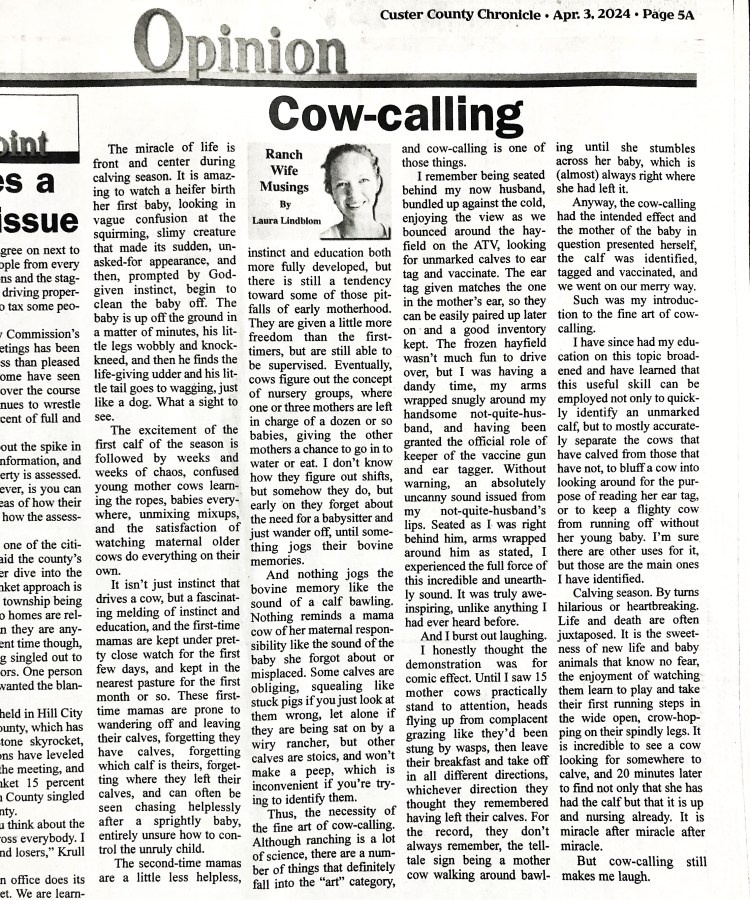
Ranch Wife Musings | Cow-Calling

Originally printed in the Custer County Chronicle on April 3, 2024

The miracle of life is front and center during calving season. It is amazing to watch a heifer birth her first baby, looking in vague confusion at the squirming, slimy creature that made its sudden, un-asked-for appearance, and then, prompted by God-given instinct, begin to clean the baby off. The baby is up off the ground in a matter of minutes, his little legs wobbly and knock-kneed, and then he finds the life-giving udder and his little tail goes to wagging, just like a dog. What a sight to see.

The excitement of the first calf of the season is followed by weeks and weeks of chaos, confused young mother cows learning the ropes, babies everywhere, unmixing mixups, and the satisfaction of watching maternal older cows do everything on their own.

It isn’t just instinct that drives a cow, but a fascinating melding of instinct and education, and the first-time mamas are kept under pretty close watch for the first few days, and kept in the nearest pasture for the first month or so. These first-time mamas are prone to wandering off and leaving their calves, forgetting they have calves, forgetting which calf is theirs, forgetting where they left their calves, and can often be seen chasing helplessly after a sprightly baby, entirely unsure how to control the unruly child.

The second-time mamas are a little less helpless, instinct and education both more fully developed, but there still is a tendency towards some of those pitfalls of early motherhood. They are given a little more freedom than the first-timers, but are still able to be supervised. Eventually, cows figure out the concept of nursery groups, where one or three mothers are left in charge of a dozen or so babies, giving the other mothers a chance to go in to water or eat. I don’t know how they figure out shifts, but somehow they do, but early on they forget about the need for a babysitter and just wander off, until something jogs their bovine memories.

And nothing jogs the bovine memory like the sound of a calf bawling. Nothing reminds a mama cow of her maternal responsibility like the sound of the baby she forgot about or misplaced. Some calves are obliging, squealing like stuck pigs if you just look at them wrong, let alone if they are being sat on by a wiry rancher, but other calves are stoics, and won’t make a peep, which is inconvenient if you’re trying to identify them.

Thus, the necessity of the fine art of cow-calling. Although ranching is a lot of science, there are a number of things that definitely fall into the “art” category, and cow-calling is one of those things.

I remember being seated behind my now husband, bundled up against the cold, enjoying the view as we bounced around the hayfield on the ATV, looking for unmarked calves to ear tag and vaccinate. The ear tag given matches the one in the mother’s ear, so they can be easily paired up later on and a good inventory kept. The frozen hayfield wasn’t much fun to drive over, but I was having a dandy time, my arms wrapped snugly around my handsome not-quite-husband, and having been granted the official role of keeper of the vaccine gun and ear tagger. Without warning, an absolutely uncanny sound issued from my not-quite-husband’s lips. Seated as I was right behind him, arms wrapped around him as stated, I experienced the full force of this incredible and unearthly sound. It was truly awe-inspiring, unlike anything I had ever heard before.

And I burst out laughing.

I honestly thought the demonstration was for comic effect. Until I saw fifteen mother cows practically stand to attention, heads flying up from complacent grazing like they’d been stung by wasps, then leave their breakfast and take off in all different directions, whichever direction they thought they remembered having left their calves. For the record, they don’t always remember, the telltale sign being a mother cow walking around bawling until she stumbles across her baby, which is (almost) always right where she had left it.

Anyway, the cow-calling had the intended effect and the mother of the baby in question presented herself, the calf was identified, tagged and vaccinated, and we went on our merry way.

Such was my introduction to the fine art of cow-calling.

I have since had my education on this topic broadened and have learned that this useful skill can be employed not only to quickly identify an unmarked calf, but to mostly accurately separate the cows that have calved from those that have not, to bluff a cow into looking around for the purpose of reading her ear tag, or to keep a flighty cow from running off without her young baby. I’m sure there are other uses for it, but those are the main ones I have identified.

Calving season. By turns hilarious or heartbreaking. Life and death are often juxtaposed. It is the sweetness of new life and baby animals that know no fear, the enjoyment of watching them learn to play and take their first running steps in the wide open, crow-hopping on their spindly legs. It is incredible to see a cow looking for somewhere to calve, and twenty minutes later to find not only that she has had the calf but that it is up and nursing already. It is miracle after miracle after miracle.

But cow-calling still makes me laugh.