Sweet Fullness

When Brad and I got married, I knew I needed to do some soul-searching when it came to having children. I had been single a long time, and I honestly think it was God’s kindness to me that He sort of lifted the desire for children away from my heart for those 10-plus years of being a single woman. I remember as a highschooler and college-aged young woman dreaming of having 10 kids, picking names out, and truly having an active desire to be a mother. But as the single years wore on, it was a struggle enough to grow in contentment and confidence that God would provide a husband if and when He chose to do so; I believe it was God’s kindness that temporarily and gently suspended the desire for children and kept it from being another stumbling block.

So when I found myself married to a good man, I knew I wanted to be the mother to his children, but I also had this strange sense of neutrality. Some of it is temperament – I’ve never been the baby-chasing sort. As sweet as new babies are, I never feel compelled to hold and cuddle other people’s babies, and am perfectly content to admire from a distance. But now that I was married? I knew this was something I needed to wrestle with. It wasn’t that I didn’t desire children, in an active sense, but rather that passively there was no active longing. Does that make sense? I wasn’t opposed to children, but I wasn’t actively experiencing a desire for them either. It was as if my years of singleness had sort of muffled the sense of that desire. And as I pondered that, I realized how empty that was.


Too often, I see women on social media or elsewhere, professing to be Believers and proclaiming confidently that they have absolutely no desire for children and that should be fine. Granted, I don’t know their situations, but a common thread in the Bible is God’s love of the family, and His desire for His people to raise families to His glory, beginning in the Garden of Eden, with the command to “be fruitful and multiply and fill the earth and subdue it.” Procreation is obviously part of that. And my personal conviction is that if God says something is good, we should think so, too. If God commands something to His people, we should take that seriously. We are not victims of our desires.

So I began to pray and ask that God would give me right desires, desires that pleased Him, and that if it was His will that we have children that He would open my heart to children, and remove the fears that gnawed at the margins of my heart.
And it is wonderful how God answers prayers. Before too long, I found I was no longer praying that God would give me a desire for children (because He had answered that prayer and had given me the desires I had prayed for!) but I was praying that He would make me fruitful, and would give me contentment and peace if He didn’t open my womb. Because I also knew that, although I am responsible to cultivate right desires, God doesn’t always satisfy those desires the way we want or expect, and He owes me nothing.

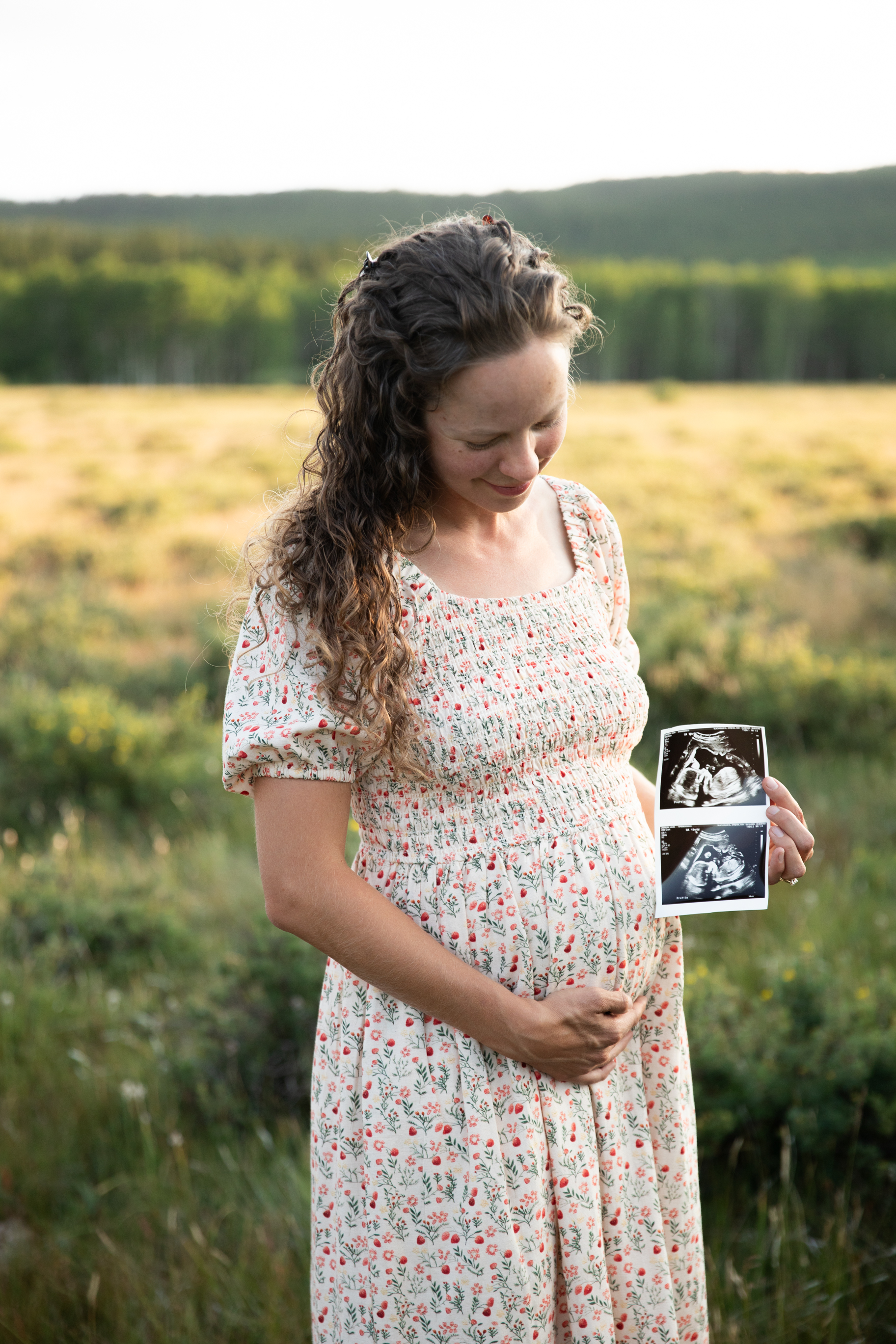
Well, it took my breath away when I saw the two red lines, and took my breath away again when I heard the heartbeat for the first time and saw the baby on ultrasound at 19 weeks. I’ve been living in a state of constant flux between incredible reality and surreality. Nothing had prepared me for how sweet it would be to feel the first quickenings, or how comforting it is to feel the baby move at all hours of the day or night. Nothing had prepared me for the sweet fullness of expectant motherhood. Fears have slipped further and further away.

And I can’t wait to meet our baby girl in November.

P.S. I took these photos for us with a tripod and shutter timer while we were camping in the Bighorns this weekend. Brad was great, and even consented to push the shutter button for me a few times. 🙂
Advent 2023 | Celebrations and Stones

Tomorrow is the first Sunday of Advent, launching us officially into the countdown to Christmas. Although culturally we tend to rush through the next few weeks, packing the calendar so full we live in whirling blur, although culturally we have turned Christmas into simply an excuse for rampant consumerism, there is so much more to this season, and so much need for this time. I hope you enjoy this article that I published at the beginning of Advent last year. I wanted to share it again, since it really speaks what is on my heart.

This time of the year is possibly my favorite. Admittedly, I love this whole season, from Thanksgiving to the New Year and experience what some might term a childish excitement as the festivities begin to take place. So many of my fondest memories take place in the period of time between Thanksgiving and Christmas, and so many of my favorite family times have been interwoven with the traditions and customs that became part of the fabric of my family. Even though the world around us goes crazy with all the frivolous and self-centered consumerism that has become the unfortunate hallmark of the American Thanksgiving-to-Christmas season, there is so much to embrace and to firmly fix in our lives. We set aside a day to remember God’s goodness and thank Him for His blessings, and then we intentionally fix our eyes on the hope, love, joy, and peace that the Advent season remembers.

In a culture that increasingly tries to erase all evidence of the Christian faith from public expressions during these historically overtly Christian holidays, I think it is more important than ever that families rally themselves around traditions that draw their eyes Heavenward.

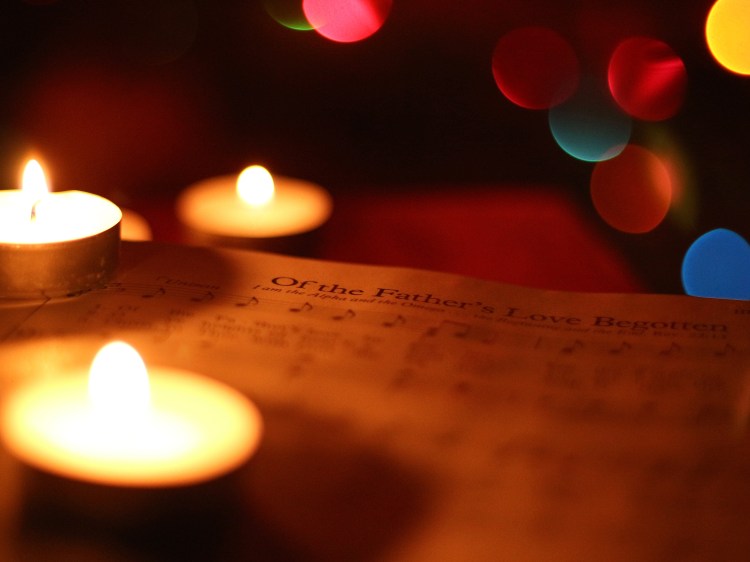
I think of the traditions my family had growing up…We had our big family Thanksgiving, usually shared with someone from our church, and in the next few days afterwards, we would usher in the Advent season by putting up our tree. Out would come all the old decorations, the lights, and the treasured Advent books we would read year after year as a family. I think of the Christmas programs at church, the traditional songs and hymns, the somber and joyful candlelight services we would attend at my grandparents church, The Little White Church in Hill City. I think of our Christmas morning Bible reading, reading through Luke’s account of the birth of Christ.

Unfortunately, America in general but even many branches of the Protestant church have either given up on Christian tradition altogether, or given up on fully appreciating and applying the traditions of the past. In the culture at large, I think it is pretty obvious why…The “old ways” have been systematically devalued and the church and expressions of faith have been essentially removed from the culture. For two religious holidays, what’s left for a culture that hates God? Nothing, really.

In the church, though, this forsaking of tradition is more complicated. It is sad to me that a lot of people find the Christmas season just another part of the year, the traditions are just kind of boring and old hat, and there’s sort of a collective eye-roll at the traditional Christmas hymns. One facet, I think, is a rather poorly-reasoned idea that too much tradition and it might become meaningless and rote.

What a loss of such a gift! How silly, to avoid a good thing because it might become less than what it should be. And can’t we having meaninglessness and roteness just as easily without our “traditional practices?” Maybe we should work on our heart attitudes instead.

Traditions of the faith join us with other Christians across the globe, through the centuries and millennia even, since we don’t just find our spiritual origin in the Christ of Christmas, but in God’s covenants with the Nation of Israel, thousands of years ago. I look at how God’s people committed His works to their memory for future generations, two big ways come to mind: Feasts and monuments. Celebration and stones.

When the Israelites were instructed on the keeping of the Passover Feast after God’s delivered them from Egypt, this was why:

And when your children say to you, ‘What do you mean by this service?’ you shall say, ‘It is the sacrifice of the Lord’s Passover, for he passed over the houses of the people of Israel in Egypt, when he struck the Egyptians but spared our houses.’” And the people bowed their heads and worshiped. (Exodus 12:26-27)

And when years later the Israelites were under the command of Joshua, God brought them over the River Jordan, rolling back the flood-swollen river waters so that the whole nation could cross in safety. Joshua, instructed by God, directed the Israelites to take twelve stones out of the riverbed of the Jordan as they crossed over and to construct a memorial, so future generations might not forget the Lord’s power and His goodness.

And those twelve stones, which they took out of the Jordan, Joshua set up at Gilgal. And he said to the people of Israel, “When your children ask their fathers in times to come, ‘What do these stones mean?’  then you shall let your children know, ‘Israel passed over this Jordan on dry ground.’  For the Lord your God dried up the waters of the Jordan for you until you passed over, as the Lord your God did to the Red Sea, which he dried up for us until we passed over,  so that all the peoples of the earth may know that the hand of the Lord is mighty, that you may fear the Lord your God forever.” (Joshua 4:20-24)

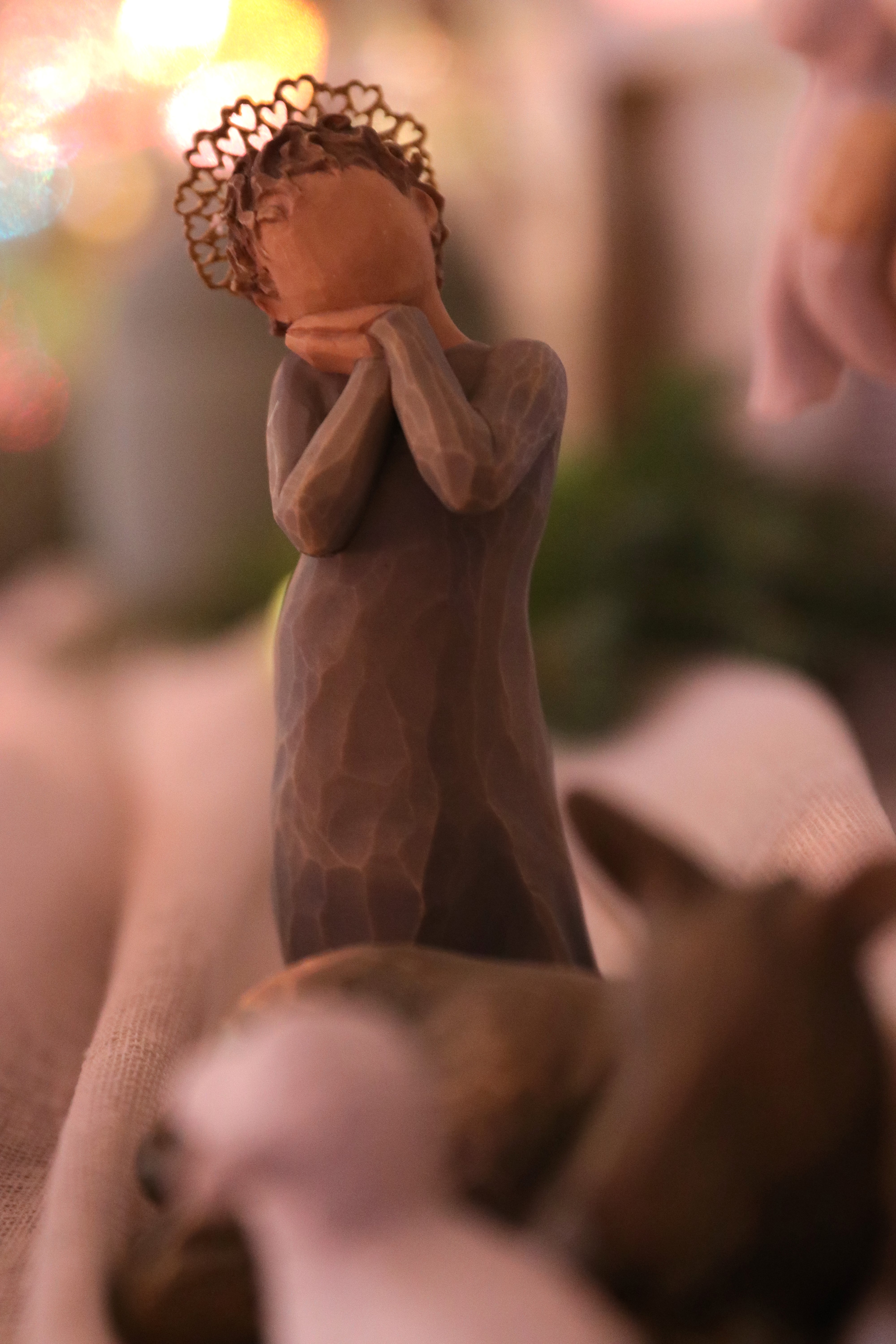
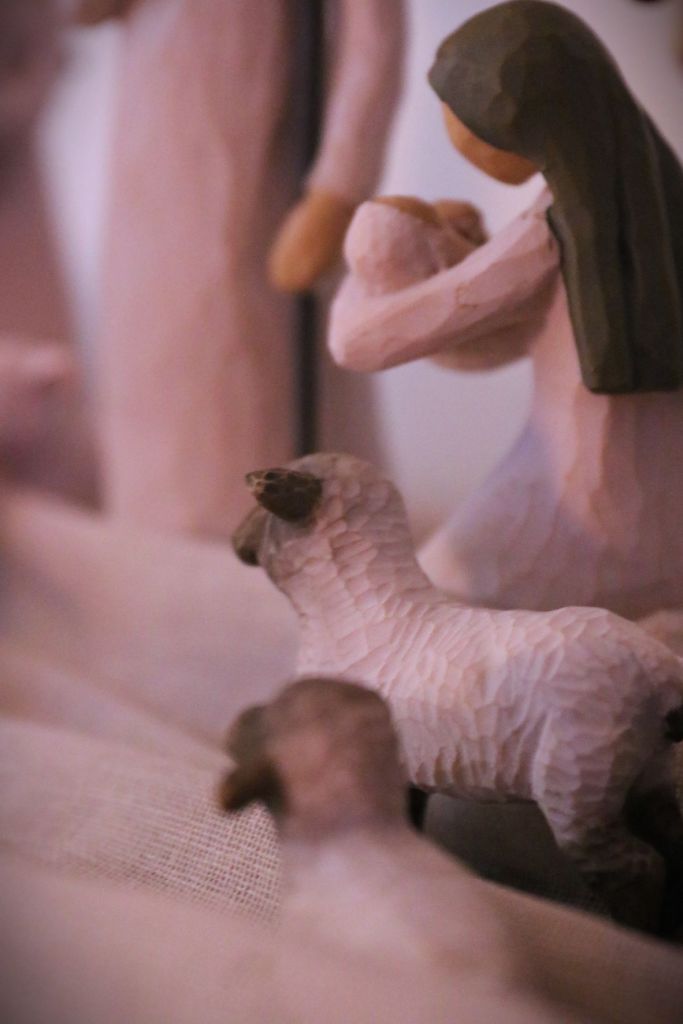
Christmas and the Advent season should be a time of celebration for the Christian. A time when we can proclaim the joy we have in Christ to a world walking in darkness. And a half-hearted participation hardly communicates joy. So set up your family monuments to the goodness of God and celebrate with friends and family. Celebrate Advent. Find a live Nativity to attend. Cultivate traditions in your family. Set up your cherished Creche and ponder its significance. Sing the old songs and really taste the words. Don’t just “make memories” for the sake of the memories, but counteract the temptation to be passive at this time of year and make memories to the glory of God!

We need our celebrations and we need our stones. Celebrations to bring us into a heart-posture of thanks and praise to God, and stones to be a visual reminder of Who it is we celebrate.

Parable in a Pasque Flower

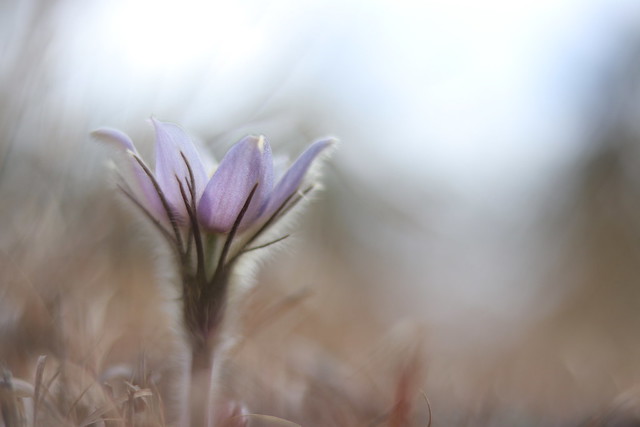
Pasque flowers appear after the bitterness of winter, often before winter has fully wasted itself out in storms and cold and darkness. They are a sign, a beacon of hope. Asleep in the ground for the months of winter’s cold, at the appropriate time they fight their way to life, seemingly delicate and vulnerable. But what strength is seen in the first of spring’s flowers! Tiny things that should be crushed under what remains of winter, they prevail. Against all odds, they spring up here and there, bathing hillsides in the glory of springtime. They are the first glimmer of hope that winter won’t last forever, and that spring will truly come. There is life in the dead ground. There is warmth, and light, and growth.
IMG_8239eFirst there is one, then a couple, then dozens, then they’re everywhere. Spring has come. Winter is defeated.

How appropriate that they bloom at Easter time, hence the name “pasque,” having to do with the time of Passover, the time of deliverance. The “paschal lamb” was the sacrificial lamb of Passover, ultimately fulfilled in Christ, our once-for-all-time Paschal Lamb.

At Easter, we celebrate hope, the hope and certainty that our Salvation, our deliverance, is secure, through the paschal sacrifice of our Lamb of God, to redeem His people from their sins. The hope began with one man, amidst a storm of controversy and opposition, against which a mere man never could have prevailed. But the God-Man could. His ministry turned into a couple, then a dozen, then hundreds, confounding the religious elite of the day who did everything they could to crush His ministry. It seemed as if they’d succeeded, that gruesome day when they nailed Christ to the cross of crucifixion, a horrific instrument of torture. Christ, the God of the Universe, was slaughtered, brutally, willingly, voluntarily, in order to satisfy the Plan of eternity to save, to give hope, to change hearts, to reconcile sinners to God.

“There in the ground His body lay
Light of the world by darkness slain.”
IMG_8386eFor two dark days, His broken body was dead, buried, but on the morning of the third day, Christ defeated death. Against all human odds or laws of science, Christ broke the chains of death and returned in a glorified human body. Death was defeated.

“Then bursting forth in glorious day
Up from the grave He rose again!”

What began with one man has blossomed into millions, millions of tiny beacons of hope that light the darkness of this world, that give us hope that the darkness won’t last forever, that the winter of our souls can become springtime, that death can give way to life, that goodness can come from decay. No other religion or person or movement has ever rocked world history like Christianity, and no other worldview can boast the lives radically changed for the better, hatreds healed, hearts transformed. In spite of all opposition, Christianity has flourished for over two millennia. And where it is hardest pressed, there it blossoms the most gloriously. Each life changed by Christ is a testament to the truth of the Gospel, the hope that we have to be reconciled to our Heavenly Father, to have our sins forgiven, to have our hearts radically changed. We aren’t doomed to ourselves and our sins forever. There is hope.
IMG_8255eRemember that, when you see these first flowers of spring. They are a mini parable of how God works and has worked to bring about Salvation, to defeat death, to bring life and hope and peace and reconciliation.


Out of Deep Darkness

God had promised a Savior. And for centuries, the Jewish people waited for this Messiah, a mighty king who would storm this earth and defeat their enemies and right all wrongs. Prophets, with words from God, gave glimpses, signs, of what this Savior would look like, what He would do, where He would come from. The Jews waited for this Savior, for a man of stature, of importance, of status and fame. They wanted a king. And they waited. And waited. And waited. But the dimming years trickled by, and the glorious prophesies ceased. For those who waited and hoped, the time must have seemed so long, the years must have seemed so dark, and hope must have seemed so faint.  But the Promise remained.

And finally, into this broken, darkened world, God began to speak once more. Into the darkness, His light burst forth. In the glorious, heavenly brilliance of angels and stars, God relayed this message: “Do not fear.” 

“Do not be afraid, Mary. Do not be afraid, Joseph. Do not be afraid, humble Shepherds.  Magi, draw near. I bring you good news of great joy.” 

The story began to unfold. And as the story unfolded, it was not the story that was expected. This isn’t the story that the Jewish people would have written. This isn’t the story that I would have written. This isn’t how a king is supposed to come. But God is not bound by human prejudice or expectation. To a young woman, a carpenter, and shepherds, angels appeared, ushering them into the glories of God’s plan to rescue this lost and hurting world, and He began to reveal the Savior, His glory.

We live in a land of deep darkness. The hearts of all of us are black with sin. We need hope. And there is hope, in the Light of the World, the Son of God, God Incarnate.

Christmas approaches during the darkest, coldest time of the year. The days are shortest, the nights are longest, and into this deepest darkness comes the celebration of Christ’s coming, a meditation on the glory of Christ and the beauty of God’s redemptive plan that is still being worked out upon this world. He is the one who opens blind eyes and softens hard hearts and whispers truth into deaf ears. He is our Hope, our Light, and our Salvation. And He was poised to descend upon this dark world in a way the world hasn’t been able to forget.

The people who walked in darkness
    have seen a great light;
those who dwelt in a land of deep darkness,
    on them has light shone. (Isaiah 9:2)

The Living Vine

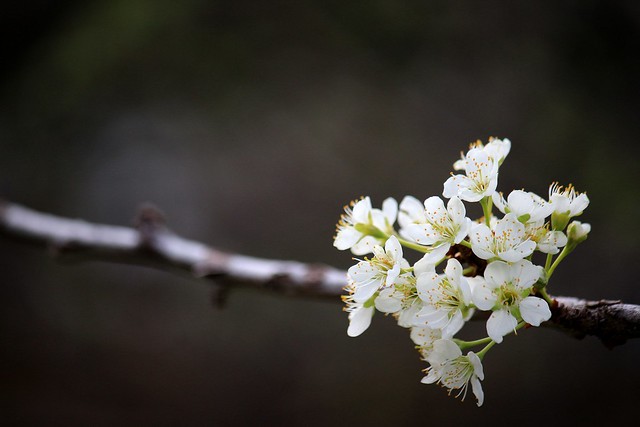
“Abide in me, and I in you. As the branch cannot bear fruit by itself, unless it abides in the vine, neither can you, unless you abide in me. I am the vine; you are the branches. Whoever abides in me and I in him, he it is that bears much fruit.” ~John 15:4-5IMG_5956eOver the last few weeks, I watched the plum and apple trees for blossoms. We have had some heavy frosts, and I was concerned the buds may have gotten frozen off or even that parts of the tree could have been killed by the winter’s cold. But today, I saw a white mist clinging around the plum tree – bountiful pale flower clusters. The tree is alive. The flowers are the precursors to harvest. They evidence life and health.

“Abide in me,” Christ said. “I am the vine; you are the branches.” He encouraged and admonished his disciples to rest in him, to bear fruit. Healthy fruit comes from a thriving branch. A thriving branch only comes from a living Vine. Bear much fruit. He told this to his disciples, men who had sacrificed everything for him to follow him and participate in his ministry.  And then he was executed like a common criminal.

Resurrection Sunday comes and goes every year, and we hear the same message every year: He is risen!  “He is risen indeed!” we respond. We can go through the motions of celebrating Resurrection Sunday as if the Resurrection were old hat. Perhaps we even feel a little sheepish, maybe a little too counter-cultural with all of the empty tomb and back-from-the-dead talk. Not to mention, Easter has been so commercialized, all the plastic eggs and chocolate bunnies and pastel colored paper shreds. We lose our wonder in the colorful array of secular trappings, the childish nature of the eggs and bunnies and cute chocolates. Maybe we wearily approach the bustle and expectations surrounding Easter, and question the significance of setting aside a day like this. Maybe in the whirlwind of “celebration,” we forget Who and Why.

Because Christ is alive, and perhaps that more than any other truth in Scripture is what must be dear and real to us. Christ is alive, and he is sitting at the right hand of the Throne of God (Hebrews 12:2). Through his life, death, and resurrection he has given us the right to become Children of God (John 1:11-13), to be reconciled to our Heavenly Father (Romans 5:10). It isn’t through his life and death, but through his life, death, AND resurrection. Because if Christ hadn’t risen, then he is no better of a sacrifice than the Passover lambs or the sin offerings, then he is no better of a king than King David or King Josiah, then he is no better of a prophet than Moses, no better of a father than Abraham, Isaac, or Jacob, no better of a priest than Aaron. They each in their own way foreshadowed the coming of and our need for a Savior – the Lamb, the Sacrifice, the Prophet, the Priest, the King, the Father of Many Nations. But they had no power over death. They each died. But Christ did not. And that is of utmost importance.

For the Christian, everything hinges on the Resurrection, everything we say we believe, everything we say we hope for. If the Resurrection did not happen, then we have hoped entirely in vain, and all Christ’s commandments about abiding in him are null. In fact, if Christ didn’t rise again on the third day, then the entire Bible is a pack of lies. That is how important the Resurrection is. It isn’t just an interesting anecdote. It is Biblical record that is absolutely vital to faith. Because our hope hinges on Christ’s power over death. If he, the “resurrection and the life,” has no power over his own life, how can he promise life to us? (John 11:25-26 and John 10:17-18)

And if Christ has not been raised, your faith is futile and you are still in your sins.If in Christ we have hope in this life only, we are of all people most to be pitied,” Paul wrote in 1 Corinthians 15.  The Bible has no merit if the Resurrection didn’t happen, because the entire Bible depends upon the Resurrection for its completeness. Without the Resurrection, then everything from Genesis onward is pointless and fraudulent. Without the Resurrection, there is no hope, there is no life. Without the Resurrection, then our Vine, the Vine from which we are supposed to draw sustenance, is dead.  If he is the Vine and he is dead, we are unable to bear the fruit we were commanded by him to cultivate. If he is the Vine, and if he is dead, then our faith is a dead faith, sealed in the tomb along with the man who claimed to be God Himself.

But that is not what we believe. That is not the end of our faith.  Because Christ’s story didn’t end at the  tomb. “But in fact Christ has been raised from the dead,” Paul continued in Corinthians. Because the next morning, the tomb was empty. Gloriously empty.

Now on the first day of the week Mary Magdalene came to the tomb early, while it was still dark, and saw that the stone had been taken away from the tomb. So she ran and went to Simon Peter and the other disciple, the one whom Jesus loved, and said to them, “They have taken the Lord out of the tomb, and we do not know where they have laid him.”  So Peter went out with the other disciple, and they were going toward the tomb.  Both of them were running together, but the other disciple outran Peter and reached the tomb first.  And stooping to look in, he saw the linen cloths lying there, but he did not go in.  Then Simon Peter came, following him, and went into the tomb. He saw the linen cloths lying there,  and the face cloth, which had been on Jesus’ head, not lying with the linen cloths but folded up in a place by itself.  Then the other disciple, who had reached the tomb first, also went in, and he saw and believed;  for as yet they did not understand the Scripture, that he must rise from the dead.  Then the disciples went back to their homes.

 But Mary stood weeping outside the tomb, and as she wept she stooped to look into the tomb.  And she saw two angels in white, sitting where the body of Jesus had lain, one at the head and one at the feet.  They said to her, “Woman, why are you weeping?” She said to them, “They have taken away my Lord, and I do not know where they have laid him.”  Having said this, she turned around and saw Jesus standing, but she did not know that it was Jesus.  Jesus said to her, “Woman, why are you weeping? Whom are you seeking?” Supposing him to be the gardener, she said to him, “Sir, if you have carried him away, tell me where you have laid him, and I will take him away.”  Jesus said to her, “Mary.” She turned and said to him in Aramaic, “Rabboni!” (which means Teacher).  Jesus said to her, “Do not cling to me, for I have not yet ascended to the Father; but go to my brothers and say to them, ‘I am ascending to my Father and your Father, to my God and your God.’”  Mary Magdalene went and announced to the disciples, “I have seen the Lord”—and that he had said these things to her. ~John 20: 1-18

So, abide in me. Christ is alive, and only because of the Resurrection are we able to truly abide in him. We are not part of a dead Vine. We are part of a Living Vine, a Vine which is bearing bountiful, beautiful fruit and has been bearing fruit for thousands of years. The ax of false doctrine and the winds of persecution and the fire of the culture have no power against our Vine. It is in perpetual flower, perpetual fruit-bearing. We have something to be excited about on this wonderful day! We have a faith that springs from and abides in Christ, and he is alive today. Reflect on that truth and revel in that hope.


He is Risen!

Now after the Sabbath, toward the dawn of the first day of the week, Mary Magdalene and the other Mary went to see the tomb.  And behold, there was a great earthquake, for an angel of the Lord descended from heaven and came and rolled back the stone and sat on it.  His appearance was like lightning, and his clothing white as snow.  And for fear of him the guards trembled and became like dead men.  But the angel said to the women, “Do not be afraid, for I know that you seek Jesus who was crucified.  He is not here, for he has risen, as he said. Come, see the place where he lay. Then go quickly and tell his disciples that he has risen from the dead, and behold, he is going before you to Galilee; there you will see him. See, I have told you.”  So they departed quickly from the tomb with fear and great joy, and ran to tell his disciples.  And behold, Jesus met them and said, “Greetings!” And they came up and took hold of his feet and worshiped him.  Then Jesus said to them, “Do not be afraid; go and tell my brothers to go to Galilee, and there they will see me.” Matthew 28: 1-10IMG_5893eChrist went ahead of his disciples to Galilee, and has now gone ahead of us to Heaven – And we will see him there.

Happy Resurrection Day!