 Time is a commodity everyone is short on. We live in a rat’s race pace, perpetually scraping for “more time”, but never feeling like we find it. And all for what? A few more dollars in the bank? A few more stamps in the passport? A few more parties, pleasures, possessions? People spend their healthy days working themselves to death in the hopes that they’ll still be healthy enough when they retire to enjoy the things they didn’t enjoy when they were younger.
 Now, I don’t for a minute think that the end goal of life is enjoyment or pleasure – I believe God put each of us on this earth with a purpose, that purpose being first and foremost to glorify Him. I believe our lives should be useful lives, seeking to serve and bless other people. This is something I’m still working on myself, trying to figure out. But even while I believe that pleasure isn’t the goal of life, I believe that God made this world beautiful for His glory and our enjoyment, and I don’t think nearly enough people are willing to enjoy it, or give themselves the time to enjoy it, or have the eyes to enjoy it, or to enjoy the deeper significance of the beauty of this world. Our culture has created a mindset towards work and daily life that makes it difficult to enjoy the good things God has created, the things that can’t be bought and paid for.
I think this is ultimately an issue of purpose, of spiritual purpose.
 Of course I understand that our culture is far from being Christian anymore – Our culture is actively rejecting any concept that is remotely Christian, but by rejecting God and the Gospel we haven’t just lost our faith or our adherence to some “strict moral code,” as some would like to argue. By losing our Christian worldview and our Christian identity, we’ve lost our purpose, our identity that goes deeper than our job title, the dollar amount on our paycheck, the neighborhood we live in, or the prestigious way we spend our free time. We are forever hungering for something we think we can buy with money, but can only be gained with spiritual eyes and a new heart. We’ve lost the joy of contentment.
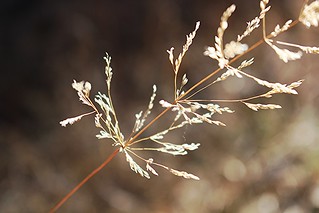 We’ve lost the ability to appreciate God’s simple daily gifts and the significance of something as ephemeral as a rainbow, or a flower, or the way the sunlight strikes the mica-encrusted quarts. We’ve lost our appreciation of beauty. And what slim appreciation of true beauty that there is becomes mired in the mindset of meaninglessness, all that there is in this world being the result of complicated and unexplained “natural processes”. Meaningless, everything is meaningless.
We have a nation that is sinking under a burden of vainly spent dollars, under a burden of depression and worry and jealousy and envy and pride and hate. We have a culture of people who live with the constant reminder of what they can do, should do, or want to do, of what the human race can do, has done, will do, wants to do. We have a culture that wakes, eats, works, and sleeps surrounded by the fruit of man’s labors. Our culture is so bent on complicated pleasures, so bent on belongings and material wealth and security, that we as a culture have completely lost sight of the brimful storehouse of God’s goodness, manifested in His wonderful Creation, which are gifts that anyone can enjoy.
 There is a whole world that exists outside of the city limits, above the light pollution, beyond the concrete, steel, brick, and glass of our world of industry. What if people could see and understand the significance of beauty? What about the beauty of true and selfless relationships? What if people had a context in which to understand sorrow and grief and pain? What if people could be reminded of what God can do, has done, will do, and could see God’s fingerprints on every hill, rock, tree, flower, pebble, lake, and cloud? What if people could see God’s promises spelled out in His Creation? What if people could revel in the plenty of contentment? What wealth of soul that would produce! These are pleasures that cannot be bought with money, comforts that aren’t material, so to these we all have equal access. Even the poorest among us can be rich indeed, rich of soul. That is a richness that lasts.
 This is a richness that begins, first and foremost, at the moment of Salvation. This is also an attitude of the heart that can be cultivated, and doesn’t require straying outside of the city limits (although it is easier to see God’s handiwork outside of man’s world). It is possible to train one’s eyes to see God’s fingerprints in the small and mundane things of life. It is possible for anyone, work-burdened, life-burdened, heart-burdened, or otherwise, to experience the joys of living, whether in the midst of difficulty or not. God gives these gifts. We have to be willing to see them.
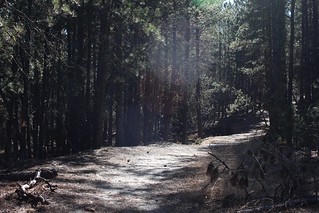 How wonderful, then, is taking the time to wander and to wonder, taking the time to stray from the beaten path, to gaze on the obscured, to revel in the majesty of this beautiful world, knowing that this world, beautiful as it is, is just a washed-out, lesser, corrupt version of the wonderful world to come.















 Christmas Eve is a good time to remember – and to reflect. On Christmas Day, Christians celebrate the miraculous birth of a Savior, God Incarnate, who humbled Himself to come to earth as a baby, as the frailest form of humanity. But I think we often make the mistake of forgetting that the Christmas story doesn’t start in the book of Matthew, but it starts back in the book of Genesis. Throughout the Old Testament, a Savior was waited for – The entire Old Testament leads us to Christ.
 In Genesis 49, the last days of Jacob, Abraham’s grandson, are recorded. Jacob was nearing the end of his life, and he gave a blessing to each of his sons. This wasn’t a blessing of earthly proportions, but was prophetic in nature and from the hand of God. In his blessing to Judah, he says, “Judah, your brothers shall praise you…The scepter shall not depart from Judah, nor the ruler’s staff from between his feet, until tribute comes to him; and to him shall be the obedience of the peoples.”
 And it continues today! The scepter hasn’t left the house of Judah. The never-ending throne of King David is still being ruled from today, because Jesus, the Son of David, is reigning in Heaven, risen and glorious, and will one day return to finish His battle with Satan. The king the Israelites expected was a king who would wipe out their earthly enemies, restore earthly peace, and give earthly justice. But the King that God had planned would be a King who would wipe away our sins, our tears, our spiritual enemies, who would provide the Gift of Salvation, who would come to earth as a Man, someone we can try to comprehend with our finite minds, someone who can sympathize with us in our weakness, someone to demonstrate a life of righteousness, love, faith, purity, joy, servanthood, humility, and sacrifice. A King who would restore Spiritual Peace, and give Spiritual Justice and Mercy. A King who would adopt us into His household and call us His children, His brothers and sisters, His family.
 After a morning of cleaning the church with Roy, Anna and I went over to make gingerbread houses with Hannah and Jacob, who also go to our church. They take their gingerbread house making very seriously – They’re pros. It turns out a number of people at Southern Hills take gingerbread house making very seriously. We might need to have a church gingerbread house making party and contest sometime.
 One tradition, though, almost got sidelined this Christmas because of space constraints, but the girls and I raised a cry of opposition – We live in a tiny house, but when it was suggested that we wouldn’t decorate a tree this year…Well, we didn’t hesitate to voice our opinion. So Saturday morning, Dad and I hopped in the truck and went out to cut us down a Christmas tree. It was a chilly, cloudy, breezy December morning, but the trees don’t mind. We were looking for a small tree, one that would sit on top of a table by our window, so it couldn’t be any more than three or four feet tall. We went out to a stand of trees near the highway, and started hunting.
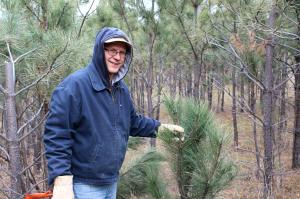 We cut down about ten trees, I think, trying to find one that would work. If an “environmentalist” had seen us, they probably would have burst an artery. But we called it “thinning.” These little stands of trees reseed and become overgrown in a matter of years, and responsible land maintenance would include thinning them or clearing parts of them completely in the next few years. Some environmentalist efforts in the Black Hills have included leaving the forest entirely alone until it is so overgrown that even animals don’t want to live there (the Norbeck Wildlife Preserve, for instance). So anyway, we chopped down a passel. There are literally millions of trees on the home place. There isn’t a shortage. There is an over-supply.
 While Dad and I were looking for the perfect tree, Remington and Dove were nearby. The cold seemed to have gotten into Remington’s blood and made him frisky. He kept coming up close, then galloping off, bucking and kicking and racing circles through the open meadow. Little Dove kept to herself, but watched us. I don’t think the cold worked in her veins the same way it worked in Remington’s.
 That evening, we opened boxes of ornaments, like opening boxes of memories – Each one has some sort of memory tied to it. Whether it was a gift from a special friend, or whether it was Mom and Dad’s first Christmas ornament (they got married two days after Christmas, in 1989), or whether it was handmade at a girls’ craft evening, or whether we simply remember laughing at how funny certain ornaments look, each of the ornaments has a memory tied to it. We packed as many strands of Christmas lights on our little tree, as many as we could, and hung as many of the special ornaments as would fit. We made every twig earn its keep.
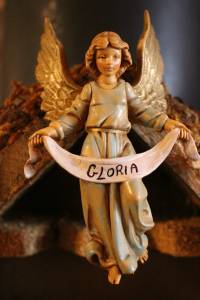
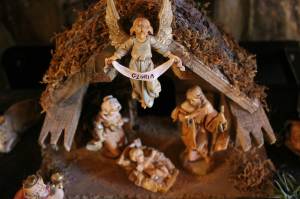
 Our Creche is my favorite of our Christmas decorations. When I was little, Dad started buying the pieces of the Creche for Mom, and gave them as Christmas gifts over several years. I loved it as a child, and I love it still – The pieces each look like a watercolor portrait, and the wistful, worshipful expression on Mary’s face is such a beautiful interpretation of the Virgin Mother.
