A Partnership with Sun and Sky

Originally printed in the July/August 2025 issue of Down Country Roads Magazine

A gentle breath of wind stirs the laundry hanging on the line – A row of snap-front shirts and faded jeans, a row of quilts and sheets. Hung out wet and cool, taken in warm and dry, bringing that clean smell of sunshine into the house. And what a privilege to complete that task in partnership with sun and sky. Such a small thing. Yet it isn’t small at all.

They tell us we don’t belong. From their remote offices of steel and glass, shaded from the sun and unable to see the sky, they wag their so-knowing fingers at the rancher, whose father’s grandfather made a living in cooperation with the natural world. But here we are, and here we’ll stay, continuing in that partnership with sun and sky, wind and weather.

In the first summer days of scorching heat, the hayfields change, slowly, then not so slowly. Alfalfa turns from green to purple, and the brome grass turns from green to golden-brown as the feathered heads cure out. The vivid colors fade. That first swath is cut. That first windrow raked. That first bale rolled. “Chasing hay,” it is called, and one by one the area ranchers and farmers take to the fields. Cutting and raking and baling and yarding it up, timing the activity to the perfect streak of weather, partnering with the sun and the sky.

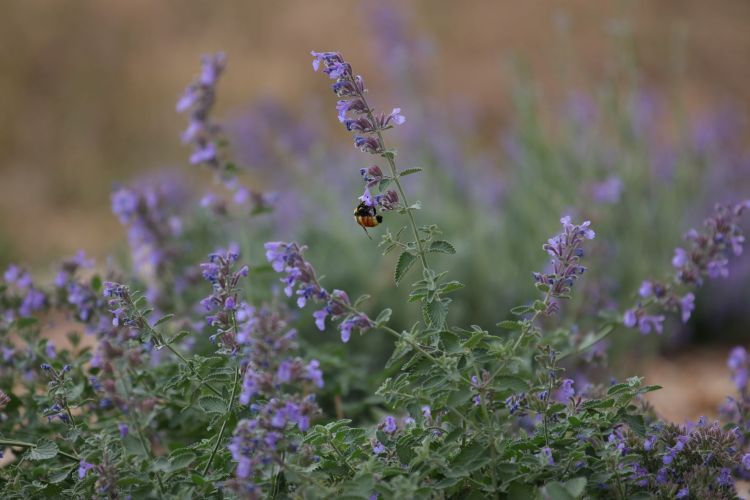
The flower garden is a riot of color, and constant activity. Countless numbers of bees drone comfortably, bending flower after flower under their slight weight, little wings stirring leaves, little legs weighed heavy with golden dust, in a mesmerizing dance of industry and grace. How something as small as a bee can have such a vital role to play is humbling. And how sweet it is to partner with those tiny workers, with something as ordinary as a homey flower garden, to help them feed their young as they help us grow our own gardens. What a sweet partnership, with sun and sky and flying thing.

Our little yard is rimmed with young fruit trees, planted as memorials to important days and as an investment in tomorrow. We have our wedding trees, and our-family-is-growing trees, trees that mark days and loves and in future years we’ll taste again those sweetnesses, fruit in hand. What simpler stewardship than to plant a tree? The apples begin to swell and blush as the days shorten, and in the woods across the ranch chokecherries hang like clusters of grapes on every side hill, it seems, and in every ravine. Many feed the birds, but many find their way into the kitchen and in this form or that they will grace tables in the months ahead. It is stewardship, partnership, cooperation with the world around us to wisely use the bounty.

From ivory towers come criticisms and accusations, rules and regulations, suggestions and mandates – But what do they know? And how could they know? Have they planted a tree? Or harvested a crop? Or watched a calf take its first suckle of mama’s milk? Have they stumbled across a sleeping bull elk in a high meadow, and watched in awe as he shook off slumber and disappeared into the woods? Have they watched the antelope raise their young? Have they welcomed the sun and the wind and the natural order of things?

Feasting on native forage, the milk cow is well-fleshed, her lean frame filled out beautifully under a healthful layer of summer plenty. Her milk is rich and sweet and abundant on sunlight-turned-to-grass – No wonder her calves are as stout as they are. Their summer coats are sleek and glossy, their gentle eyes bright and content as they seek out shade on a warm day and chew their cud. They truly haven’t a care. The beef herd is out to summer pasture, thriving in their self-sufficiency. What a life they live, gently handled, carefully tended, in this partnership with sun and sky and beast of the field.

The hens dart to and fro in the barn yard, sometimes making it up as far as the house and the garden. They are gorgeous this time of year, feathers full and flawless, and their eggs are a marvel as well – Hard symmetry cracks open to reveal a golden heart, the darkest of yolks, dark with summer’s vegetation and the insects the chickens consume, golden like at no other time of the year. The egg basket runs over, and the bounty overtakes the kitchen. Another simple partnership, with sun and sky and barnyard fowl.

How simple, each of these partnerships, each of these stewardships. How intuitive and instinctive to want to be a part of this world we live in, to care for it, to help it to thrive. To live in and amongst, not apart from. To take what we need with gratitude, to cultivate and invest, and to leave our little corner of this green earth better than it was when we came to it. And finally, to leave something for the next generation, something beautiful and beloved.

It isn’t we who have invaded, carving up the landscape to suit our whims and ways. It isn’t we who have razed the woods and hidden the hills beneath asphalt and high-rises, chiseling away at the contours of the land to favor buildings of cinderblock and stone. It isn’t we who have divided and subdivided, trading the warmth of the living land for the coldness of a dollar. It isn’t we who have rerouted waterways and planted lawns where native grass once grew. It isn’t we who have buried fertile ground beneath roads and infrastructure, slowly erasing the beautiful asymmetry of rolling hills and prairies.   

We are stewards. We exist with and alongside the birds and beasts, the land and trees, the wind and the weather; not bending nature to suit our wills but submitting ourselves to nature’s order, partnering, not subjugating, working with, not against. We live here. In partnership with sun and sky.

Ranch Wife Musings | On Whose Shoulders We Stand

Originally printed in the Custer County Chronicle on June 18, 2025

Have you ever noticed the following contrast?

When Mother’s Day comes around, in sweeps the sappy sentimentality from all quarters, religious and secular alike. Church sermons laud the important role mothers play, encouraging mothers to embrace their God-given status and find joy in the motherhood journey. Ushers hand out $5 gift cards for ice cream or flowers to all the mothers. Mothers are showered with admiration and gifts, treated to lunch, and generally doted upon. All the wrongs mothers can commit are overlooked, and motherhood is suddenly elevated to frank heroism by a culture that at all other times actively discourages women from having children and decries motherhood as being demeaning and bowing to the patriarchy (but can’t even define “mother” anyway), while memes circulate social media saying that Mother’s Day isn’t just for mothers, but for anyone who wants to be considered a mother – cat moms, dog moms, anyone. I find it all very confusing.

Father’s Day rolls around, though, and it is a different dynamic altogether. Church services might give a tiny nod to the day itself, might offer a brief prayer of thanks for all the fathers in our lives, but any sermon that takes place is generally not a celebration of God’s gift of fathers but a warning to fathers that they had better shape up, and here’s how to do it. Fathers aren’t lavished with gifts, and social media takes no break from the campaign against toxic masculinity (which really is usually just a campaign against masculinity, period). Fathers are often the butt of sarcastic jokes, and many run-of-the-mill issues full-grown adults wrestle with are tacitly or explicitly blamed on fathers and mistakes that were made during childhood. 

The dichotomy is striking, if nothing else.

It seems to be a daily thing on the news, hearing about violent crimes, abuses, tyrannies, behind each of which is a man being dragged through the mud, sometimes justifiably, sometimes not. But for every single one of those events that dominate the news cycle, I would guess there are 10,000 men, invisible to all but their families, standing in the gap for their wives and children, for their communities, and for their faith. Men who rightly set the standard for manhood, for virtue and morality, for right and wrong, willing to hold the line against those who threaten the spiritual and physical wellbeing of those they love.

And we need that. We need those men. Desperately.

In a society where many social ills truly can be traced to fatherlessness and abuse by fathers, what we need is more strong, masculine figures, not fewer. More men who take the privilege of their strength seriously. And those men who are exemplary in their roles as husbands and fathers should never be in doubt about their value or importance.

We are who we are because of our fathers. Good fathers give us an example to follow. Poor fathers give a warning about what to avoid. But our fathers make us, and that trickles down through the generations, for better or for worse. Men learn how to treat their wives by watching how their fathers treat their mothers, for better or for worse. Women learn how they should be treated by watching how their fathers treat their mothers, for better or for worse. The importance of fatherhood – for better or for worse – absolutely cannot be overstated.

My dad set the standard of manhood for me. He was a steady, dependable, wise, Godly force in my life through all of my growing up years (and still is), and so much of the woman I became is a direct result of the example set by my own father. His living out of his masculinity gave so much context for my living out of my femininity. So much of what characterizes my faith and my thoughts and my loves and interests are because of my dad. How I view life, how I process information, decisions I’ve made – because of my dad. As an adult, he became the standard for what I ought to pray and look for in a husband, and his example of a loving and kind father and husband set the bar when I was dating. He demonstrated devotion to God, faithfulness to wife, love of children, gentle but firm in his expectations and corrections of us, and always pointing us back to Christ. He, with all of his imperfections and flaws notwithstanding, was my standard of masculinity and manhood.

Then there is my father-in-law, who has been a constant presence in my life for the last 7 years, as the first person on the volunteer fire department to take me under his wing and show me the ropes, and, more importantly, as the man who helped make my husband the man that he is. And I’m so thankful for that. I’m thankful for the honesty and integrity that my father-in-law has modeled to his son, for the instinct to generosity, the work ethic and ingenuity (it is amazing what can be done with wire and willpower), the commitment to family and community, the importance of being a capable and compassionate leader, and that there are more important things in life than the money in one’s bank account. I’m even thankful for the somewhat twisted sense of humor that I now have to suffer with on a daily basis.

And it isn’t too long before I get to watch husband step into his own role as father. Who we are because of our fathers will shape and mold the next generation.

We stand on the shoulders of the men who made us.

A Love that Feels Like Home

It is amazing how fast everything can shift.

At the age of 30, with no one in sight, I had more or less come to the conclusion that I’d be a loner for the rest of my life, or at least the foreseeable future, and honestly I functioned decently in that capacity. Introverted by nature, and truly trusting in a loving Heavenly Father who knew what I needed – not wanted, but needed – I had learned a level of contentment. As an adult, I had wrestled with well-intended but off-kilter promotion of marriage as the ultimate state for the Christian. Things like, “Marriage is God’s greatest gift.” (No, it isn’t, Jesus is) Or, “being a wife and mother is God’s highest calling.” (Then what about those to whom God doesn’t give that privilege? Did He shortchange those women? Some beautiful clarity from the Westminster Catechism: “What is the chief end of man? The chief end of man is to glorify God and to enjoy Him forever.” Wow.)

I wrestled with loneliness and uncertainty, grew in contentment but never perfected that virtue, and grew in my trust of God, logically and theologically concluding that the “gift of singleness,” at least for the time being, was mine, and I could either thank God for it and learn to flourish in it or try to throw it back in His face like an ungrateful child. As an aside, contentment cannot be circumstantial. If a person can’t find contentment and trust in God in an undesirable state, he or she truly won’t find contentment or trust in God in the coveted state.

So I threw myself into my work, whatever it was, and after a few years of volunteer firefighting, search and rescue, becoming EMT certified and getting my National Outdoor Leadership School Wilderness First Responder certification, I found myself pursuing my paramedic education and then employed as a firefighter-paramedic for the Rapid City Fire Department. It was new and exciting, it was challenging, it was satisfying, it provided camaraderie and a level of security, and it was finally something I could picture myself doing years down the road, if that was what God had in store. I grew in physical fitness and stamina, mastered the art of keeping my head down and doing my job, and pretty swiftly earned a level of respect from my coworkers and officers.

And then everything shifted. Into my adrenaline-laced life of lights and sirens, IVs and EKGs, life and death situations where death was a key feature all too often, 24- and 48-hour sleepless shifts, a life that I was embracing but never really felt like it was embracing me back, into that life came a familiar face and form. A face and form that had caught my eye over the years. A comfortable and comforting presence, brotherly, humorous, companionable.

I think of the first handful of days we spent together. Our first date to the Gaslight Restaurant in Rockerville – I remember telling my mom ahead of time that I honestly wasn’t very excited. I’d been disappointed enough times before. But something here was different. He picked me up at my cabin, the old-fashioned way. When our meal was served, he took my hand and said a simple prayer. He treated me like a queen. And we sat in his truck in the driveway in front of my house and talked. For two more hours. This was different.

We picked chokecherries together at his place, a few days later, and he grilled hamburgers. The best burger I’d ever had. And we talked. For hours. He hugged me before I left. And I didn’t want to let go.

We cemented a leaky stock tank a few days after that. “Boy, I bet you’re impressed,” his dad quipped, when he brought out the bags of cement. “I volunteered,” I quipped back.

That familiar face and form brought peace and certainty, and within 11 days – 11 days – I knew beyond the shadow of a doubt that I would be this cowboy’s wife.

His sweat-stained cowboy hat, snap-front western shirt, and dust-covered boots; his lanky figure and his easy, swinging gait; his wide, straight smile flashing bright in his brown, sun-leathered face; large, gentle hands that just about swallowed mine; and behind his thick glasses a pair of eyes almost too handsome that just about disappeared when he laughed. Everything shifted. I felt like I was home.

For two introverted, self-sufficient, independent individuals in their 30s to suddenly be confronted with “their person” and no shadow of doubt was nothing short of a work of God. He had planned this, and He was bringing it about. We realized and verbalized often that “we are better together.” And we both knew. Beyond the shadow of a doubt.

We got married 10 months later on a beautiful June afternoon under a blue sky with just a bit of rain, after 4 months of dating and 6 months of engagement, and we are now looking back on 3 years. Three blessed years. Three tough years. Three incredibly good years. Three growing years. Three years of becoming more and more the people that God wants us to be in the life in which He has placed us. I’m not the person I was 3 years ago, thank God, and neither is he. Isn’t that amazing? It isn’t all roses and sunshine. But it has been so incredibly good.

Years of loneliness put into perspective the petty and selfish desires that are the root of so much marital conflict. Painful relationships highlighted the sweetness of what God had given us. We had been given a partner for life, and as quickly as 10 months of dating and engagement went, or the first year or two of marriage, there was a mutual feeling of “always.” Like we’d always been together. Like we’d always been married.

I left a life of Nomex and tactical boots and embraced a life of blue jeans and muck boots. I left a life of constant adrenaline and trauma for the steady, peaceful volatility that is life on a ranch. I found my person. And everything suddenly made sense.

Memories from childhood, simple longings in a little girl’s heart, an unexplainable affection for the Black Hills, strange homesickness driving past places I didn’t even know and had no idea would become my home as a married woman: everything made sense.

God has given me such a gift in my husband. He is a flawed man with a perfect Savior, who loves his Savior and loves me. He is my provider and protector, my support and best friend. He is home.

Early in our marriage, I remember Brad laughing as I trotted out of the house wearing a short little nightgown and sandals with a calf bottle in hand to feed the calf waiting at the gate below the yard. “You belong here,” he said when I got back in.

And what a life he has invited me into with him. What wholesomeness and wholeness. What a life he has given me. I am more myself now than I was 3 years ago, or 5 years ago, or 10 years ago. What a life God has allowed us to build together. What sweetness when you find a love that feels like home.

It took awhile. And it was entirely, wonderfully worth it.

“God bless the broken road, that led me straight to you.”

Happy anniversary, my love.

We are Young Here

Originally published in the May/June 2025 issue of Down Country Roads Magazine

Summer clouds before a summer storm skate across a wild sky, and the rusty, dusty, weather-beaten sides of a barn rise up, like a slab of Black Hills granite, from the prairie grasses and strewn rocks. It grows there, somehow belonging as much as the antelope that scatter and settle and fawn in the summer, or the meadowlarks singing on a fence wire. Somehow a part of the land, not an intruder, and a reminder of a simpler time, when men and women, sturdy of mind and stout of heart, cooperated with the land, submitting themselves to the wind and the weather and the natural order rather than seeking to bend nature to suit their wills.

And how recent this was. How young we are here.

A tumbledown cabin is tucked into a remote hollow.

In a steep ravine, a pump handle rusts away, leaning against a tree, the only evidence remaining of what had been.

An abandoned schoolhouse in a pasture, cows looking out the door, chewing their cud.

Hewn fenceposts scattered under old grasses.

A collapsing roof over a dugout, and some broken jars and coffee cans, all that’s left of an old root cellar.

People lived here, learned here, loved here, built lives here. And we are young here.

Once, not so very long ago, that barn door opened at evening and warm lantern light streamed out. A farmer and his wife or children milked their cows, and cats waited for what they knew was coming. Soft singing or humming, or scraps of conversation, or gentle mutterings to the cattle flew about inside like gentle birds, like the barn swallows that nested in the eaves.

Once, not so very long ago, children sat and learned at benches and desks in that old schoolhouse. Bare feet swung and chalk tapped slates. Horses and ponies were tied outside, a ball and bat and a jump rope waited for recess, and laughter rang out during rambunctious games.

Once, not so very long ago, a homesteader’s wife carefully tended a hedge of roses, hauling water for them to drink, perhaps plucking a blossom for her hair, beautifying her life in a rugged place.

There is an ache in my heart at these glimpses into the past. It isn’t an ache of grief, though there is sorrow there. But it is a sweet ache, almost a homesickness, at the reminders, however small, of the lives lived before we were here, those reminders of the callused, hardened hands, of minds steeled against an uncertain future.

It is the twists of wire patching an age-old barbed wire fence, coaxed and muscled by a cowboy sometime long ago, or not so long ago. The odd-shaped nails in the doorframe of a tumbledown building. Farming implements, long since left to rust. Walls of stone, remnants of industry, of mining days and flume-building, intricate, painstaking work, masculine work, reminders of the hard work done by tough men in tough times.

And then there are the shards of blue glass from old canning jars, a woman’s skill and offering. Little glimpses of domesticity in a wild age. Bright colors, somehow still crisp, of a scrap of wallpaper in a pile of plaster. Lace curtains like cobwebs, blown by a breeze streaming through a broken windowpane. White irises on the ridge above our house, not wild ones, and no one now knows where they came from or who planted them, but someone did. Lilacs flourishing on a remote hill in the middle of the ranch, the only evidence of an optimistic hope for a future life, optimism that still thrives, solitary and beautiful. Oregon Trail roses, those yellow roses of Texas, homesteaders’ roses, along a stone foundation of an old stagecoach stop. Simple, sweet, womanly reminders of a softer side to a rougher age, and that the softer side mattered, even in a rougher age.

You can’t help but pause, and think, when you stumble across these relics, whatever they may be. There is a life behind them. And was it so very different from now?

How many sunny days just like this one have shined down on this spot? How many years were the roses or lilacs or irises enjoyed in a vase by the window, before the hands that planted them disappeared into the past? How many boots kicked mud off on the now crumbling doorsill as a welcome home rang out? How many beloved cows were milked in the old dairy barn? How many work-worn hands have mended this fence? How many times have cattle have been herded across these hills, the very ones I’m walking? How many families have earned their living from the dirt beneath my feet?

I love when the grass grows tall in the summer months and I can imagine in my mind’s eye how it must have looked, back then. I can imagine fresh lumber without the weather-age and paint without chips and scratches; I can imagine cinderblock walls still standing, and panes of glass instead of empty space. There is an illusion of time standing still, or the past converging with the present. A summer storm rolls by, unable to shake the strength of those ancient walls that have weathered so many – how many? – storms and gales. But one day, those walls, that roof, will collapse and molder and fade away.

There’s a temptation, in this modern age, to live as if we live alone, to forget our context, our origin, our heritage, our traditions. To breeze past these little hints of the past, these gifts left by our predecessors, evidence of lives and hopes and dreams and hard work and sweat and tears. As far-removed as the past can feel, it is a mere few generations behind us, and wonderfully near, and beautifully dear.

We are, in fact, young here.

Ranch Wife Musings | Praying for Rain

Originally published in the Custer County Chronicle on April 23, 2025

I don’t know if there’s a better time of year on the ranch than the tail end of calving season, those first summerish days, when the mornings are still crisp and cool, and the warming earth is fragrant and greening up. The abundance of baby animal life, the springing up of flowers in the garden, the first wildflowers, the blossoming of the fruit trees, and the lilac bush heavy with dark purple buds are reminders of the order woven into this world. Spring always follows winter, summer always follows spring, and after a good calving season optimism runs high, especially when the cattle market is where it is at today. We are looking forward to some of the best of the year’s ranch work, the sorting and pairing out of the cows and calves, long days in the open air, the brandings, and getting bulls out.

But behind it is a glimmer of uncertainty. When a dry winter leads into a dry spring, when we watch spring storm system after spring storm system fail to materialize, and little shots of rain barely manage to wet the ground, when dams are bone dry and the window for growing grass gets narrower and narrower, it is easy for that optimism to take a back seat to negativity, or what some of us might simply call “being realistic.”

It is hard to watch as the grass springs up in the warm summer-like temps, but stops growing for lack of moisture. It leaves a little pit in your stomach to see the dust devils blow down in the stubble of the hayfield, and to feel the unyielding, cracking ground beneath each step. If the dry conditions continue, the grass will head out early and essentially be done, and no amount of rain can cause a finished blade of grass to finish growing.

Grasses grow and mature in different seasons, so even if we miss the window for the early spring grasses, we can still grow later season grasses, but those early rains are incredibly important for healthy summer pastures and growing enough for winter forage. Healthy summer pastures make for cattle that are well-summered, and well-summered cattle have better conception rates and lower rates of disease, and then handle the winter well. Cattle that are well-wintered, with good winter forage, handle calving well, and produce plenty of milk for their calves, who are vibrant and healthy. And on it goes.

What happens now has ripple effects long into the distance. A rancher worrying over a lack of rain now is never thinking just about right now, but about 2 or 12 months down the road.

It can be worrisome. It is easy to become discouraged or to feel helpless in the face of things over which we have no control. A spring without rain provides ample opportunity for our complaints, for bitterness or resentment to spring up, or for us to wallow in uncertainty and take it out on those closest to us. All those are unconstructive and even deconstructive reactions, over which we absolutely have control. We can choose to wallow, or we can look higher.

We may not have control over the rain, or over other situations in which we find ourselves. But there is Someone who does.

And so we pray for rain, trusting that He hears, and that He cares.  

We pray for the moisture needed to grow grass.

We pray for the ability to steward our livestock well, to give them what they need to thrive.

We pray for fruitfulness in our endeavors, to the glory of God.

We reflect on His faithfulness over the years and over the generations.

We acknowledge His ability to provide exactly what we need, with eternity in mind, even if it isn’t what we think we need, or what we want at this moment.

We acknowledge that what we perceive to be our needs can be extremely short-sighted, and that our Heavenly Father has purposes that are much higher than merely the health of the pasture grass or the conception rates on our heifers.

There will be hard years. There have been plenty of hard years before, plenty of uncertainty, plenty of downturns in the market and years the grasshoppers ate everything. We have no trouble remembering those things, and tend to have a harder time remembering the good years, the years of rain and plenty and full dams, or the surprising ways needs were met against all expectations.

A spring without rain is a reminder that nowhere have we been promised everything we hope for in life and, more importantly, all those details are actually in the loving and perfect care of the same Someone who orders the seasons and keeps the earth spinning on her axis, the same Someone that has brought rain in its season for millennia, and Who has promised that, ”While the earth remains, seedtime and harvest, cold and heat, summer and winter, day and night, shall not cease.”

We can worry about the balance in our bank account, the food on our plates, the clothes on our backs, the cars we drive, the houses we inhabit – But our Heavenly Father knows what we need, and if He feeds the sparrows and clothes the fields, He also cares about our needs.

So, we pray for rain. And leave it safely in God’s hands.

Nurse Cow Drama

Posey’s job description is “nurse cow.” Nurse cows, ideally, will take any calf offered to them without much of a fight, but Posey isn’t most cows. And frankly, that’s pretty idealistic – Most cows are maternal enough that they really do only want their own calf, and aren’t happy with freeloaders, but Posey, Posey, Posey, it’s your job.

My father-in-law insists cows recognize their calves by smell, and the science behind grafting a bum calf on a cow that lost her calf is that after a few days of nursing her milk, the calf will smell like her own. The same principle should apply to Posey, but I pointed out to my father-in-law that it couldn’t be this cut and dry. Posey, last summer, would only ever let her adopted calf nurse if her own calf was nursing, so clearly there was some recognition there that went beyond smell. And this year, with two extra babies on her, she always knows which calf is Marigold. Marigold gets extra loving and grooming that the other two never get, and even though Posey has settled down and is content with all three, the two grafts never get the extra attention. Pretty fascinating.

However, even with the lack of maternal affection, the char and the black are doing well. It took a couple weeks of persistence, of separating all three calves from Posey and letting them nurse as a group twice a day and supervising Posey while she fed them, for things to settle into a routine, but it worked, and all parties are thriving and enjoying pasture freedom. The little black angus calf always nurses off the back, which are the largest quarters, and she is stout!

But it sure is satisfying to sit and watch those little tails whip back and forth.